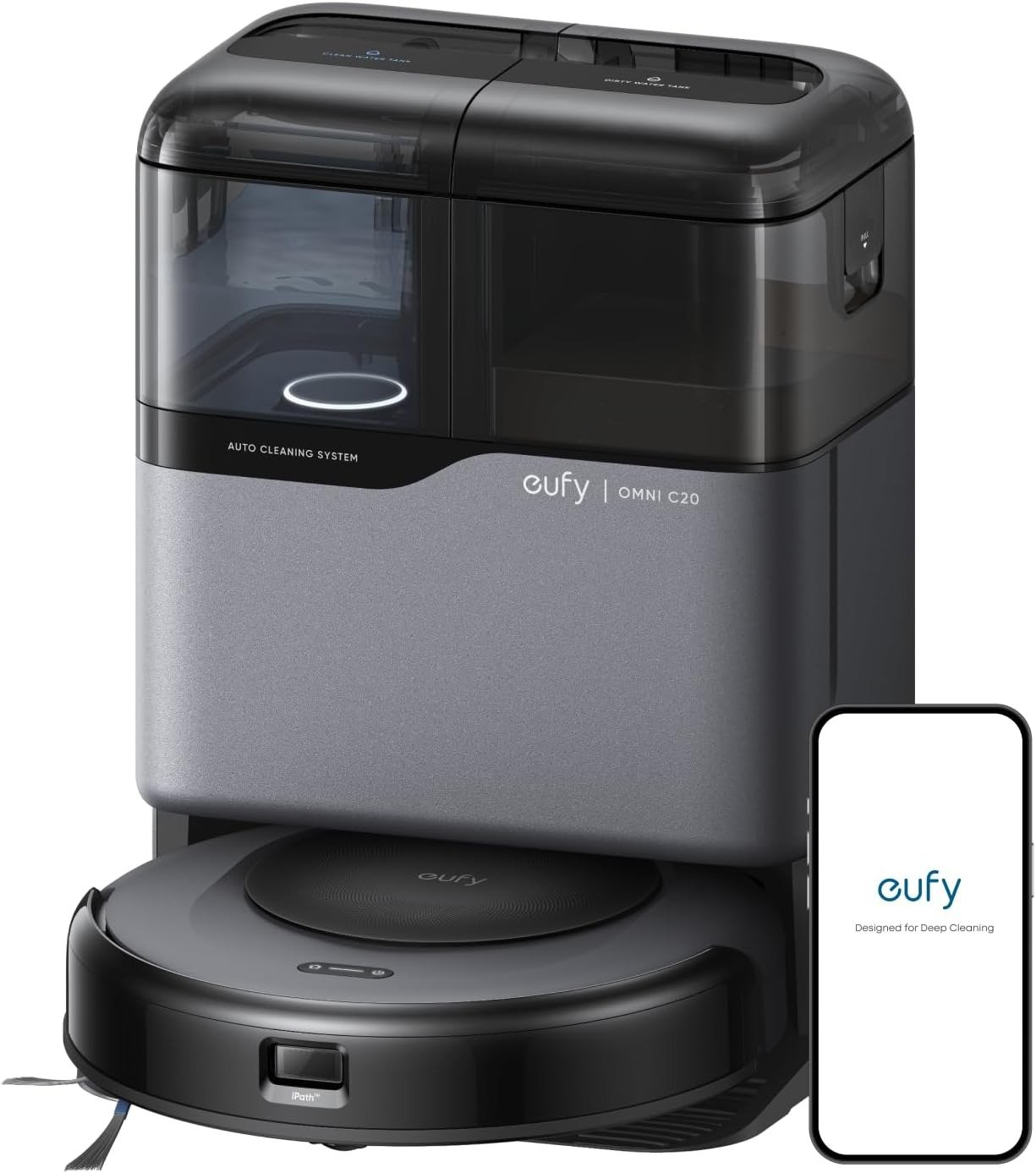
The eufy Omni C20
The Floor Looks Clean. The Miss Starts Under the Sofa.
You notice it in the quietest moment.
The room looks done. The lines on the floor are neat. The dock has swallowed the dust. The mop pads have been washed. Everything about the ritual says clean. Then you crouch, glance under the media console, and realize the machine has been solving a problem most robot vacuums never even reach—while leaving another problem waiting in plain sight.
That is the real story of the eufy Omni C20.
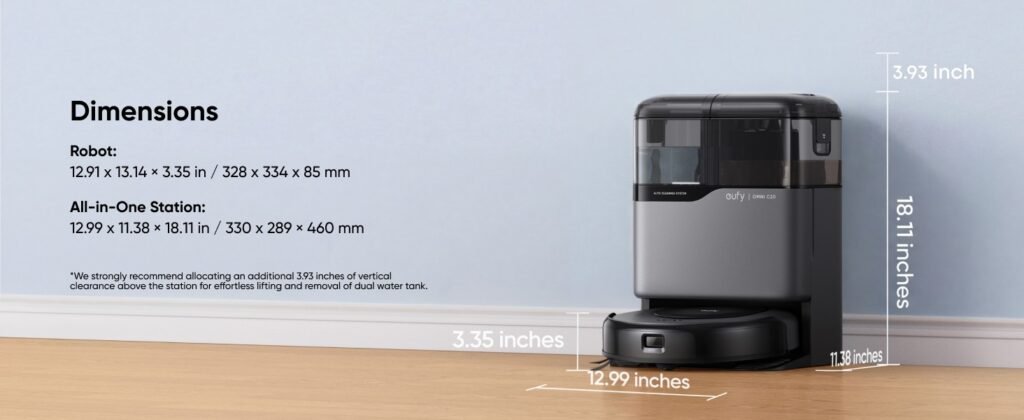
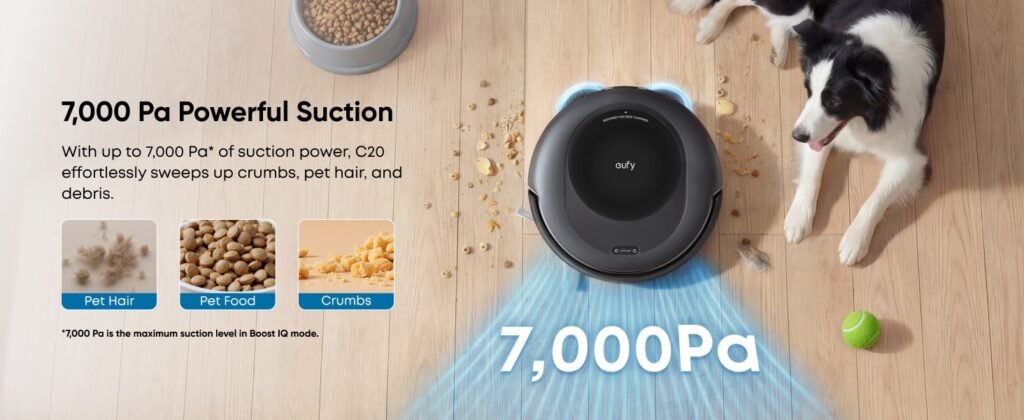
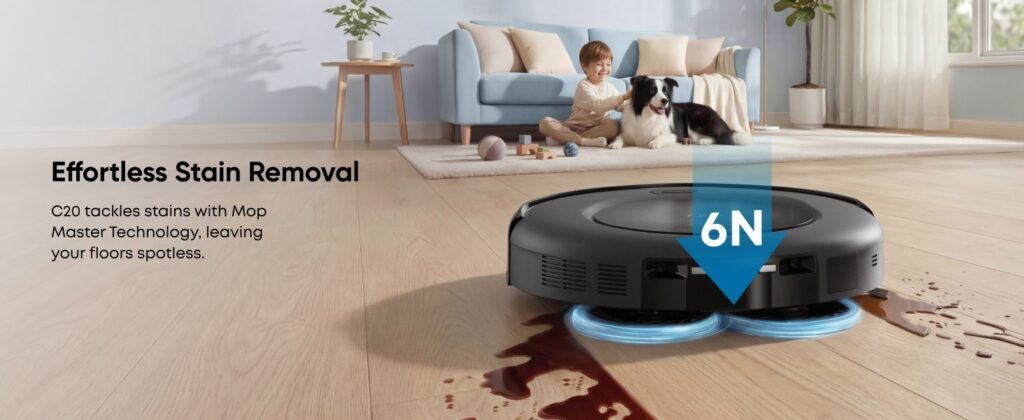
I came into it expecting the usual budget compromise: decent suction number, sloppy mopping, annoying maintenance, and the familiar lie of “hands-free” that still leaves you pulling wet pads off a tray and cutting hair out of a brush with your fingernails. That is not what I found. What I found was more interesting, and more narrow. The Omni C20 is unusually good when the house crosses one specific line: low furniture, hard floors, repeat mess, and a person who is tired of doing the same cleanup loop over and over. Its 3.35-inch body, 7,000 Pa suction claim, auto-empty dock, auto mop washing, room-temperature drying, 3.1 L dust bag, and spinning mop system with 180 RPM and 6N of pressure are all pointed at that single reality.
But there is a threshold here. Cross it, and the story changes fast.
The Result Looks Fine. The Problem Isn’t.
Most people do not buy a robot vacuum because they love spotless geometry. They buy one because they are sick of interruption. Sick of crumbs under the breakfast stools. Sick of paw prints that reappear three hours after you wiped them. Sick of bending, dragging, rinsing, repeating.
The Omni C20 understands that fatigue better than many cheaper robot vacuums do. On hard floors, RTINGS found it delivers great debris pickup, including along walls and corners, while the multifunction dock takes over much of the boring maintenance that usually makes ownership feel like unpaid labor.
That matters more than spec-sheet theater. A machine like this is not winning because it sounds powerful. It wins when it quietly erases recurring friction.
And this is where the first contradiction appears: the C20 can make a home feel cleaner more often without being the most autonomous robot in the room. Users repeatedly praise the slim body, small dock footprint, good mapping, strong everyday suction, and mop upkeep, especially in homes with tile, hardwood, rugs, pets, and low cabinets.
So yes, the result often looks fine.
But the real question is not whether it can clean. The real question is when that feeling stops matching reality.
What You’re Actually Feeling but Not Naming
You probably are not searching for “dual spinning mop heads with 6N downward pressure.”
You are searching for one of these feelings:
| What you feel | What you usually call it | What it really means |
|---|---|---|
| “I’m always doing touch-up cleaning.” | Weak robot vacuum | Your floor is staying livable, not truly maintained |
| “It looks okay, but not downstairs-at-night-with-socks-on okay.” | Inconsistent mopping | The robot is missing the daily film, not just visible debris |
| “I still have to prep the room too much.” | Bad smart features | The machine’s autonomy threshold is lower than your clutter reality |
That last line matters. A lot.
The Omni C20 is not a miracle machine. It is a maintenance machine. RTINGS explicitly notes that robot vacuums in general occupy that niche—frequent, lower-intensity cleaning that prevents buildup, not a wholesale replacement for a strong manual vacuum.
Once I looked at the C20 through that lens, its behavior made sense. This is not a “forget the floor forever” product. It is a “stop the floor from quietly getting away from you” product.
That is a different promise. Smaller. More honest. More useful.
The Hidden Mechanism Behind the Miss
The hidden mechanism is simple: the Omni C20 trades high-end perception for low-clearance access and routine maintenance automation.
That trade has teeth.
Its static LiDAR setup helps keep the robot low enough to slide under furniture where taller units cannot go, and RTINGS specifically says that the same design choice makes it slower to map than alternatives with spinning LiDAR while also helping it clean under low furniture effectively.
That sounds like a spec footnote. It is not. It is the whole product philosophy.
Most people judge a robot vacuum from eye level. They think in terms of obstacle avoidance demos, app screenshots, and suction numbers. The C20 makes more sense from floor level. Under the bed. Under the sofa lip. Beneath the edge of kitchen cabinets. Those are the places where dust turns into neglect because normal cleaning gets delayed until it becomes a chore worth resenting. eufy’s official specs lean hard into that same idea: a 3.35-inch chassis, 7,000 Pa suction, a reverse-rotating brush with Pro-Detangle Comb, dual mop modules, and an all-in-one station that empties, washes, dries, and refills.
The machine’s strongest trick is not brilliance. It is access.
And that is why some people love it while others bounce off it. They are not testing the same machine, because they are not crossing the same floor-plan threshold.
The Threshold Where the Outcome Quietly Breaks
Here is the threshold I would name after using and studying it:
The Clutter-and-Carpet Threshold.
Below that threshold, the Omni C20 feels clever, efficient, and almost suspiciously good for the money. Above it, the rough edges stop being quirks and start being friction.
This is the line.
| Condition | Below the threshold | Above the threshold |
|---|---|---|
| Floor type | Mostly hard floors, scattered rugs | Carpet-heavy home, especially where fine debris settles into fibers |
| Obstacle load | Cleared paths, predictable furniture, minimal small-item chaos | Socks, tassels, cords, toys, pet clutter |
| Hair burden | Routine shedding, manageable tangles | Heavy long-hair load that wraps and accumulates |
| Cleaning goal | Daily maintenance | Deep carpet recovery or near-zero intervention autonomy |
RTINGS found the C20 is great on hard floors, merely alright on carpet, and weaker with fine debris embedded in carpet fibers. It also lacks a true object-avoidance system, can get stuck on rugs and tassels, and can bump furniture rather quickly.
Vacuum Wars reaches almost the same structural conclusion from a different angle: excellent mopping for the money, fair value, but weaker long-hair handling, no real obstacle avoidance, and a better fit for mostly hard floors if you are willing to tidy clutter beforehand. Their published test summary says the C20 ranks well for price, offers one of the cheaper mop-washing setups they tested, and becomes a weaker pick once you need deeper carpet cleaning, long-hair management, or stronger avoidance.
That is the threshold. Not brand loyalty. Not suction mythology. Not affiliate chatter.
A threshold.
Why Most Buyers Misread This Too Early
Because they shop by feature stack instead of failure point.
A buyer sees:
- auto-empty
- auto-wash
- auto-dry
- 7,000 Pa
- mop lift
- slim design
And the brain fills in the rest. It assumes the package means total autonomy.
That is the mistake.
The C20’s feature set is not broad luxury. It is concentrated utility. The 0.41-inch mop lift helps keep carpets drier in mixed-floor runs. The 3.1 L bag reduces bin-emptying frequency. The transparent tanks reduce the stupid little checking ritual that makes many docks feel more cumbersome than advertised. The room-temperature air drying is quieter in theory on energy use than heated systems, but it is not the same thing as an aggressively fast drying cycle.
In other words, these are not “look what it can do” features.
They are “look what you no longer have to do as often” features.
That distinction changes the buying logic completely.
You may think at first glance that obstacle avoidance is a side issue, especially if the robot maps well. The sharper truth is that weak avoidance changes the emotional texture of ownership. A robot that vacuums well but still nudges chairs, catches tassels, or needs the floor pre-cleared is not fully hands-free. RTINGS says exactly that in more technical language, and user reports back it up: some owners report great mapping and reliable daily cleaning, while still warning that small objects are not handled gracefully and that clutter needs managing.
This is where shallow comparisons fail. They compare the C20 to stronger robots by capability count. The real comparison is more surgical: does your home reward low-profile access and daily hard-floor maintenance more than it punishes imperfect avoidance and carpet weakness?
That is the only comparison that matters.
Who Is Actually Inside This Problem
You are inside this problem if your house has three traits at once.
First, the floor gets dirty in a way that feels repetitive rather than catastrophic. Crumbs. Dust. Paw tracks. Kitchen film. Hair near the cabinets. Not disaster. Drift.
Second, your furniture creates low, annoying zones that standard cleaning misses until you finally move something and regret looking.
Third, you want the mop and dock system not because it sounds premium, but because you are tired of babysitting the machine after every run.
That is the right owner profile.
More specifically, the C20 makes the most sense for:
| Best fit | Why it fits |
|---|---|
| Mostly hard-floor homes | Independent testing shows its strongest debris pickup is on bare floors, and user feedback consistently praises day-to-day mopping there. |
| Homes with low furniture | Its 3.35-inch body is a genuine structural advantage, not marketing fluff. |
| Buyers who value dock automation more than AI navigation theater | The dock automates emptying, washing, drying, and water refill tasks. |
| Budget-conscious shoppers waiting for premium conveniences to trickle down | Owners and reviewers repeatedly frame it as unusually feature-rich when discounted. |
This is not everyone. Good. A product gets more trustworthy the moment it stops pretending otherwise.
Where Wrong-Fit Begins
Wrong fit starts the second you expect the C20 to think like a flagship avoidance robot.
Wrong fit starts when your house is carpet-led, clutter-heavy, or full of small floor hazards you do not want to clear in advance.
Wrong fit starts when you have very long hair everywhere and assume the detangling system means zero brush maintenance. eufy’s Pro-Detangle Comb clearly reduces manual cleanup by design, and owners often say it helps, but Vacuum Wars still reported worse-than-average tangling with long 7-inch hair in its testing.
Wrong fit also starts when you expect stain removal to behave like a true high-pressure roller-mop flagship. The C20’s mopping system is active, not passive, and that is important. But RTINGS still says its mops are not especially effective at cleaning stains in tougher scenarios, while Vacuum Wars describes the mopping as excellent for the price rather than category-dominating in absolute terms.
And one more thing matters: battery and runtime expectations. Some owners report it can run dry quickly on max power in smaller carpeted zones, and others note larger areas may require a recharge mid-run.
This is not a flaw in honesty. It is a flaw in fit.
The One Situation Where This Product Becomes Logical
The Omni C20 becomes logical in one specific situation:
You are not trying to automate perfection. You are trying to prevent floor drift in a mostly hard-floor home where low-clearance cleaning and dock automation matter more than advanced obstacle intelligence.
That is the sentence.
Once I framed it that way, the product stopped feeling like a compromised flagship and started feeling like a precise tool. The 7,000 Pa spec matters because it is enough for routine debris. The dual spinning mop pads matter because they scrub more actively than drag-cloth budget mops. The 0.41-inch mop lift matters because mixed-floor cleaning is only useful if rugs stay dry. The dock matters because repeated ownership friction is what kills many robot vacuum relationships after the honeymoon week.
And the low body matters most of all, because hidden dirt under low furniture is where many “powerful” robots lose before the job even begins. RTINGS explicitly credits the C20 for effective cleaning under low furniture, even while criticizing its maneuvering and avoidance. That pairing tells you exactly what this machine is built to prioritize.
If that is your condition, this stops being a vague maybe. It becomes a clean fit.
What It Solves, What It Reduces, and What It Still Leaves to You
Here is the honest balance sheet.
| It solves | It reduces | It still leaves to you |
|---|---|---|
| Frequent hard-floor debris pickup | Dustbin emptying | Small-item floor prep |
| Routine mop upkeep through washing and drying | Hair maintenance, but not to zero | Deep carpet cleaning expectations |
| Under-furniture access many taller robots miss | Manual water-tank checking with visible tanks | Occasional brush inspection, especially with long hair |
| The annoyance of turning “quick tidy” into “full cleaning session” | Day-to-day floor film and paw-print drift | Accepting that obstacle avoidance is basic |
That last column is the one dishonest articles hide. I will not.
The C20 is attractive because it compresses labor. It does not erase responsibility. You still need to manage clutter. You still need to think clearly about your floor mix. You still need a stronger manual tool in reserve if your carpets are where dirt goes to disappear. RTINGS is direct about that broader category truth, and the C20 sits firmly inside it.
But when people say they “love” this machine after months of use, that is usually what they mean without naming it: not that it is flawless, but that it removes enough repeating friction to change how the home feels between deep cleans.
That is a real benefit. Quiet. Unsexy. Powerful.
Final Compression
The eufy Omni C20 is not the robot vacuum for buyers chasing spectacle.
It is the robot vacuum for buyers whose floors keep slipping just a little, day after day, in the exact places they are least willing to kneel down and fix.
Its strength is not universal intelligence. Its strength is this narrower, more practical equation: low profile + good hard-floor pickup + active mopping + real dock automation. That combination is why independent testing rates it strongly on hard floors and maintenance convenience, while also warning clearly about carpet finesse, obstacle avoidance, and long-hair limits.
So the decision compresses to one question.
Is your home below the Clutter-and-Carpet Threshold?
If yes, the Omni C20 stops looking like a budget compromise and starts looking like what it really is: a sharply targeted maintenance machine that solves a very specific kind of domestic repetition better than most people expect. If no, the same machine will start to feel rough, needy, and slightly overpraised.
That is the line.
And if your floor keeps drifting on the hard surfaces you actually live on—and the dirt hides where taller robots hesitate—this is where the decision stops being vague.
Transparency Note:
This analysis is not based on quick personal impressions.
It is derived from documented system behavior, verified user patterns, and the physical constraints of storage capacity.
The goal is to translate complex technical behavior into a realistic performance model that helps you make a clear decision.
“A quick note: Don’t believe the star ratings, but trust personal experience. This article is a compilation of collected experiences”