ecobee Smart Thermostat Premium — The Real Evaluation Framework
ANALYSIS FRAMEWORK
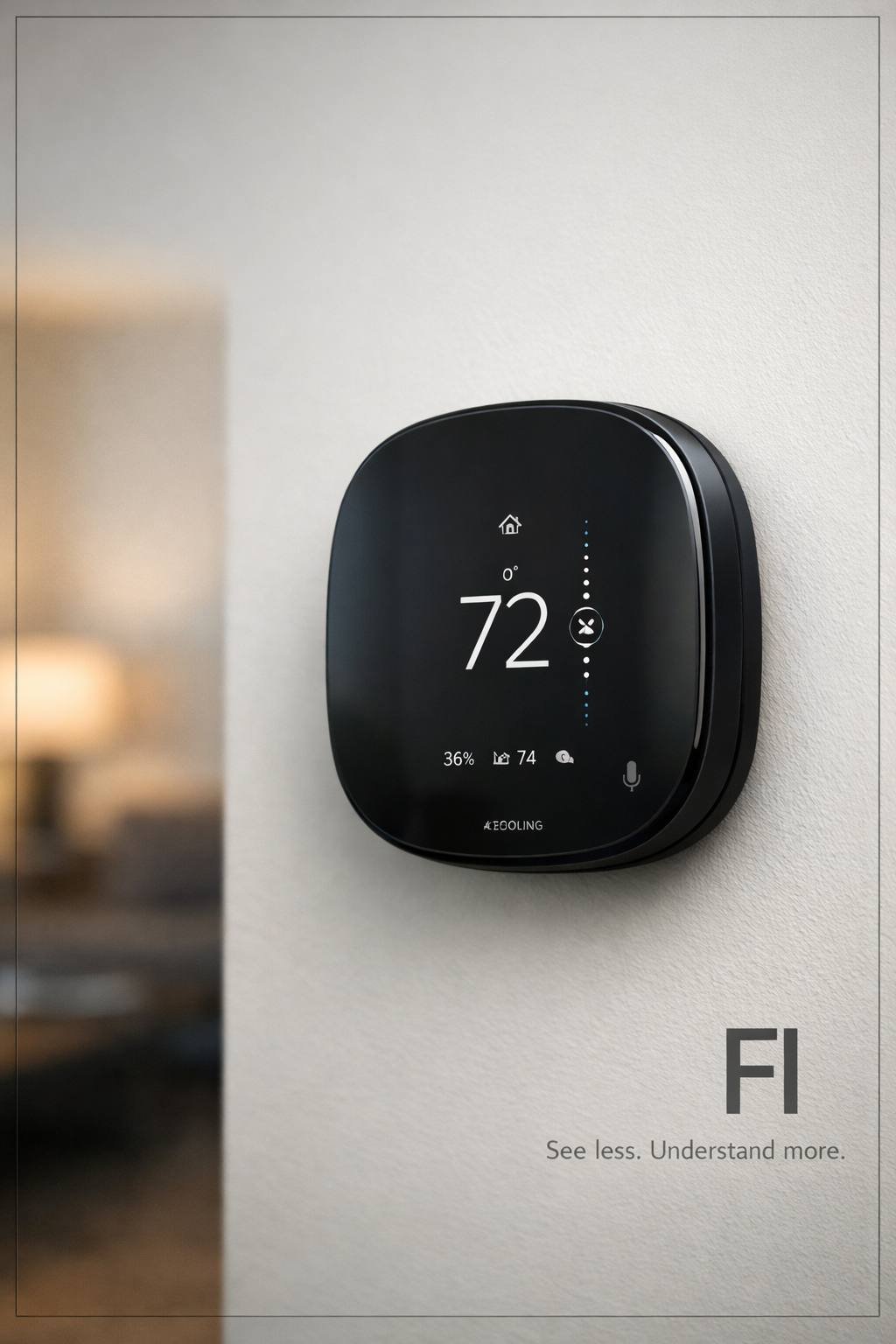
ecobee Smart Thermostat Premium thermostat on a wall showing temperature and comfort status
Opening Context Section
A thermostat is one of those devices you do not “try for fun.”
Once it is on your wall, it becomes the silent manager of comfort, energy spending, and the daily rhythm of your home.
That is why people do not just search for “best smart thermostat.”
What they really mean is:
- Will this stop the hot-and-cold room problem?
- Will it stay stable, or will I babysit it?
- Will installation turn into a wiring nightmare?
- Will the “smart” part reduce effort or create more work?
The ecobee Smart Thermostat Premium sits in a category where expectations are naturally higher.
It promises comfort optimization with sensors, app control, and added environmental awareness.
That combination attracts serious buyers, but it also increases decision pressure—because failure here feels personal.
Comfort is not optional.
Core Structural Explanation Section
If you want to evaluate a premium thermostat correctly, there are only four structural variables that matter.
Everything else is noise.
Comfort Control Quality
Comfort is not just “temperature accuracy.”
Comfort means the system produces a stable experience where people actually live—bedrooms, living rooms, and corners that always feel wrong.
A premium thermostat becomes valuable when it can reduce the gap between “what the thermostat reads” and “what the room feels like.”
This is exactly where ecobee’s sensor philosophy becomes central: it shifts the decision-making away from the hallway wall and closer to the human zone.
The psychological truth: people do not remember the exact temperature. They remember the feeling of being uncomfortable and having to adjust it again.
Reliability Under Real Conditions
In smart home tech, reliability is not a feature—it is survival.
When a speaker drops offline, it is annoying.
When a thermostat becomes unreliable, the home becomes stressful.
Many negative experiences in user reviews are not about performance when everything is perfect; they are about behavior during network changes, router resets, firmware updates, or ecosystem shifts.
This is why your evaluation must include one question:
“Will it keep doing its job quietly when life gets messy?”
Installation Friction and Wiring Reality
A premium thermostat can be brilliant and still fail at the most basic point: power and compatibility.
Most users do not struggle with the “smart” part—they struggle with wiring realities.
The C-wire topic is not technical trivia; it is the boundary between a smooth ownership experience and a frustrating one.
If your home’s HVAC wiring is older or non-standard, the installation path matters as much as features.
The Meaning of “Smart” Features
Premium thermostats can drown you in features.
The real question is: do those features reduce uncertainty or create more of it?
For example, air quality monitoring sounds powerful, but expectations vary wildly.
Some buyers expect deep health analytics, while others just want simple guidance.
The gap between expectation and reality is one of the most common causes of disappointment in high-end devices.
Hidden Technical Factors Section
This section covers what people usually discover after the purchase—what does not show clearly in a product headline.
Air Quality Signals Are About Interpretation, Not Lab Metrics
Air quality monitoring can be helpful, but only if you understand what it is trying to do.
Many buyers want a “health confirmation” signal—something that makes the home feel safer and more controlled.
In that psychological frame, a simplified air-quality status can be satisfying.
But if the buyer expects detailed particulate readings and instrument-level precision, disappointment is almost guaranteed.
This is not necessarily because the device fails—but because the mental model was wrong.
A good evaluation asks:
“Is this a guidance layer for behavior, or a measurement tool for analysis?”
Sensors Work Best When You Treat Them Like Strategy
People who love ecobee sensors usually do one thing differently: they place sensors intentionally.
If you treat sensors like decoration, you can create confusion.
If you treat them like a strategy—sleep room vs day room—you can unlock the real value: fewer manual adjustments and more consistent comfort across rooms.
A common psychological error appears in reviews: users assume a sensor should match their handheld thermometer perfectly.
But what they actually need is consistent comfort behavior across time, not matching numbers.
Ecosystem Fit Is More Important Than Feature Count
Many high-end thermostat buyers are not “smart thermostat buyers.”
They are ecosystem buyers.
That means their satisfaction depends on whether the thermostat behaves naturally inside their existing world:
- Apple HomeKit users often prioritize stability and predictable automation behavior.
- Alexa users often prioritize voice consistency and routine reliability.
- Google Home users often prioritize integration flow and simple control.
In other words, the same thermostat can feel “perfect” in one home and “unstable” in another, depending on the home’s network and ecosystem design.
Market Reality Section
In the premium thermostat space, buyers are rarely comparing a single product.
They are comparing a philosophy:
- Comfort optimization through sensors and room-based logic
- Simpler learning behavior and design-driven experience
- Future-proofing against ecosystem change
This is why people keep revisiting the same fear underneath their research:
“If I install this, will I regret it two years from now?”
That fear is not irrational.
Thermostats are not like phones.
You do not want to replace them often.
The more premium the price, the more the buyer wants long-term confidence, not just short-term excitement.
Decision Transition Section
At this point, informational intent is complete.
You now have a framework.
The next step is to convert the framework into a product-specific decision evaluation, based on:
- HVAC compatibility and wiring reality (especially power stability)
- sensor deployment plan (what rooms matter most)
- air quality expectation alignment (guidance vs analytics)
- reliability risk factors (network, ecosystem, updates)
- value logic compared to direct premium competitors
If you want the complete technical analysis that turns this framework into a purchase decision, read the detailed evaluation next. 🔗 [LINK: complete technical analysis]
For credibility, we analyze technical data and user experiences to provide you with insights that you may not find in official manuals.
One Comment