Your Doorbell Isn’t Missing Motion. It’s Missing the Part That Matters
ECOBEE SMART DOORBELL CAMERA
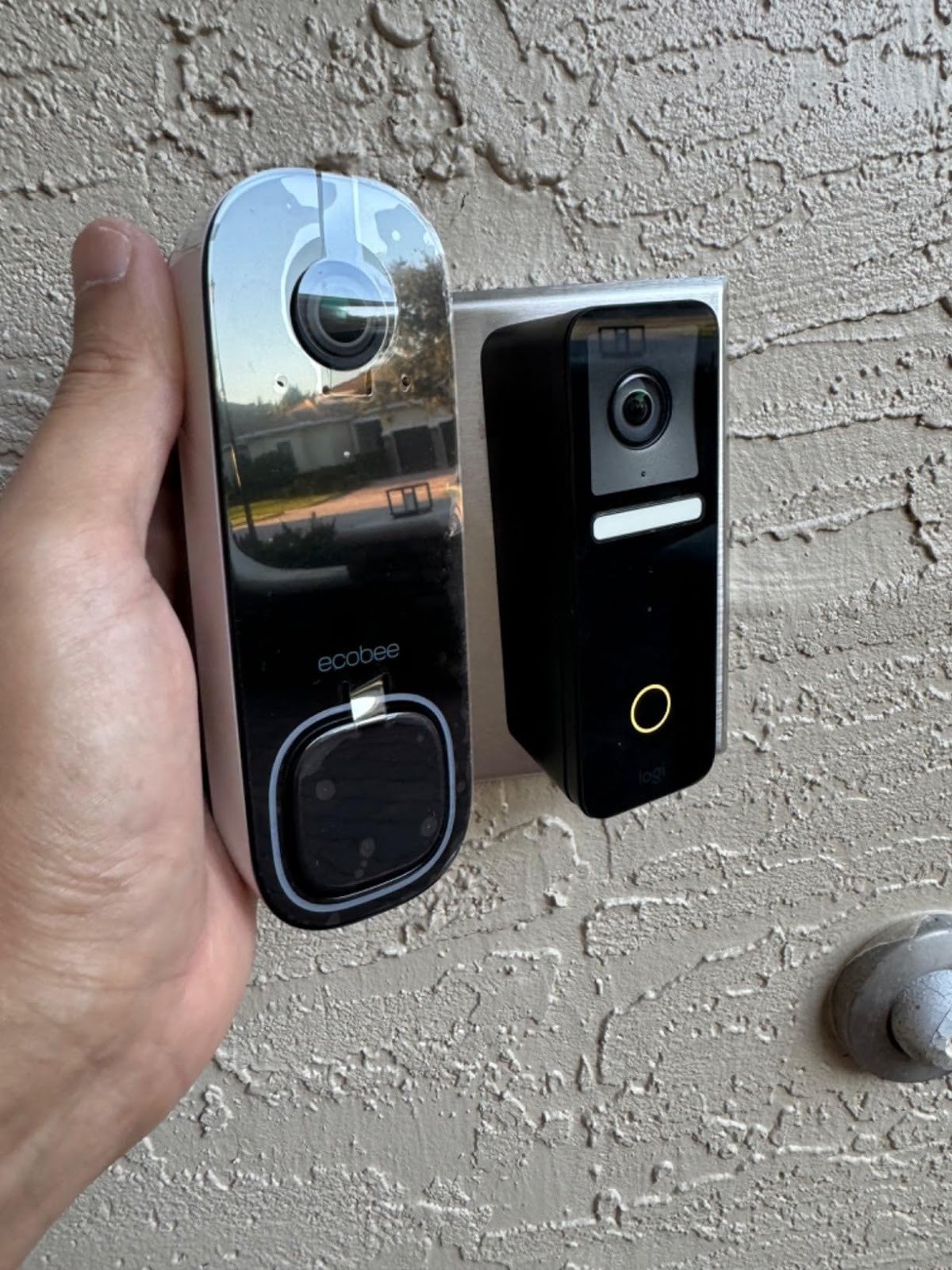
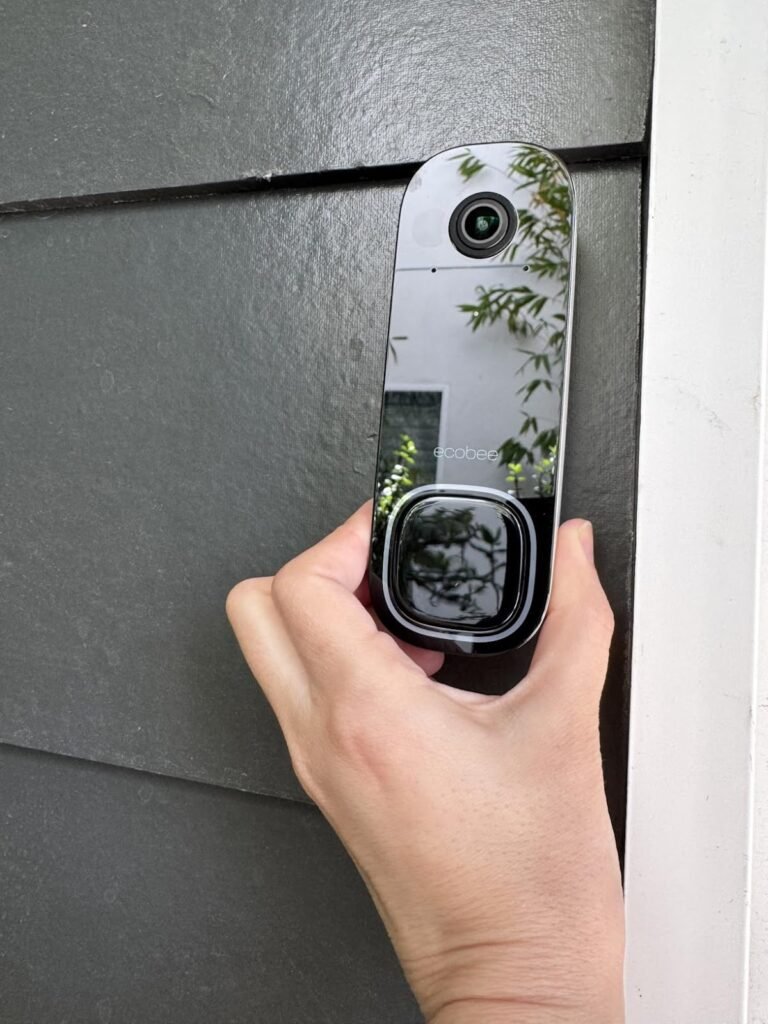
The ugly part of a bad doorbell camera is not blur. It is false confidence. You get the alert. You open the clip. The person is already turning away, the package is half out of frame, and the one detail you wanted was living at the bottom edge of the porch the whole time. That is the break point I kept circling back to with the ecobee Smart Doorbell Camera: it is not built around “more video.” It is built around seeing the front-step zone that many doorbells quietly crop out. ecobee’s official spec sheet centers that with a 4:3 portrait view, a 175-degree vertical field of view, 1080p HDR video, package and person detection, and a wired design that avoids an on-device battery. Independent reviews repeatedly land on the same core idea: the head-to-toe view and fast person/package alerts are the real story here, not raw spec bragging.
The Result Looks Fine. The Problem Isn’t.
A lot of doorbells fail in a way that looks acceptable at first glance. The porch is visible. The person is visible. The app works. But the camera is still making a small mistake with a large consequence: it favors a conventional front-facing scene over the exact strip of space where deliveries, drop-offs, and doorstep interactions actually happen.
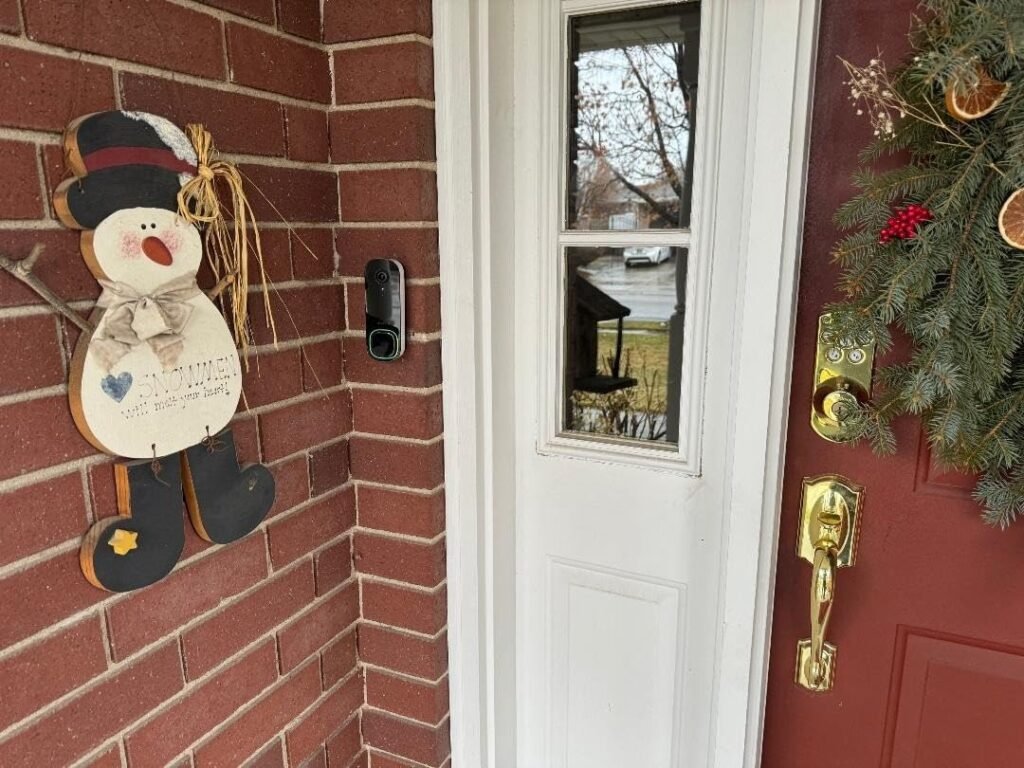
ecobee’s design leans the other way. Its official materials emphasize the unusually tall viewing angle so you can see visitors head to toe and packages placed close to the door, while reviewers at The Verge and Tom’s Guide both highlight that porch coverage as a real advantage in practice. That sounds minor until you remember what most people check a doorbell for after the fact: not “Was there a human?” but “What exactly happened at the threshold?”
| What looks “fine” on paper | What actually matters at the door |
|---|---|
| Wide enough scene | Clear view of the doorstep itself |
| Motion exists | Person or package is identified cleanly |
| Video starts | Video starts before the useful moment is gone |
| App opens | You can decide without replaying guesswork |
What You’re Actually Feeling but Not Naming
What most buyers call “bad alerts” is often a bundle of smaller frictions.
You are not just annoyed by notifications. You are annoyed by interrupted attention that still does not resolve the question.
You are not just annoyed by missing footage. You are annoyed by outcome ambiguity. Was the package delivered? Was it left at the side? Did the visitor step away before the clip caught the useful angle?
That is why the ecobee doorbell lands best with a very specific kind of homeowner: someone whose front-door stress is less about general surveillance and more about doorstep resolution. ecobee’s own positioning leans hard on that porch zone, and user-facing reviews keep praising the same cluster of benefits — reliable response, good video, easy setup, thermostat integration — when the device is used as a practical front-door tool rather than as a full security recording system.
The Hidden Mechanism Behind the Miss
The hidden variable is not “camera quality” in the abstract. It is coverage geometry plus decision filtering.
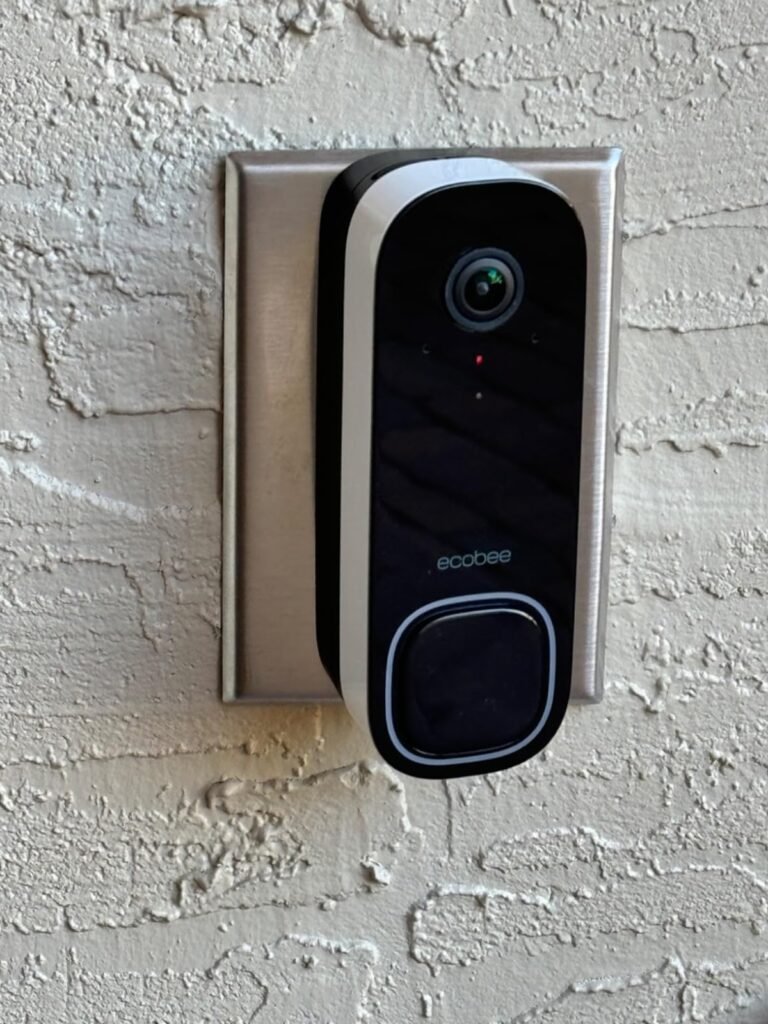
ecobee uses a 4:3 portrait aspect ratio instead of the wider cinematic framing people associate with cameras. On the spec side, that means 1920 × 1080 video at up to 30 fps, a 5MP image sensor, HDR, night vision with two infrared LEDs, and a viewing distance of up to 30 feet in night mode. On the detection side, ecobee says the device combines advanced radar verification with motion, person, and package detection. The Verge’s review adds that the radar-powered detection contributes to fast alerts with fewer irrelevant triggers, while the official product page and launch material frame the whole system around more accurate alerts rather than simply more alerts. That matters because useless coverage and noisy detection usually compound each other: you get notified at the wrong time about the wrong frame. ecobee is clearly trying to solve both at once.
| Mechanism | Why it matters |
|---|---|
| 4:3 portrait framing | Favors head-to-toe and package-at-the-door visibility |
| 175° vertical view | Expands the zone many buyers actually care about |
| Radar + computer vision / detection stack | Aims to reduce junk alerts and tighten trigger accuracy |
| Wired design | Avoids battery-related behavior in harsh weather |
| Thermostat live view | Shortens the gap between alert and action inside the home |
The Threshold Where the Outcome Quietly Breaks
Here is the threshold I would use.
If your problem starts at the door mat, not at the curb, this product makes sense.
If your break point is “I keep missing what was left right against the door,” ecobee is built for that threshold. If your break point is “I want a broader outdoor security camera with free recording, local storage, facial recognition, or 24/7 continuous history,” the logic changes fast.
The Verge notes there is no free or local recorded video and no 24/7 recording, while ecobee’s own pricing makes clear that serious video history starts with Smart Security plans from $5 per month or $50 per year. Tom’s Guide also flags the subscription as less competitive than Ring’s. In other words, the threshold is simple: this device is strong when front-door visibility is the main job, and weaker when you expect it to behave like a more open-ended surveillance platform.
| Need | Fit |
|---|---|
| Clear package-at-the-door visibility | Strong |
| Fast person/package alerts | Strong |
| Works with existing wired doorbell system | Strong if compatible |
| Apple Home / Alexa / Google Home viewing | Strong |
| Free event recording | Weak |
| Local storage | Weak |
| HomeKit Secure Video | Weak |
| Battery-powered flexibility | Weak |
Why Most Buyers Misread This Too Early
Most buyers misread doorbells by shopping the category as if all “good” models solve the same problem.
They do not.
One common early mistake is feature-led judgment. Someone sees 1080p and assumes midrange video. Someone sees subscription pricing and assumes poor value. Someone sees wired-only and assumes inconvenience. Those are not meaningless objections, but they are incomplete. This product’s value is not its headline resolution.
It is the way the tall field of view, person/package logic, and thermostat integration work together around a specific doorstep use case. The Verge flatly calls the thermostat integration genuinely useful, and recent coverage confirms ecobee later added Google Home integration as well, on top of Apple Home and Alexa support already present in its official documentation. That expands the smart-home fit, but it does not erase the core trade-off: ecobee is stronger as a system-aware front-door device than as a subscription-free archive machine.
Another mistake is assuming “HomeKit support” means full Apple parity. It does not. ecobee’s own support materials state that Apple Home Secure Video is not supported, and that limit shows up repeatedly in review coverage and owner discussions. So the product is not for the buyer who wants to live entirely inside Apple’s recording model with no parallel service layer. It is for the buyer who wants Apple Home compatibility, but can tolerate ecobee keeping recorded video inside its own subscription path.
Who Is Actually Inside This Problem
You are inside this problem if your front door has become a small source of repeat uncertainty.
Packages arrive when you are out. Guests stand closer to the frame than your old camera expected. You want the quickest possible answer from inside the house, not a forensic project after the fact. And you already live, or plan to live, in an ecobee-centered home. ecobee’s thermostat can show a live stream from the doorbell and support two-way talk, and reviewers consistently treat that as more than a gimmick.
It shortens the action chain. You do not have to reach for a phone first. That sounds trivial until you are cooking, upstairs, or halfway through something that made the original alert annoying in the first place.
This is also a better fit if you already have compatible doorbell wiring. ecobee states the unit is designed for 16–24 VAC systems, requires a minimum 10VA transformer, supports 2.4GHz and 5GHz Wi-Fi, and usually takes about 45 minutes to install in compatible homes. That does not make installation difficult by category standards, but it does mean this is not a casual battery cam you stick to a wall and forget.
Where Wrong-Fit Begins
Wrong-fit begins the moment you want this to solve a different class of problem than the one it was built around.
If you want no-subscription recording, wrong fit begins there. Ecobee’s own service structure and third-party reviews are clear that recorded clips and richer smart alerts live behind Smart Security plans.
If you want HomeKit Secure Video, wrong fit begins there. ecobee explicitly says it is not supported.
If you need a battery-powered install because wiring is absent or weak, wrong fit begins there. The device is wired-only and expects a compatible transformer. Owner reviews also suggest older homes can hit power or chime issues, which matches the general reality of wired doorbells even when the product itself is functioning properly.
If you are buying primarily for broad-spectrum security evidence, wrong fit begins there too. Some owner complaints focus on missed events, clip behavior, or the feeling that the system is better at door-step awareness than full security capture. Those reports are anecdotal, but they matter because they echo the same structural limit found in the formal reviews: ecobee is optimized for selective, front-door usefulness more than maximal recording freedom.
| Buyer type | Likely result |
|---|---|
| Wants an ecobee-centered front-door system | Good fit |
| Wants thermostat-as-intercom convenience | Good fit |
| Wants package visibility right at the mat | Good fit |
| Wants free recording and local storage | Poor fit |
| Wants full Apple HKSV path | Poor fit |
| Wants easiest no-wiring install | Poor fit |
The One Situation Where This Product Becomes Logical
The ecobee Smart Doorbell Camera becomes logical in one very specific situation:
You already treat your front door as a decision point, not just a motion zone.
That means you care about who is there, what was left, and whether you can resolve it quickly from wherever you are in the house. In that situation, the product’s design starts to feel coherent instead of fragmented. The tall view, the person/package focus, the live thermostat feed, the two-way talk, the wired weather-resistant build, and the integration across Apple Home, Alexa, and now Google Home line up around one clean job: making the threshold easier to read and easier to respond to. At that point, the ecobee Smart Doorbell Camera stops looking like “just another 1080p doorbell” and starts looking like a front-door tool with a very deliberate bias.
What It Solves, What It Reduces, and What It Still Leaves to You
What it solves is porch ambiguity.
What it reduces is wasted attention. Fewer meaningless alerts. Better visibility near the threshold. Faster in-home response if you use ecobee’s thermostat layer. Reliable wired operation in weather that can punish battery-first devices, with IP65 resistance and operation from -13°F to 113°F according to ecobee’s spec materials.
What it still leaves to you is the system choice.
You still have to accept the subscription model if stored clips matter to you. You still have to live without HomeKit Secure Video. You still need compatible wiring. And you still need to be honest about whether your problem is really doorstep visibility or whether you are trying to purchase a full security platform through the shape of a doorbell. That distinction is where regret begins or disappears.
| Category | What ecobee gives you | What it does not fully solve |
|---|---|---|
| Front-door view | Strong head-to-toe / package-oriented framing | Not a substitute for wider-property coverage |
| Alerts | Person and package focus, radar-assisted logic | Free rich recording/history is not included |
| Smart-home use | Ecobee thermostat integration, Apple Home, Alexa, Google Home | Apple HKSV is absent |
| Installation | Wired reliability, wedge included, common chime support | Requires compatible wiring and transformer |
| Ownership model | Useful even without full ecosystem lock-in | Best experience gets more expensive with subscription |
Final Compression
After working through the official specs, support requirements, professional reviews, and owner feedback, the cleanest reading is this:
The ecobee Smart Doorbell Camera is not the doorbell I would choose for everyone. It is the one I would choose when the real problem is doorstep visibility, package placement, and fast in-home response inside an ecobee-leaning smart home. Its best qualities are structural, not flashy: unusually practical porch coverage, useful thermostat integration, fast person/package awareness, solid weather-ready wired design, and broad major-platform compatibility. Its limits are just as clear: no local storage, no free recorded history, no HomeKit Secure Video, and a value equation that weakens fast if your priority is subscription avoidance.
If your break point starts at the mat, this is a logical next step. If your break point starts at ownership freedom, recording flexibility, or Apple-first video storage, stop here. The decision is not hard once the threshold is named.
Transparency Note:
This analysis is not based on quick personal impressions.
It is derived from documented system behavior, verified user patterns, and the physical constraints of storage capacity.
The goal is to translate complex technical behavior into a realistic performance model that helps you make a clear decision.