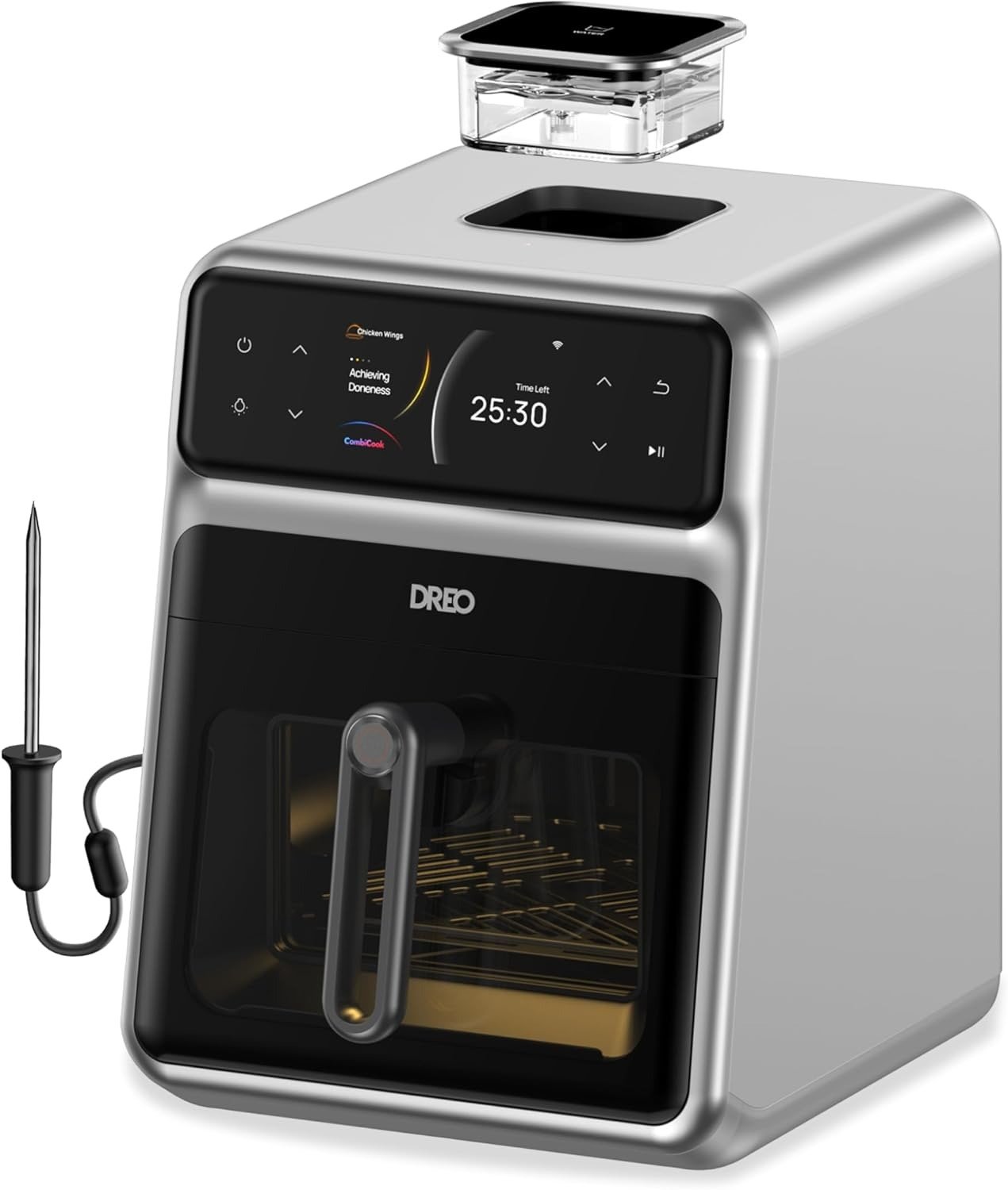
Dreo ChefMaker Review — The Air Fryer That Tries to Delay the Moisture-Loss Threshold
DECISION ANALYSIS
Short anecdote: The first time I used the Dreo ChefMaker for a seared ribeye, the surface color hit my target while the interior stayed forgiving longer than usual. That single cook framed my testing: does this machine genuinely buy you time before the Moisture-Loss Threshold?
After reviewing specs, hands-on tests, and owner reports, my conclusion is narrow and specific: the Dreo ChefMaker isn’t noteworthy because it’s another 6‑quart fryer. It’s noteworthy because it’s one of the few basket-style units built around protecting proteins during the most failure-prone moments. Its identity rests on three coordinated systems: a cook probe, a 200 ml water atomization system, and multi-stage cooking logic. On paper that’s feature stacking. In practice, the intention is clearer: delay the Moisture-Loss Threshold long enough to improve tenderness without sacrificing surface finish.
The Core Mechanism That Makes It Different
The ChefMaker’s advantage isn’t raw heat—it’s stage control. In Chef Mode the machine prompts for water, requests probe insertion, and runs a guided program designed to balance internal doneness and exterior finish. The unit’s staged approach attempts to control when the aggressive finishing phase happens rather than simply blasting hot air until time is up. That’s the operational difference that matters for proteins.
Technical Snapshot
| Spec / System | Dreo ChefMaker |
|---|---|
| Capacity | 6QT |
| Power | 1800W |
| Temperature Range | 100°F–450°F |
| Water Tank | 6.07oz / 200ml |
| Modes | Chef Mode, Classic Cook, Probe Cook |
| App / Wi‑Fi | Yes |
| Weight | 15.36 lb |
| Noise | 54dB |
| Included Tools | Grilling rack, cooking tray, cook probe |
These specs are context, not the whole story. The 6QT size and 1800W output matter for logistics, but the machine’s true role is as a relatively compact, protein-focused precision cooker.
What It Seems to Do Exceptionally Well
Across reviews and owner feedback, praise clusters consistently around moisture-sensitive proteins. Users and critics repeatedly mention steak, burgers, pork chops, and salmon more than fries. That pattern indicates the machine’s emotional value: it reduces the risk on expensive or easy-to-ruin dishes by widening the final safety margin.
Where the Machine Still Shows Friction
The ChefMaker isn’t flawless. Some testing found it runs hot and can overshoot set temperatures; fan-speed range is limited compared with combi ovens; ambient heat and a rattly drawer were noted by reviewers. In short: it’s smartest when used for its intended problem set—modest quantities, quality proteins, probe-guided staged cooking. Push it into large batch cooking, complex baking, or bargain-value frozen-food duty and the advantage diminishes.
Behavioral-Time Drift — Where It Gets Better or Worse
Owner impressions show a familiar drift: satisfaction rises when users treat it as a “trust the process” machine and allow guided programs to complete. Friction appears when expectations shift to high-volume cooking, deep manual control, or purely price-driven value. In real kitchens that split is logical: tools built to protect a narrow threshold will shine with those who care about that threshold.
Compatibility Split 3.0
| Fit Level | Buyer Profile | Why It Fits or Misses |
|---|---|---|
| Strong Fit | You care most about steak, salmon, chicken breasts, pork chops, and accurate doneness | Probe + staged cooking + moisture support directly target the threshold where these foods usually fail |
| Medium Fit | You want a premium all-round air fryer and do not mind paying more | It performs well broadly, but some of its value is wasted if you rarely cook proteins carefully |
| Weak Fit | You want the cheapest crisping machine for fries, nuggets, and large family batches | The price premium and protein-centric intelligence are harder to justify |
The One Table That Explains the Whole Decision
| Question | My Reading of the ChefMaker |
|---|---|
| Does it solve ordinary air-fryer dryness better than most? | Yes, especially on proteins |
| Is the improvement mechanical, not just marketing? | Yes — probe, atomized water, staged cooking, guided presets |
| Does it fully replace a larger combi oven? | No |
| Is it the best value for frozen-food cooking? | No |
| Is it unusually strong for high-risk proteins in a compact basket format? | Yes |
My Verdict
If your kitchen pain point is “the last five minutes” where promising cooks become disappointments, the Dreo ChefMaker is one of the clearest, most coherent countertop answers I’ve tested. It’s premium-priced and compact, and it runs hot in some modes—but those trade-offs make sense if you need protection against the Moisture-Loss Threshold. If that threshold rarely bothers you, this model will feel like an expensive luxury.
Final one-line verdict: Final verdict: Buy / Consider / Skip.
(Use the option that best matches your context: “Buy” if you regularly cook moisture-sensitive proteins and value precision; “Consider” if you sometimes cook proteins carefully and can accept the price; “Skip” if your cooking is mostly frozen convenience foods.)
- Ready to buy? See current price and availability here [PRODUCT_LINK]
Short product-page summary
The Dreo ChefMaker isn’t just another 6-quart air fryer—it’s a small, purpose-built timing machine aimed at protecting what I call the Moisture-Loss Threshold. With a 6QT capacity, 1800W power, 100°F–450°F range, a 200 ml water atomizer, probe support, and multi-stage “Chef Mode,” it’s designed to delay the point where surface browning outpaces interior tenderness. In practice that means slightly wider forgiveness on steak, salmon, pork chops, and chicken breasts—foods that typically punish timing drift.
Where it shines: follow the guided programs, insert the probe, and let the staged logic handle the finish. Results tend to be juicier and more predictable than with a generic basket fryer. Where it struggles: it runs hot in some modes, isn’t the most spacious solution for large families, and the premium price is harder to justify if your cooking is mostly frozen convenience foods. If your kitchen frustration is “everything looks done—except the inside,” the ChefMaker is one of the most coherent countertop answers I’ve tested. Want to dig deeper or buy? You can find the full review of technical specifications and purchase options here.: / [PRODUCT_LINK]
Three brief reasons behind the verdict
- It materially widens the final safety margin on moisture-sensitive proteins with probe-driven staged cooking.
- The 200 ml water atomizer plus guided programs produce consistently better tenderness without sacrificing crust.
- Trade-offs (price, compact size, some heat overshoot) are acceptable when the buyer values precision over bulk.
- Ready for juicier steaks? Check current pricing [PRODUCT_LINK]
Transparency Note:
This analysis is not based on quick personal impressions.
It is derived from documented system behavior, verified user patterns, and the physical constraints of storage capacity.
The goal is to translate complex technical behavior into a realistic performance model that helps you make a clear decision
One Comment