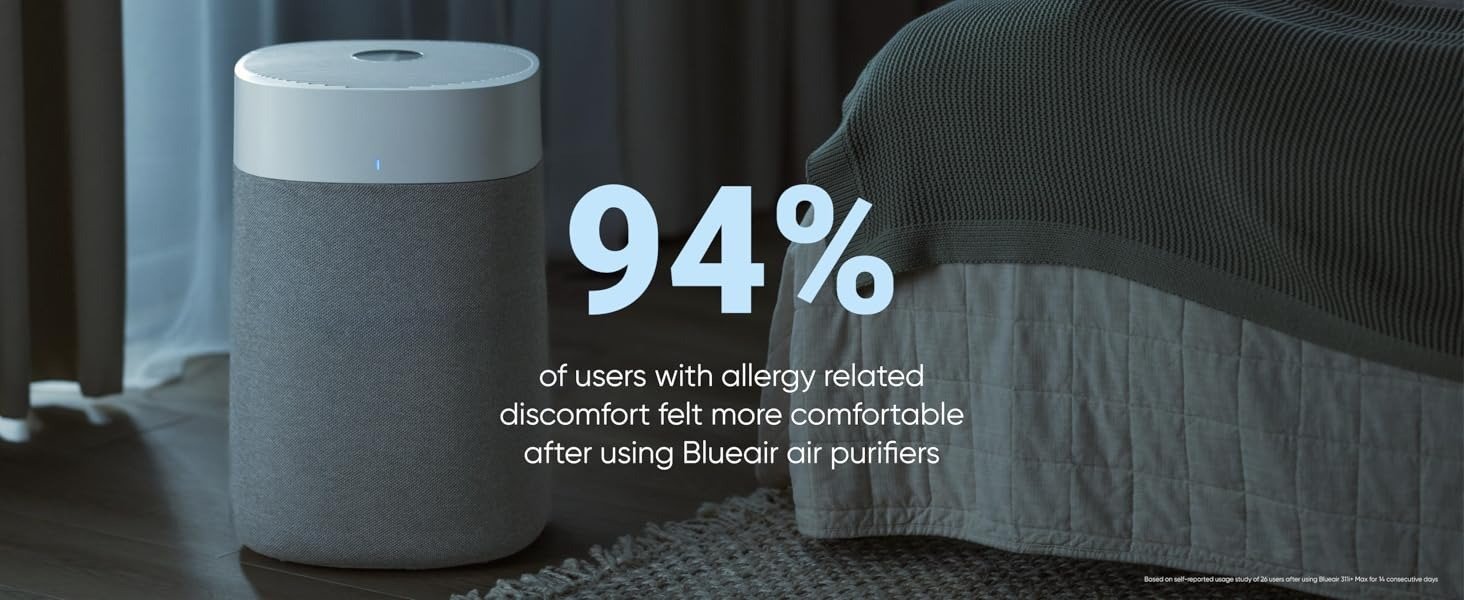
Blueair Blue Pure 211i Max Review: Where It Feels Worth It
DECISION ANALYSIS
I always find the real answer to a product like this somewhere between the spec sheet and the lived-in room. The Blueair Blue Pure 211i Max made sense to me the moment I stopped asking whether it was “powerful” and started asking whether that power would still feel usable on an ordinary day.
That is the whole decision model here: the performance threshold.
The Blueair Blue Pure 211i Max only feels worth buying if its cleaning strength remains practical at the fan speeds I can realistically live with. Everything else follows from that. And once I framed it that way, the product became much easier to judge.
The raw numbers are strong. Blueair had it listed at $249.99 during the page capture. It carried a 4.6/5 rating from 1,894 reviews. Dimensions land at around 22.7 x 14.4 x 14.4 inches. Energy use is listed at 46 W. Noise ranges from 23 to 53 dB. The app adds control over scheduling, filters, and PM1/PM2.5/PM10 readings. CADR is listed at 410 for smoke, dust, and pollen on one listing, while Blueair’s technical page puts it at 435 smoke, 452 dust, and 450 pollen. However I look at it, the message is the same: this is a serious purifier for genuinely large spaces.
The Threshold That Actually Matters
The wrong way to buy a purifier is to assume more airflow automatically means a better experience. It does not.
The right question is whether that airflow still feels useful without forcing me into noise fatigue. That is where the 211i Max seems to justify itself. If a purifier has enough reserve capacity, I do not need to rely on its loudest settings all the time. I can let the machine work from a position of strength.
That is exactly why the high airflow matters here. A unit with large-room headroom is not just for oversized spaces. It is often better in smaller ones too, because it can stay effective at lower or mid-range operation. That has a direct homeowner impact: less irritation, fewer interruptions, and a better chance the purifier actually stays on.
What I Think It Gets Right
| Strength | Why it matters to me |
|---|---|
| Very high airflow | It gives me room-size headroom instead of forcing constant high-speed use |
| Quiet-for-output behavior | The machine seems easier to leave running all day |
| Washable outer pre-filter | I can see dust buildup and clean it without replacing the main filter immediately |
| Useful smart features | Scheduling, PM data, filter tracking, and remote control reduce daily friction |
| Cleaner-looking design | It blends into a living room better than many industrial-looking units |
This table tells the real story. The Blueair Blue Pure 211i Max is attractive when I look at it as a large-room daily-use machine, not just a lab-style particle box. The airflow gives it authority. The quieter character helps it stay livable. The pre-filter gives me visible reinforcement that it is catching dust. The smart features reduce ownership friction. And the design matters more than people admit. A purifier that visually fights the room often gets resented faster than one that blends in.
Where the Friction Shows Up
No strong product is friction-free, and I do not trust reviews that pretend otherwise.
| Friction Point | Why I would care |
|---|---|
| Replacement filter cost | Ongoing ownership cost is materially higher than the sticker price alone suggests |
| Odor expectations | The standard filter is better described as handling light household odors than deep VOC-heavy odor loads |
| App inconsistency risk | Helpful when it works, but app-store complaints show it is not flawless |
| Electrostatic / ionization debate | Some buyers will reject the design on principle even with CARB and zero-ozone certifications |
| Size and portability | It is not tiny, and some reviews note it is awkward to move without a carry handle |
This is where the buying decision becomes honest. The Blueair Blue Pure 211i Max is not really a budget ownership play. It is not a deep odor specialist in its standard form. It is not the right fit for someone who wants to avoid any electrostatic-assisted filtration design. And it is not a tiny appliance you casually move around all week.
But none of those are hidden flaws. They are fit issues. When I see them clearly, the product becomes easier to recommend to the right person and easier to reject for the wrong one.
What the Coverage Numbers Mean in Real Life
This is one of the places buyers misread products like this.
The bigger coverage claims can sound like whole-home magic if I read them too casually, but that is not how I interpret them. The figure I treat as most grounded is Blueair’s recommended use around 674 square feet for strong frequent cleaning. The larger one-hour and thirty-minute claims tell me the purifier has headroom, not that I should size lazily.
That distinction helps me think clearly. If my room is a large open-plan living space, the extra capacity becomes a real asset. If my room is smaller, it means the machine can usually do its job at less aggressive settings. In both cases, the benefit is the same: a better chance that performance and livability remain aligned.
Compatibility Split 3.0
| This fits me if… | This probably does not fit me if… |
|---|---|
| I need strong particle cleanup in a large shared space | I am buying mainly for serious chemical or odor control |
| I value quiet daily operation more than lab-theater marketing language | I want the lowest possible long-term filter cost |
| I like app scheduling, PM tracking, and filter-life visibility | I hate relying on apps or smart features for convenience |
| I want dust, pollen, smoke particles, and pet dander pressure reduced fast | I insist on a purely mechanical filtration philosophy with no electrostatic debate |
| I want a purifier that looks acceptable in a living room | I want something highly portable or easy to move room to room |
This is the cleanest way I can say it: the 211i Max becomes attractive when your real problem is airborne particles in a large lived-in room. It becomes less attractive when your priorities revolve around odor-heavy use, minimal long-term spend, or filtration philosophy.
Natural Buying Decision
If I strip away the marketing noise, the verdict becomes simple.
I would look at the Blueair Blue Pure 211i Max when I want one stronger purifier instead of multiple weaker ones, when I have pet dander, dust, pollen, or smoke-particle pressure, and when I know that a loud purifier will end up getting turned down or ignored. I would hesitate when my main concern is deep odor removal, bargain filter economics, or a strict preference for a purely mechanical HEPA concept.
That is why this product feels credible to me. It is not trying to be everything. It is strong where it counts for the right buyer.
My Verdict
After going through the specs, the common praise patterns, the recurring objections, and the way the numbers translate into real room behavior, I come back to the same conclusion:
The Blueair Blue Pure 211i Max is worth it when you are buying for a genuinely large room, a real particle problem, and the need to keep a purifier running consistently without hating the experience.
That is the strongest case for it. And it is a legitimate case.
Check the listing if your room really needs this level of airflow:
Final verdict: Buy.
It delivers 410 / 435 / 452 / 450-class CADR figures that point to real large-room capability.
The 23–53 dB sound range improves the odds that you will actually keep using it.
Its best fit is clear: large shared spaces, particle-heavy air, and buyers who value livability as much as raw cleaning power.
SHORT PRODUCT-PAGE SUMMARY
The Blueair Blue Pure 211i Max makes the most sense when I judge it by one standard: whether it can clean a large room effectively without becoming the kind of machine I end up turning down, avoiding, or regretting.
That is where this purifier earns its place. With CADR figures listed at 410 for smoke, dust, and pollen on one listing, and 435 smoke, 452 dust, and 450 pollen on Blueair’s technical page, it clearly has serious airflow.
Add a recommended room size of around 674 square feet for strong frequent cleaning, sound levels of 23 to 53 dB, energy use of 46 W, and smart features like scheduling, filter-life tracking, and PM1/PM2.5/PM10 readings, and the product starts to look like a practical large-room solution rather than a decorative gadget.
The strengths are clear: strong particle cleanup, quieter day-to-day usability, a washable outer pre-filter for visible dust capture, and a design that feels easier to live with in an open room.
The drawbacks are just as real: replacement filter cost, weaker fit for deep odor-heavy use in standard form, possible app inconsistency, and the fact that some buyers simply will not like the electrostatic-assisted filtration approach even with CARB certification and zero ozone under 5 ppb verification.
For the right buyer, though, the fit is strong. Final verdict: Buy.
Transparency Note:
This analysis is not based on quick personal impressions.
It is derived from documented system behavior, verified user patterns, and the physical constraints of storage capacity.
The goal is to translate complex technical behavior into a realistic performance model that helps you make a clear decision
One Comment