Your Home Isn’t Uncovered. It’s Under-Watched in the Moments That Actually Matter
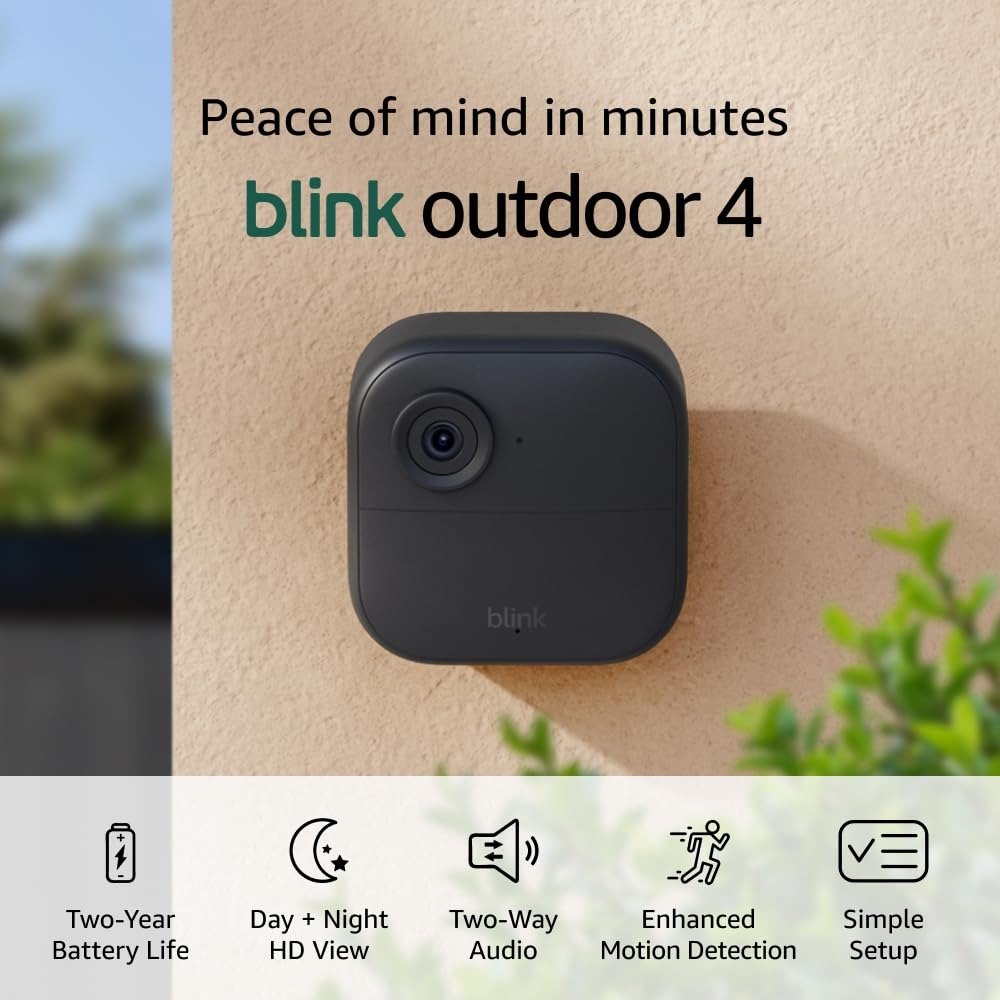
BLINK OUTDOOR 4 + MINI BUNDLE
You do not usually notice the weakness of a camera setup on day one.
It shows up later. A side gate you stopped checking. A hallway angle that seemed “good enough.” A backyard zone that technically has a camera, but not the kind of camera you still trust after a month of alerts, battery worries, app friction, and clips that arrive a little too late to feel decisive.
That is the real break point I found while digging through Blink’s own technical documents, support behavior, retailer feedback, and hands-on testing from major reviewers: most people do not actually hit a camera-quality problem first. They hit an intervention threshold. The system starts asking for more attention than the household wants to keep giving it.
The Blink Outdoor 4 + Mini bundle makes sense exactly at that threshold. Not before. Not after. And not for everyone. Its logic is simple: give up premium-video ambition, reduce wiring and upkeep friction, spread coverage widely, and keep the system light enough that you actually continue using it. That is why it works for some homes unusually well—and feels thin for others.
The Result Looks Fine. The Problem Isn’t.
A lot of camera systems look reassuring in screenshots. Clean app tiles. Sharp-enough footage. Motion alerts. Night vision. Voice integration.
But a setup can look complete and still fail in practice.
The practical failure is not always “the video is bad.” It is often uglier than that. One camera is too much work to wire where you need it. Another needs the kind of detail this class of product was never built to deliver. Another keeps pinging you for motion that matters less than the fact that you are starting to ignore the app. That slow drift is where cheap security either becomes smart—or becomes clutter.
Blink’s bundle leans hard into broad, low-friction coverage: Outdoor 4 cameras are wire-free, battery-powered, weather-resistant, and tied to a Sync Module 2; the included Mini covers the indoor side with a plug-in camera. On paper that sounds ordinary. In reality, it solves a very specific kind of household fatigue: the one created by too many weakly covered edges.
| System piece | What it changes in real use |
|---|---|
| Outdoor 4 cameras | Makes exterior placement easier because you are not solving for power first |
| Mini indoor camera | Covers the inside without battery management |
| Sync Module 2 | Keeps a multi-camera setup centralized and allows local storage with a USB drive sold separately |
| Alexa support | Simplifies quick checks for households already inside that ecosystem |
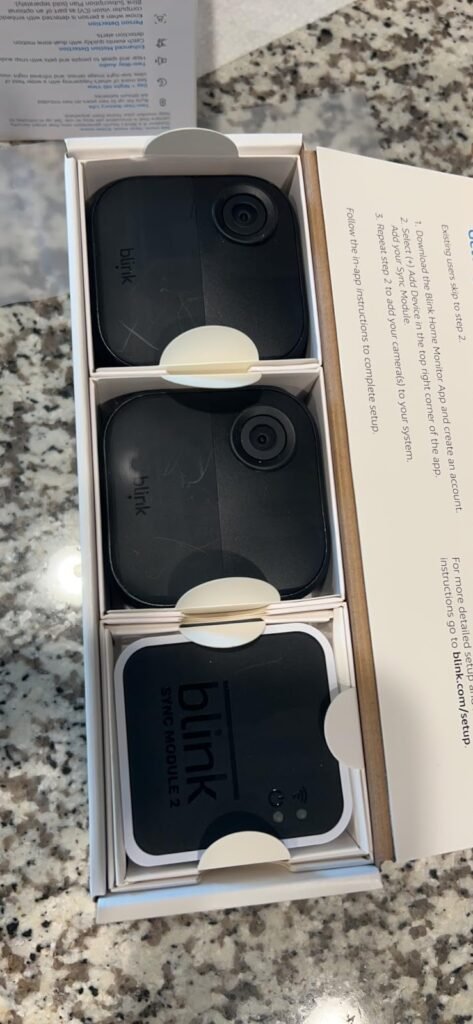
The table above reflects the system architecture Blink itself sells: eight Outdoor 4 cameras, one Mini, one Sync Module 2, two USB cables, two power adapters, and sixteen AA lithium batteries, with optional cloud storage or local storage via Sync Module 2 plus a separately sold USB drive.
What You’re Actually Feeling but Not Naming
Most buyers describe the wrong pain.
They say they want “better image quality.” Sometimes that is true. Often it is not.
What they really hate is this: checking more, trusting less.
You install a camera to remove a small background burden. Then the burden comes back wearing a different costume. Slow clip access. Too many low-value alerts. A blind spot you mentally compensate for. A yard angle that works in daylight but feels less certain once contrast drops. A system that is cheap enough to buy, but only useful if you keep babysitting it. That is not a picture problem. It is an attention-load problem.
What impressed me here is that Blink does understand part of this burden. Outdoor 4 widened its field of view to 143 degrees diagonal, improved low-light performance, added enhanced motion detection, and introduced person detection—though that last feature sits behind a subscription. The direction is clear: fewer missed edges, fewer useless alerts, less interpretive labor from the user.
The problem is that Blink only solves this burden up to a point. If your standards go beyond “I need dependable broad awareness,” you start hitting the product’s own ceiling.
The Hidden Mechanism Behind the Miss
The hidden variable is not resolution.
It is coverage density per unit of maintenance.
That is the mechanism most buyers miss.
Blink Outdoor 4 is still a 1080p camera. The included Mini is also 1080p. The Outdoor 4 has the wider 143-degree diagonal view; the Mini sits at 110 degrees. Outdoor 4 motion clips can be set between 5 and 60 seconds, while Mini clips top out at 30 seconds. Standard live view sessions run up to five minutes, and the Mini can stretch to longer viewing with a subscription-enabled extended live view feature. None of that is premium on spec sheets anymore. But in a bundle, it changes the economics of whole-home visibility.
This is the quiet truth: one expensive camera can outperform one Blink camera. But that is not always the right comparison.
The correct comparison is often one premium camera versus enough cameras to stop leaving the house mentally unwatched.
That is where Blink becomes dangerous to spec-led thinking. Because once you are solving for actual perimeter spread, AA-battery longevity, simple mounting, indoor add-on coverage, and manageable cost, the system starts looking stronger than its 1080p badge suggests.
| Metric | Blink Outdoor 4 | Blink Mini | Why it matters |
|---|---|---|---|
| Resolution | 1080p | 1080p | Good enough for awareness, not a forensic-detail monster |
| Field of view | 143° diagonal | 110° | Outdoor 4 covers more area per camera |
| Power | 2 AA lithium batteries | Plug-in | Mixed system reduces battery burden indoors |
| Motion clip length | Up to 60 sec | Up to 30 sec | Outdoor events get more recording flexibility |
| Live view | Up to 5 min | Up to 5 min; longer on Mini with subscription feature | Important for active checking behavior |
These technical points come from Blink’s support and spec documentation, not marketing shorthand.
The Threshold Where the Outcome Quietly Breaks
Here is the threshold I would name after studying this system:
The Blink Threshold is the point where your need for wide, low-intervention coverage is higher than your need for premium evidence detail.
Below that threshold, the bundle is logical.
Above it, the compromise starts to show.
If your main job is to know whether someone entered the side path, crossed the driveway, opened the gate, approached the back door, or moved through the main interior transition point, Blink’s structure is coherent. It is built for practical awareness, not cinematic scrutiny. Tom’s Guide called the Outdoor 4 the best cheap outdoor security camera and highlighted the wider field of view and person detection, while also noting the limitations against more expensive rivals. Security.org likewise frames Blink’s strongest argument as affordability and unusually long battery life rather than advanced imaging.
The threshold breaks when you need the camera to do more than tell you what happened in broad operational terms.
If you need top-tier night detail, rich native AI without fees, more advanced smart-home integrations, or a system philosophy built around continuous surveillance rather than event-based clips, this is where the pleasant simplicity turns into friction of another kind: interpretive doubt.
Why Most Buyers Misread This Too Early
Because they compare camera systems the lazy way.
They compare the headline. 1080p versus 2K. Battery versus wired. Cheap versus premium.
That is not how a house is lived in.
A house is lived in through routines. You leave. You come back. You sleep. You miss a notification. You check one camera more than another. You stop opening clips that waste your time. What survives is not the camera with the prettiest spec card. It is the one whose compromises match your actual tolerance.
Blink gets misread because people underrate two things at once:
First, the value of camera count without wiring fatigue.
Second, the cost of subscription-gated refinement.
Those two forces pull in opposite directions. The bundle is stronger than it first appears because broad deployment is genuinely easier. It is also weaker than it first appears because some of the intelligence people now expect—most notably person detection for Outdoor 4 and richer cloud conveniences—depends on Blink’s subscription structure.
| Early assumption | What usually happens later |
|---|---|
| “I just need clear video” | You realize placement and coverage consistency matter more |
| “Battery cameras always become a hassle” | Outdoor 4’s low-power design is one of its real advantages |
| “Cheap means unusable” | Cheap can be enough when the job is awareness, not evidence-grade detail |
| “Subscription is optional, so it doesn’t matter” | It matters the moment you want better filtering and smoother long-term use |
That table is the entire product in miniature. Its strength and weakness are the same thing: Blink keeps the system light, then charges extra when you want it to feel smarter.
Who Is Actually Inside This Problem
This system is for people whose security problem is coverage drift, not image obsession.
I would put the right-fit buyer into one of these groups:
- You have multiple exterior approach points and you know that one or two premium cameras will leave dead zones.
- You rent, or you simply do not want to design your week around power access and cable routing.
- You want an indoor checkpoint camera, but you do not want indoor battery management.
- You value local storage as an option, even if it requires the Sync Module 2 and your own USB drive.
- You already use Alexa and want the least dramatic path to basic smart-home control.
The broader Blink ecosystem review from Security.org backs the same pattern: the standout strength is inexpensive, simple, long-running hardware. Not a feature war. Not a premium-AI war. A low-friction-coverage play.
Where Wrong-Fit Begins
This is not for the buyer who wants the camera to think for them without paying extra.
It is not for the buyer who treats 1080p as an automatic deal-breaker.
It is not for the person who wants deep Home Assistant-style flexibility, advanced automations, or a system built around broad third-party integration.
It is not for the person who expects every alert to feel premium out of the box.
And it is definitely not for the household that will only feel calm when the footage itself carries high-detail evidentiary weight.
| Need | Fit |
|---|---|
| Broad exterior coverage on a budget | Strong |
| Low-maintenance battery life | Strong |
| Indoor add-on without battery management | Strong |
| Premium native AI without recurring fees | Weak |
| Advanced smart-home tinkering | Weak |
| Maximum image detail for identification | Borderline to weak |
| Basic local storage path | Strong |
| Continuous-view mindset | Weak |
That is the Compatibility Split in plain language. No drama. No fake neutrality. Just boundaries.
The One Situation Where This Product Becomes Logical
It becomes logical when your house has crossed from single-camera confidence into multi-zone uncertainty.
That is the moment.
Not when you want the “best camera.”
When you want to stop leaving the same areas under-explained.
In that situation, the Blink Outdoor 4 + Mini bundle is a structurally clean answer. Eight wire-free Outdoor 4 units let you cover the perimeter and transition points without turning installation into a side project. The Mini gives you one always-powered indoor check point. The Sync Module 2 keeps the system coherent. The battery proposition is not a side note here—it is the backbone of why the bundle works at scale. Blink says Outdoor 4 can reach up to two years on two AA lithium batteries under default settings, and reviewers who tested the system found battery drain unusually light compared with many wireless rivals.
This is the part many buyers only understand after overspending elsewhere: a merely good camera in the right place is often more protective than a great camera pointed at the wrong slice of life.
That is the hidden arithmetic this bundle wins.
What It Solves, What It Reduces, and What It Still Leaves to You
What it solves is deployment friction.
What it reduces is routine anxiety around blind spots, battery churn indoors, and the feeling that your system only sees the obvious angles.
What it still leaves to you is judgment.
You still need to place the cameras intelligently. Blink’s own support notes that motion detection works best at roughly 7 to 19 feet and can respond up to about 30 feet depending on conditions, which means setup quality is not optional. You also need to tune sensitivity and retrigger time, because the default behavior can create either missed follow-on motion or too much noise if you never refine it. And you need to decide, honestly, whether subscription-gated features are part of your real use case.
| What you gain | What you trade |
|---|---|
| Easier whole-home coverage | You do not get premium-detail footage |
| Exceptional battery convenience outdoors | Some smarter filtering lives behind a subscription |
| Clean indoor + outdoor split in one bundle | Mini is still a basic indoor camera, not an advanced one |
| Lower install friction | You must do more placement thinking up front |
| Local storage option | USB storage is extra, and local workflows are not as seamless as premium ecosystems |
That is the honest trade. The weakness is the cost of the strength. And in this category, that is exactly how a truthful recommendation should sound.
Final Compression
After pulling apart the specs, the support behavior, the reviewer praise, and the repeated complaints, I do not think the Blink Outdoor 4 + Mini bundle wins by being impressive.
It wins by being light enough to keep alive.
That is different.
If your problem is that you need premium evidence, richer AI, or a more advanced ecosystem, this is not your clean answer. The ceiling arrives too early.
But if your problem is that your home has more vulnerable edges than your current attention span can carry, this bundle becomes rational fast. It covers a lot. It asks less of the walls. It asks less of indoor battery management. It stretches value through camera count, not glamour. And once that is your real threshold, the decision stops being vague.
If this is the condition you are actually dealing with, this is the logical next step
Transparency Note:
This analysis is not based on quick personal impressions.
It is derived from documented system behavior, verified user patterns, and the physical constraints of storage capacity.
The goal is to translate complex technical behavior into a realistic performance model that helps you make a clear decision.