When a Countertop Water Purifier Stops Sounding Impressive and Starts Feeling Reliable
ANALYSIS FRAMEWORK
The first thing that caught my attention with the AquaTru Classic Smart Alkaline was not the contaminant list. It was the familiar gap between what a purifier promises on paper and what it feels like to live with every day.
Plenty of products look impressive when you read “reverse osmosis,” “smart app,” and “alkaline minerals.” Fewer feel calm, predictable, and worth the counter space a month later.
What kept surfacing in the technical documentation, test-based reviews, app listings, and user commentary was a simple pattern: the AquaTru’s strongest case is not that it filters water more theatrically than pitcher filters.
It is that it crosses a more important threshold. It starts to feel worthwhile when your concern is not “nicer taste,” but “verified removal plus manageable routine.” That distinction matters. AquaTru’s own materials say the system is independently certified by IAPMO to NSF standards to remove 84 contaminants, including PFOA/PFOS, lead, fluoride, chlorine, and microplastics, and the Smart version adds TDS sensing plus app-based monitoring.
Independent hands-on testing from WaterFilterGuru also gave the Classic line especially high marks for contaminant reduction and setup, while rating filtration speed notably lower.
The Threshold I Would Use to Judge It
The right model for this product is not hype versus skepticism. It is a threshold model.
For me, the threshold is this: a countertop purifier becomes truly useful when the mental burden of using it stays lower than the unease of relying on ordinary tap water or lighter-duty filtration. AquaTru gets close to that threshold because the filtration case is unusually concrete.
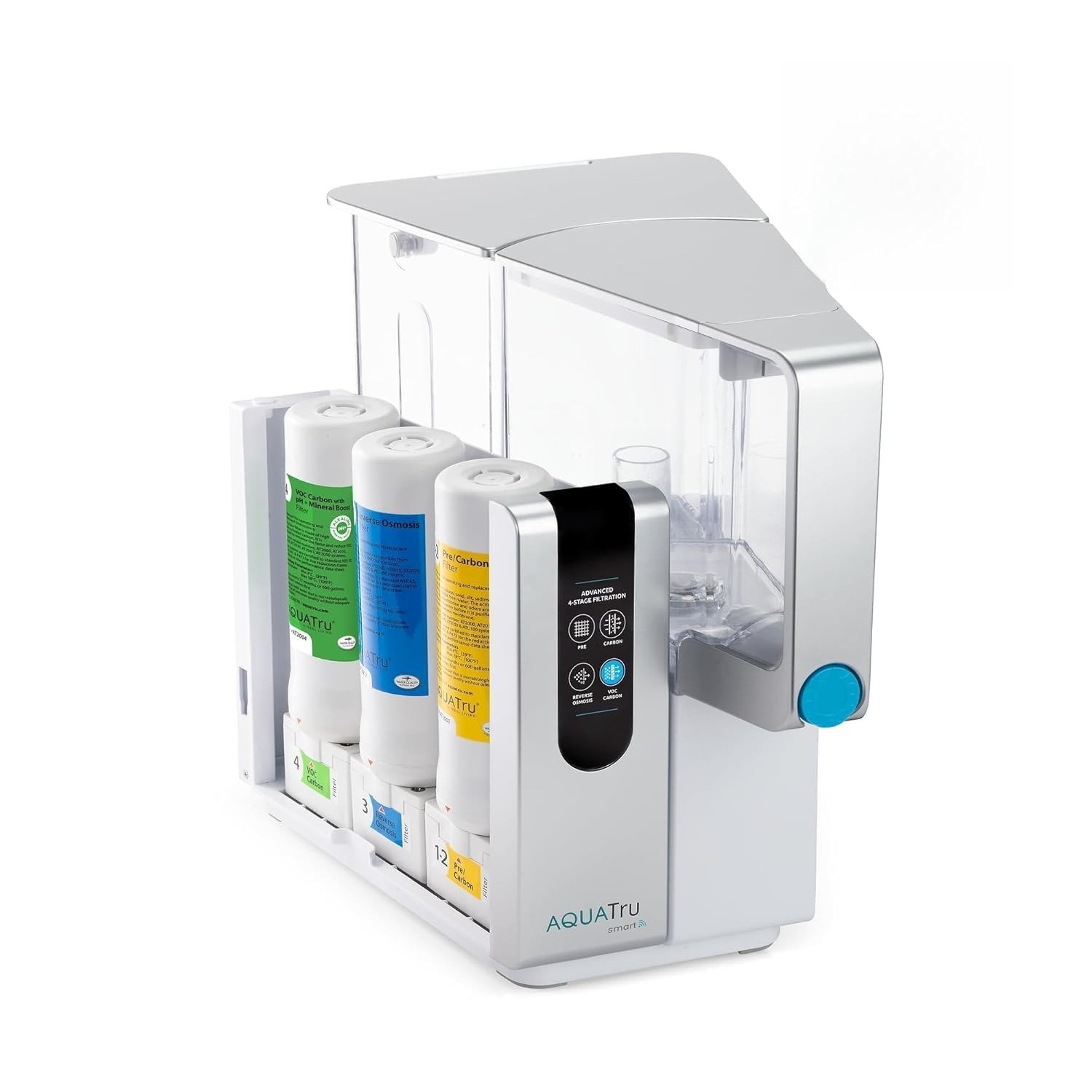
The system uses a 4-stage process, the Smart model measures TDS in both tap and purified water, and support documents spell out filter intervals rather than hiding maintenance in vague language. The pre-filter is rated for 6 months or 600 gallons, the RO filter for 2 years or 1,200 gallons, and the VOC or alkaline mineral boost filter for 1 year or 600 gallons.
The hidden variable is not purification. It is routine friction.
That is where a lot of water products quietly lose people. Not because the water is bad, but because the rhythm becomes annoying: filling a tank, emptying wastewater, waiting through filtration cycles, and dealing with scale if your water is hard.
AquaTru’s own support material is revealing here. A new unit should filter a tank in roughly 10 to 15 minutes, and the company says descaling is warranted if filtering stretches past 25 minutes.
It also recommends weekly cleaning in hard-water areas, and its performance sheet warns against use above 10 grains per gallon hardness unless the water is softened first. That tells me the real story is not “Does it purify?” but “How gracefully does it hold up once mineral load and repeated use enter the picture?”
The table below is the clearest way to see the product’s real operating shape. It consolidates manufacturer specs, support guidance, and independent testing notes.
| Factor | What I found | Why it matters |
|---|---|---|
| Filtration type | 4-stage reverse osmosis + carbon + alkaline mineral boost | Strong purification case, not just taste improvement |
| Certified removal | 84 contaminants claimed by AquaTru | Builds trust beyond vague “cleaner water” language |
| Smart layer | TDS monitoring in tap and clean tanks, app alerts, filter reminders | Adds visibility, especially for people who want confirmation rather than guesswork |
| Filter schedule | 6 months / 600 gal, 1 year / 600 gal, 2 years / 1,200 gal | Maintenance is structured, not ambiguous |
| New-cycle speed | Around 10–15 minutes per tank | Acceptable if planned, annoying if you expect instant behavior |
| Slowdown trigger | Descale if cycles exceed 25 minutes | Drift over time is real, especially with mineral-heavy water |
| Water hardness boundary | Not recommended above 10 gpg without softening | This is a serious fit boundary, not a minor footnote |
| Independent testing tone | Excellent contaminant reduction, slower flow/dispense | Strong purity profile, weaker convenience profile |
What People Seem to Like — and What They Keep Bumping Into
The positive pattern is easy to understand. Third-party reviewers consistently treat AquaTru as one of the more credible countertop RO options because it pairs certification with strong contaminant reduction in testing.
In forum discussions, some users explicitly contrast that reassurance with less transparent systems. The recurring upside is not glamour. It is confidence. People like that the water tastes clean, that the machine does not need plumbing, and that the filtration claim feels documented rather than hand-wavy.
The recurring complaints are just as informative. They cluster around operational drag, not conceptual failure. Users talk about having to refill more often than they expected, noise during operation, slow output, app frustrations, and customer-service disappointment.
The App Store listing for AquaTru’s app shows a very weak rating sample and complaints about logins and reset issues, while Trustpilot complaints repeatedly mention noise, mold concerns, and support problems.
I do not treat those as universal verdicts, but I do treat them as friction signals that align with the system’s own maintenance reality.
The Real Question This Product Raises
After going through the evidence, I do not think the AquaTru Classic Smart Alkaline is mainly asking, “Do you want better water?”
It is asking something sharper:
Do you care enough about verified contaminant reduction to accept a visible, recurring countertop routine?
That is the threshold.
If your answer is yes, the product starts to make sense in a more serious way than a typical filter pitcher ever will.
If your answer is no, even good water may not feel good enough to justify the interruptions. The Smart features help by making the system legible—TDS readings, filter life, reminders—but they do not eliminate the core ritual. They only make it easier to monitor.
Where the Signal Leads Next
What convinced me most is that the AquaTru argument becomes stronger the moment you stop judging it like a convenience gadget and start judging it like a contamination-control appliance with a routine attached.
That framing reveals both its strength and its boundary. It is not trying to be invisible. It is trying to be trustworthy enough that the routine feels justified.
That is exactly where the real decision begins.
Transparency Note:
This analysis is not based on quick personal impressions.
It is derived from documented system behavior, verified user patterns, and the physical constraints of storage capacity.
The goal is to translate complex technical behavior into a realistic performance model that helps you make a clear decision