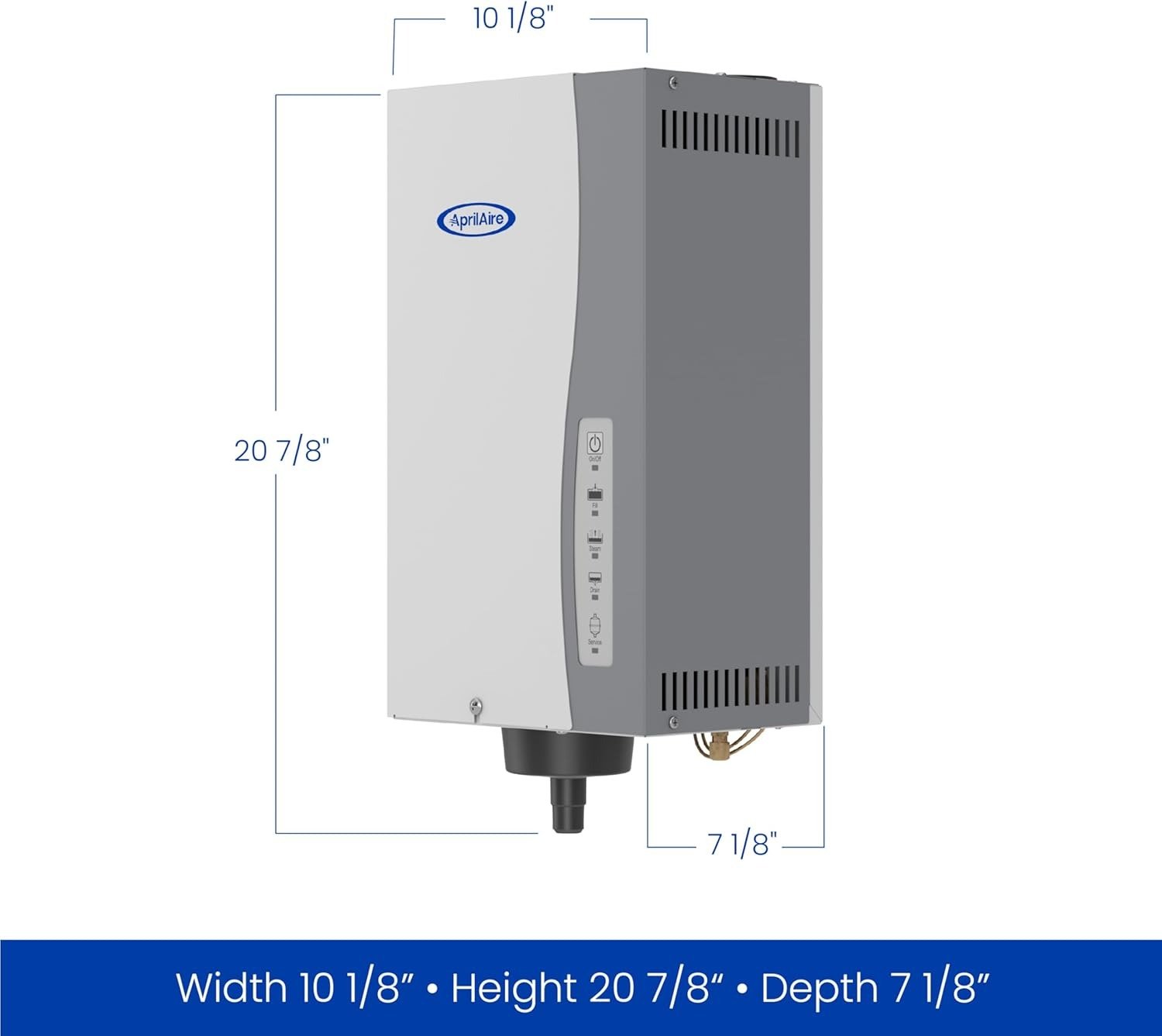
Aprilaire 800 Review — The Point Where a Steam Humidifier Starts Making Sense
DECISION ANALYSIS
What I like about the AprilAire 800 is that it does not pretend to solve a small problem with a big machine . It is very obviously built for homes that have already crossed a threshold. If the house is large, tightly built, full of wood that reacts to winter dryness, or dependent on HVAC behavior that does not provide long steady heating cycles, this unit starts to look rational very quickly.
It is a whole-house steam humidifier that generates steam through submerged electrodes in a replaceable canister, uses automatic control with indoor and outdoor sensing, and can deliver up to 34.6 gallons per day depending on voltage and configuration. AprilAire also frames it for homes up to 10,300 square feet in tightly built conditions.
What the Aprilaire 800 Actually Solves Better Than Lighter Systems
The strongest case for this model is not “more humidity.” It is more dependable humidity when the house is a difficult load. That matters.
I kept seeing the same pattern in the technical documents and in homeowner conversations: where simpler humidifiers begin to fall behind, steam keeps making sense because it is less tied to long furnace calls and more tied to actual moisture demand.
The Model 800 can work with ducted air systems with or without forced-air heat, and its control logic can work with the blower to maintain humidity when the HVAC system is otherwise standing by. In plain English, this is the kind of machine I would take seriously when the home does not naturally give a weaker humidifier enough operating window to recover lost moisture.
The Mechanical Advantage I Trust Here
The most important technical advantage is the steam architecture itself. The unit heats water in its internal canister and moves steam through a hose and dispersion tube into the duct.
That sounds simple, but it changes the whole feel of the product. I am not waiting for a pad to stay clean, for a trickle system to remain efficient, or for a perfect heating cycle to coincide with the driest period of the day.
I am looking at a system designed to produce output on purpose. The manufacturer also includes automatic digital control, an outdoor temperature sensor, a steam hose, dispersion tube, and drain tubing in the package, which tells me this is meant to operate as a deliberate control system, not as a passive add-on.
The Threshold Model I Would Use for This Product
I would keep the model brutally simple.
| Threshold Question | My reading |
|---|---|
| Is the home dry only occasionally? | The 800 is probably too much machine |
| Is the dryness persistent across winter and tied to short runtime or large space? | The 800 becomes logically relevant |
| Are comfort, wood preservation, and stable humidity all important at once? | The 800 fits better |
| Is the buyer trying to minimize electrical demand, install complexity, and annual maintenance? | The 800 becomes harder to justify |
That is the right split because the 800 is not light-duty equipment. The installation guidance calls for qualified HVAC and electrical contractors, and the unit ships factory-wired for 240V with provisions for 208V or 120V operation depending on rewiring and setup. There are also dedicated circuit requirements tied to current draw.
What I Would Count as Real-World Strengths
The first strength is output headroom. Even if a house never needs the upper end every day, having more moisture capacity changes how the system responds when winter air gets aggressive.
The second strength is automatic control. The third is that purified water is not required; electrode technology actually depends on impurities to conduct electricity, which can reduce installation complexity compared with systems that expect treated water.
The fourth is that AprilAire designed the unit around replaceable canisters instead of making seasonal maintenance a scrubbing ritual. In owner discussions, that trade-off reads clearly: people accept the canister model because the performance class is different from the lighter alternatives they were tired of managing.
What I Would Not Hide From Anyone Considering It
This is not a cheap, invisible, zero-attention solution. The manual is explicit about water conductivity, back-pressure limits, installation geometry, and service behavior.
Mineral buildup is part of the operating reality. As the electrodes lose effective surface area, the control raises water level to maintain nominal current, and eventually the service light indicates the canister needs replacement.
AprilAire says the canister is typically replaced yearly, with electrode wires replaced every three years by a licensed contractor.
Homeowner reports also point to the practical downsides you would expect in a stronger steam system: dedicated power requirements, some operational noise, occasional sensor-reading mismatch depending on the control setup, and canister life that can vary a lot with water chemistry and runtime.
The Drift Pattern That Matters Over Time
The longer I looked at this unit, the more obvious the drift pattern became. Performance drift here is usually not mysterious.
It is tied to time, mineral accumulation, water conductivity, and the difference between rated output and the actual load the house is creating.
During initial startup, the unit may cycle through fill and drain behavior before reaching rated capacity, and low-conductivity water can delay full output.
Later in life, when mineral buildup changes electrode effectiveness, the unit compensates until it can no longer hold nominal current and asks for canister replacement. That means the machine is honest. It does not quietly turn weak forever. It tells you when the threshold has been crossed.
My Verdict
I would not buy the AprilAire 800 just to say I own a steam humidifier.
I would buy it only when the house has already proven that lighter humidification is no longer stable enough.
That is why this product makes sense to me in larger homes, tighter homes, heat-pump or short-cycle environments, and homes where dry-air damage and winter discomfort are no longer occasional annoyances but repeating operating conditions.
If that threshold is real, the AprilAire 800 looks like a serious, high-output, mechanically coherent answer. If that threshold is not real, it looks like an expensive way to solve a smaller problem than you actually have.
Transparency Note:
This analysis is not based on quick personal impressions.
It is derived from documented system behavior, verified user patterns, and the physical constraints of storage capacity.
The goal is to translate complex technical behavior into a realistic performance model that helps you make a clear decision

One Comment