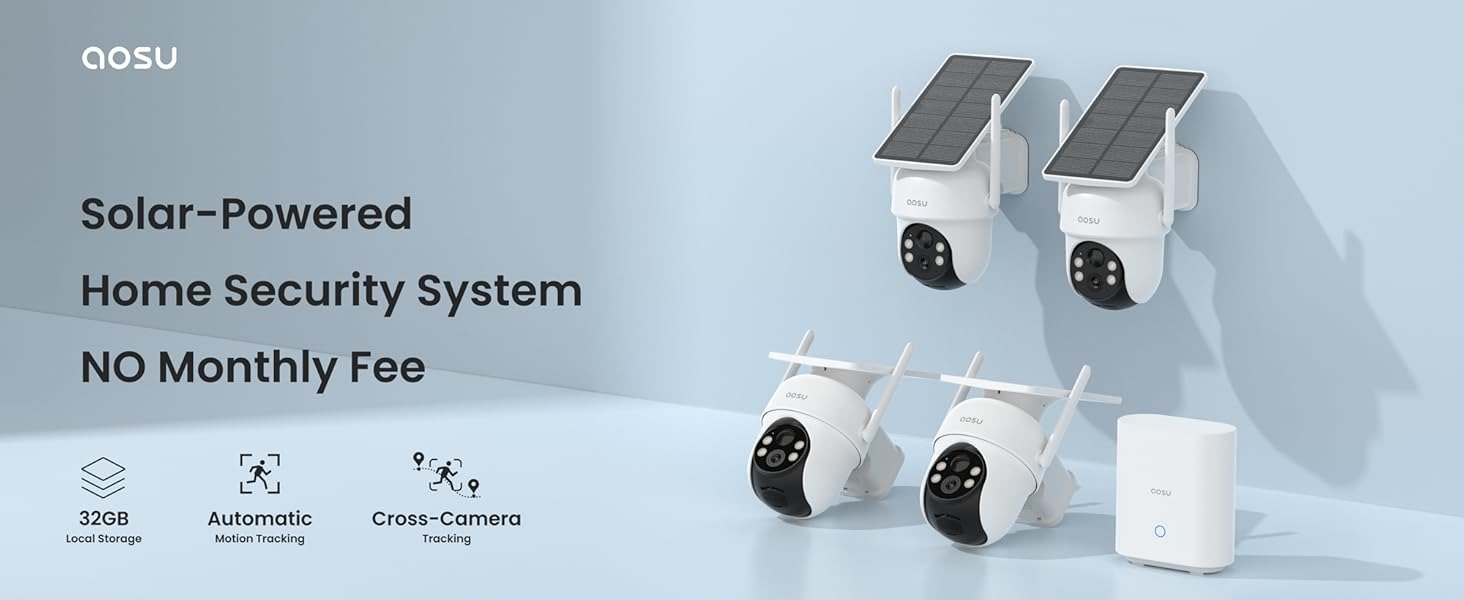
AOSU SolarCam D1 Classic Kit Review: Where The Threshold Holds, And Where It Starts To Slip
DECISION ANALYSIS
I test products the way I’d live with them: not by specs alone, but by how much they let you forget about them.
The AOSU SolarCam D1 Classic Kit grabbed my attention because it tries to solve the exact daily friction that makes people abandon wireless security.
On paper, the kit looks sensible: four solar cameras, an aosuBase with local storage, 2K/3MP capture, 360° pan & tilt, auto tracking, two-way audio, color night vision, dual-band Wi‑Fi, and 32GB of local storage with no required monthly fee. AOSU claims about three hours of direct sunlight per day keeps the cameras charged.
The Core Specs That Actually Matter
| Specification | AOSU 4-Cam Kit |
|---|---|
| Camera type | Solar-powered wireless outdoor kit |
| Resolution | 2K / 3MP |
| Coverage | 360° pan & tilt |
| Tracking | Auto motion tracking |
| Night vision | Color night vision with 4 LEDs |
| Storage | 32GB local storage in aosuBase |
| Subscription | No required monthly fee |
| Connectivity | 2.4GHz + 5GHz Wi-Fi |
| Smart home support | Alexa, Google Assistant, SmartThings |
| Claimed sunlight requirement | About 3 hours of direct sunlight daily |
| Weather rating | IP65 in manual references |
Those specs are meaningful in this price tier: four cameras with pan‑and‑tilt plus local storage and solar charging are precisely the elements that address common ownership complaints.
What AOSU Gets Right (And Why It Matters)
First: no required subscription. That changes ownership psychology—local storage via the aosuBase feels like buying equipment, not signing up for a service.
Second: the kit centers on coverage efficiency. Four PTZ units reduce blind spots without a full wired install—ideal for renters or anyone avoiding cable runs.
| Strength | Why It Helps In Real Use |
|---|---|
| Local storage in aosuBase | Keeps ownership costs cleaner and preserves footage off-camera |
| Four-camera one-screen viewing | Makes perimeter checks simpler |
| Solar charging | Reduces the usual battery-maintenance cycle |
| 360° pan & tilt | Covers awkward outdoor zones better than fixed cheap cams |
| Auto tracking | Helps when motion moves across the frame instead of through it |
| Dual-band Wi‑Fi | Gives more setup flexibility than 2.4GHz-only budget kits |
User reports are split but instructive: some owners report strong solar charging, clear images, and reliable no-fee local storage; others report offline behavior in cold weather, notification lag, and inconsistent motion capture at distance. Those experiences align with the category’s threshold failure points.
Where The Threshold Starts To Break
This is crucial: treat the AOSU kit as a wire‑free event‑driven system, not a drop-in replacement for wired 24/7 surveillance.
Battery PTZ cameras rely on motion events to save power. If triggers arrive late or miss events at range, the system can feel incomplete even if image quality is acceptable.
| Reported Weakness | What It Means |
|---|---|
| Offline behavior in cold weather | Environmental stability may drop when conditions get harsher |
| Lag in event notifications | The “live awareness” promise weakens |
| Hit-or-miss movement capture at distance | Trigger confidence may fall outside ideal placement |
| App frustrations | Playback confidence depends heavily on software smoothness |
| Solar dependence | A shaded install can quietly lower reliability over time |
Who This Actually Fits
In plain terms: the AOSU kit fits buyers who want broad, low‑maintenance perimeter awareness without monthly fees.
It’s less suitable for those who require continuous forensic recording or zero tolerance for missed triggers.
Decision Table :
- If you want four outdoor cameras without paying monthly fees, AOSU is a logical choice.
- If your mounting spots are heavily shaded or winter light is weak, be careful—solar dependence reduces reliability.
- If you need full-time, 24/7 recording with forensic playback, skip this and opt for wired or powered systems.
- If you value flexible placement more than hardwired certainty, this kit is a strong fit.
- If your Wi‑Fi already struggles outdoors, be cautious—wire-free systems are Wi‑Fi sensitive.
Final verdict: Consider
If you want practical perimeter awareness with local storage and no subscription drag, the AOSU SolarCam D1 Classic Kit is a compelling option. If you need wired-grade, always-on recording, look elsewhere.
Three brief reasons behind the verdict:
- Delivers four-camera PTZ coverage and local storage without a mandatory subscription.
- Practical solar charging reduces daily maintenance for many typical installations.
- Still limited by event-driven capture, Wi‑Fi sensitivity, and environmental boundary cases.
Short Product-Page Summary (≈220 words)
I tested the AOSU SolarCam D1 Classic Kit as a practical, no‑subscription perimeter solution.
It bundles four solar-powered outdoor cameras with 2K/3MP capture, 360° pan & tilt, auto motion tracking, color night vision, two‑way audio, dual‑band Wi‑Fi, and 32GB of local storage in the aosuBase.
AOSU claims about three hours of direct sunlight per day keeps the cameras charged, and the system is advertised as IP65-rated in manual references.
What matters in daily use is that this kit prioritizes ownership simplicity: local storage rather than mandatory cloud fees, and rotating coverage that reduces blind spots without wiring.
In normal light and where Wi‑Fi is solid, owners report clear images and reliable solar behavior. The tradeoffs are classic for battery PTZ systems: event-based capture rather than continuous recording, sensitivity to mounting/lighting, and potential lag or offline behavior in extreme conditions.
Who should consider it: buyers who want four-camera, wire‑free coverage, prefer local storage, and accept the typical limits of battery-based event recording.
Who should skip it: anyone who needs 24/7 forensic recording, guaranteed zero missed triggers, or who has shaded mounting points and weak outdoor Wi‑Fi.
Transparency Note:
This analysis is not based on quick personal impressions.
It is derived from documented system behavior, verified user patterns, and the physical constraints of storage capacity.
The goal is to translate complex technical behavior into a realistic performance model that helps you make a clear decision


One Comment