Alternator Chargers for Power Stations: Why “Car Charging” Still Feels Unstable
ANALYSIS FRAMEWORK
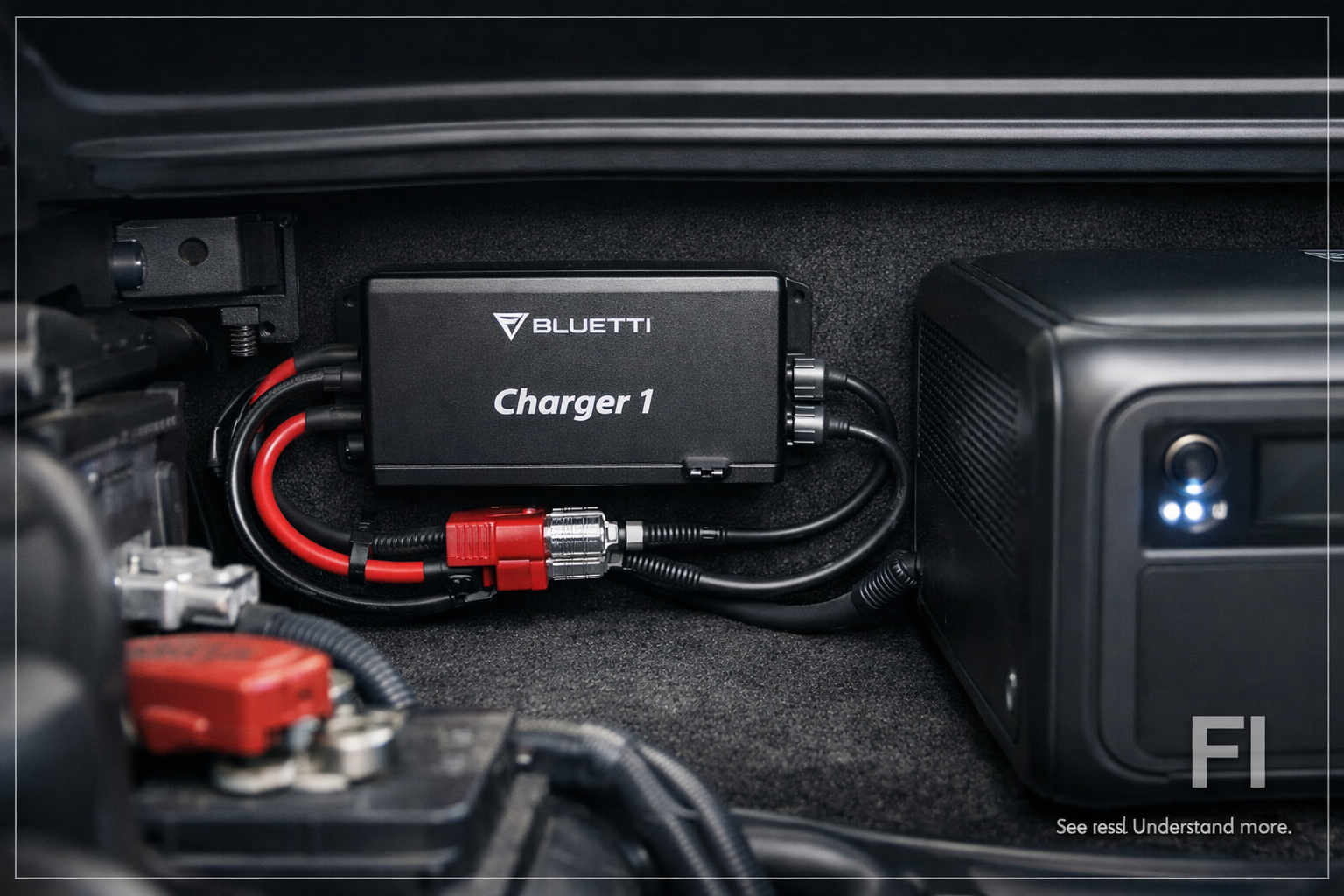
“A compact DC-DC alternator charger wired from a vehicle battery to a portable power station.”
Opening Context
I used to treat in-vehicle charging as a solved detail—plug in, drive, arrive with more power. Then I started reading the signals the market leaves behind: the wiring questions, the smart-alternator confusion, the inconsistent charging reports, the quiet battery-drain anxiety. That’s when the problem shifted in my head.
This isn’t about “more watts” as a flex. It’s about restoring mental equilibrium: a charging setup that runs in the background without demanding repeated attention.
The Equilibrium Gap I Keep Seeing (And Feeling)
The gap is subtle but persistent: I notice myself checking—again and again—because something feels slightly off.
It usually shows up as three micro-frictions:
- The charge rate feels lower than the drive time should justify, so I keep recalculating.
- I’m never fully relaxed about the starter battery when the engine is off, even if “it should be fine.”
- With modern vehicles, I can’t assume the alternator behaves like an old-school system—so inconsistency becomes the default fear, not the exception.
This is not drama. It’s quiet cognitive noise. And if it keeps returning, the system has failed its real job.
Criteria Framework (The 6 Signals I Use Before Trusting Any Setup)
When I evaluate an alternator-charging solution, I use criteria that reduce doubt—not marketing claims.
- Starter-Battery Protection That’s Structural (Not “User Discipline”)
I look for explicit engine-off protection behavior: voltage sensing, automatic stop logic, and clear boundaries. If the system relies on my memory, it’s not stable. - Smart Alternator Compatibility That’s Designed-In
Modern charging systems behave dynamically. I treat D+ (or an equivalent ignition/engine-run signal) as a serious stabilizer, because it’s a clue the design expects real vehicles—not ideal lab conditions. - Charging Power That Matches Real Driving (Not Theoretical Use)
I’m not chasing extreme numbers. I’m looking for a charge path that makes a day on the road feel meaningfully different—where the battery state changes enough that I stop obsessing. - Installation Realism (The Hidden Cost Nobody Mentions)
This is where regret usually lives: cable routing, mounting, access to the battery, and how “clean” the final result feels. If installation becomes a project, the system’s friction simply moves from “charging” to “ownership.” - Protection Hardware Included (So I Don’t Improvise Safety)
A high-current setup must be treated like a high-current setup. Fusing and protection aren’t accessories; they are the boundary between stable and reckless. - Thermal & Placement Discipline
Ventilation clearance and secure mounting aren’t “manual filler.” In a vehicle, heat and movement are constant. If the physical realities don’t fit your layout, the best spec sheet in the world won’t protect you from long-term instability.
Hidden Technical Factors That Quietly Decide Everything
Here’s what I think most people underestimate—because it’s not exciting until it goes wrong:
- Smart alternators can reduce output behaviorally, which creates “it charges sometimes” confusion.
- Voltage drop and heat aren’t abstract; they’re what cause intermittent performance and future troubleshooting loops.
- The human loop matters: if the install feels messy or uncertain, I avoid using the setup—and avoidance becomes the new friction.
When these factors stack, the result is a system that works “enough,” but never becomes mentally invisible.
Market Reality (Why Feedback Often Clusters Around Friction, Not Features)
When I look at how people react to this category, I notice something consistent: the most important questions aren’t “How cool is it?” They’re:
- Will it behave consistently in my vehicle?
- Will it protect my starter battery without me babysitting it?
- Will installation leave me feeling confident—or trapped in a wiring project?
That tells me the market isn’t buying a gadget. It’s buying equilibrium.
Controlled Curiosity (The One Question I Refuse to Answer Here)
After mapping the claimed design signals that matter most—engine-off protection, smart-alternator signaling, and a higher-power charge path—the only question that remains is the one that decides everything:
Does this kind of alternator charger actually remove the daily “checking loop”… or does it simply move the friction into installation and vehicle-compatibility edge cases?
Now I understand what’s structurally missing in most setups. But I still don’t have the quiet closure.