AirDoctor AD3500 Review: Does It Cross the Usable Purification Threshold?
DECISION ANALYSIS
The question I kept coming back to with the AirDoctor AD3500 was not whether it sounds advanced. It does.
The real question was whether it crosses the point where a purifier’s large-room promise, filtration depth, automatic sensing, and ownership burden stay coherent enough to justify the price.
For me, that is the only decision model that matters here: the Usable Purification Threshold.
If a purifier cleans aggressively but becomes annoying, overpriced to maintain, or mismatched to the room, it slips below the line. If it can stay meaningfully effective in normal life, it crosses it.
The AD3500 gets very close to the heart of that threshold because it has real strengths, but it is not a casual buy.
What the AD3500 Technically Gets Right
On paper, the AD3500 looks serious for the category. AirDoctor says it uses a three-stage system with a pre-filter, carbon/VOC filter, and UltraHEPA filter rated for particles down to 0.003 microns.
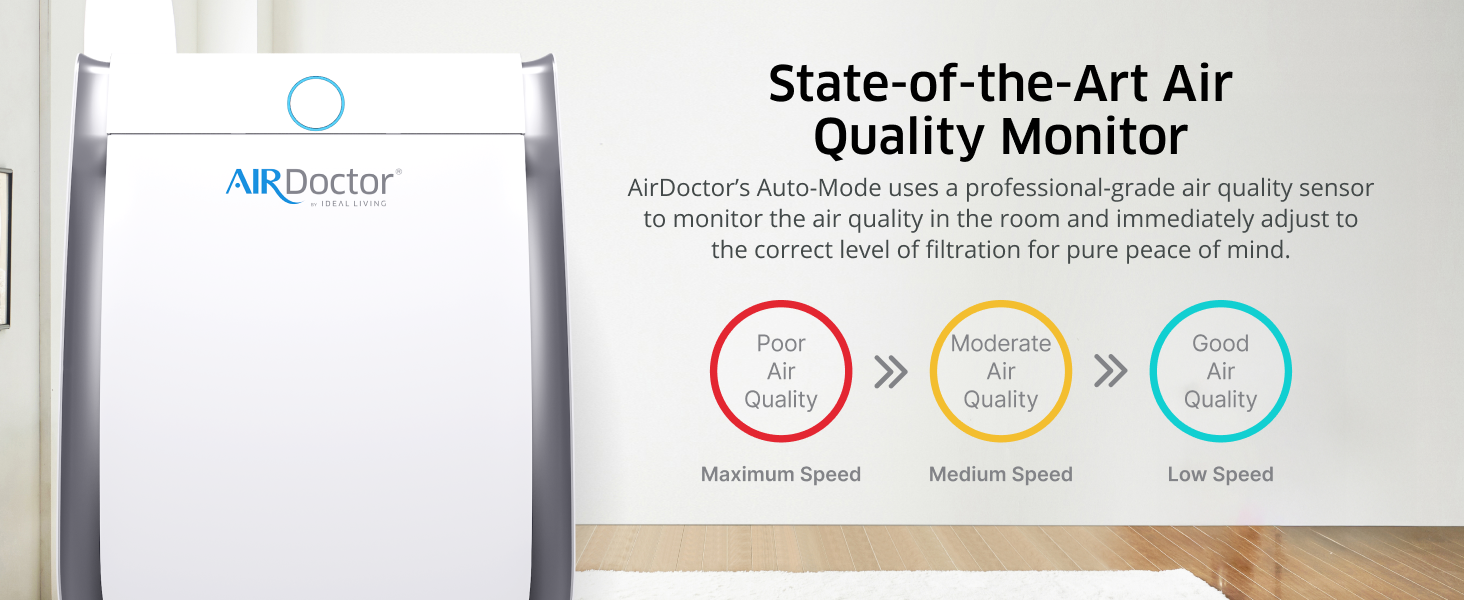
It also claims coverage of 630 square feet at 4 air changes per hour and 1,260 square feet at 2 air changes per hour, with auto mode, an air-quality sensor, night mode, timer, child lock, and optional ions.
The stronger point is that outside reviewers did not dismiss those claims as empty marketing. Live Science reported excellent real-world smoke and ambient-air results after more than two months of testing.
HouseFresh’s testing on the closely related AirDoctor 3000 found very effective removal of tiny particles, and Modern Castle’s AD3500i review described exceptional performance, 340 CFM CADR, and outstanding 1,274-square-foot coverage at 2 ACH.
So the core technical case is real: this is not a decorative purifier. It belongs in the part of the market where performance is supposed to be noticed.
The Detail That Separates Specs From Daily Life
The most important thing I learned about the AD3500 is that its value depends on whether you care more about filtration confidence or efficiency per dollar.
That distinction matters because the AD3500 asks you to accept premium ownership logic:
| AD3500 decision variable | What it means in practice |
|---|---|
| Ultra-fine filtration claim | Reassuring if you are buying around smoke, allergens, dust, and airborne irritants |
| Large-room coverage | Useful if the room is genuinely mid-to-large and you want stronger turnover than a bedroom unit can provide |
| Auto mode + sensor | Reduces micromanagement and makes daily use more realistic |
| Proprietary filters | Long-term cost is part of the purchase, not a footnote |
| Premium positioning | You are paying for stronger purification framing, not just convenience |
Live Science said the replacement filters are expensive at $152.99 for a one-year supply, and Modern Castle flagged the approved-filter requirement as a notable downside. That is not a small detail. It is part of the threshold itself.
What People Seem to Like Most
The positive pattern is remarkably consistent across reviews and owner feedback:
- Strong sense that the air feels cleaner
- Good performance with smoke, allergens, and general particle cleanup
- Large-room usefulness
- Straightforward controls
- A design that is plain but easy to live with
- Automatic response when air quality changes
Live Science’s review of user feedback noted praise for powerful cleaning, an unobtrusive design, and relatively quiet operation, while Reddit owners who were happy with the brand described visible dust capture and useful automatic speed changes during cooking or vacuuming.
That is important because air purifiers usually win trust through repeated, ordinary moments. A machine that reacts when the kitchen gets smoky or the room gets dusty tends to feel more real than one that only wins on technical jargon.
What Would Stop Me From Calling It an Easy Yes
This is where the AD3500 stops being universal.
The first issue is cost. Even reviewers who liked it framed it as expensive, and the filter ecosystem adds to that burden over time. Live Science described both the standard and smart variants as pricey, and its criticism of replacement-filter cost was direct. Modern Castle also made price and filter lock-in part of its “considerations” section.
The second issue is that noise claims need context. Amazon lists a 34 dB noise level, but Live Science measured a 59 dB max noise figure, and Modern Castle reported 66.8 dB in its testing.
I would read that combination as a reminder that low-setting quietness may be true while max-speed comfort is still situation-dependent, which is completely normal for powerful purifiers.
The third issue is support confidence. Negative user feedback collected by Live Science mentioned chemical smell complaints and poor customer service, and Reddit discussion included skepticism about long-term reliability and support outside warranty. That does not erase the positive reviews, but it does keep the decision honest.
Compatibility Split 3.0
| Fit tier | Who this sounds like | Verdict |
|---|---|---|
| Excellent Fit | You have a real mid-to-large room, care deeply about smoke/allergen/particle cleanup, want auto mode, and can absorb premium filter costs without resentment | The AD3500 crosses the threshold clearly |
| Good Fit | You want a stronger purifier than mainstream mid-range models, but you do not need app-heavy features | Still a sensible buy if filtration confidence matters more than value optimization |
| Acceptable Fit | You mostly want cleaner background air in a moderate room and do not mind paying extra for peace of mind | It can work, but the premium may be more emotional than necessary |
| Borderline Fit | You are price-sensitive, dislike proprietary consumables, or only occasionally need heavy cleanup | The threshold starts weakening |
| Poor Fit | You are buying for a bedroom-size space or trying to minimize long-term ownership cost | Better value exists elsewhere |
| Wrong Fit | You want the cheapest credible purifier for the money, or you want a set-and-forget purchase with minimal concern about filter economics | The AD3500 is the wrong answer |
Where It Sits Against the Main Alternatives
| Model | Coverage / airflow angle | Noise / convenience angle | Best use case |
|---|---|---|---|
| AirDoctor AD3500 | 630 sq ft at 4 ACH, 1,260 sq ft at 2 ACH; strong premium-filtration positioning | Auto mode, sensor, optional smart version; premium filter cost | Buyers who prioritize filtration confidence and larger-room capability |
| Levoit Core 600S | 391 CFM, 606 sq ft at 4.8 ACH; very high CADR for the class | Strong app features, but repeatedly described as noisy at high speed | Value-driven buyers who want raw airflow and smart control |
| Coway Airmega 200M | 243 CFM, recommended room size about 456 sq ft at max fan | No app, but very usable auto behavior; also noisy at high speed | Buyers who want strong mid-range performance without premium pricing |
| RabbitAir A3 | 1,070 sq ft at 2 ACH, 535 sq ft at 4 ACH | More design-forward and quiet-focused, but more expensive | Buyers who care about aesthetics and quieter premium ownership |
The numbers and use-cases above are drawn from manufacturer specs and independent testing, not from marketing language alone.
My Decision
If I strip this down to the core judgment, the AirDoctor AD3500 is not the purifier I would call the smartest default for everyone.
It is the purifier I would call credible for the buyer who knows why they are paying more.
It crosses the threshold when the room is genuinely large enough, the air problem is recurring enough, and the owner values stronger filtration performance more than bargain operating economics.
It falls short of that threshold when the room is smaller, the budget is tighter, or the buyer mainly wants the best airflow-per-dollar ratio.
That is why my verdict is simple:
The AirDoctor AD3500 is a strong yes for serious large-room air cleaning, but only if you are buying for performance first and cost-efficiency second.
The moment that order flips, better-value alternatives start making more sense.
Transparency Note:
This analysis is not based on quick personal impressions.
It is derived from documented system behavior, verified user patterns, and the physical constraints of storage capacity.
The goal is to translate complex technical behavior into a realistic performance model that helps you make a clear decision