When an Air Purifier Starts Feeling Truly Effective Instead of Merely Reassuring
ANALYSIS FRAMEWORK
What kept standing out to me as I dug through the AirDoctor AD3500’s specs, reviewer testing, and owner feedback was this: the real divide is not between “good” and “bad” air purifiers. It is between machines that sound comforting on a product page and machines that still feel useful once they are living in the room with you. AirDoctor positions the AD3500 as a large-room purifier with a three-stage system, claimed coverage of 630 square feet at 4 air changes per hour or 1,260 square feet at 2 air changes per hour, and an UltraHEPA filter rated to capture 99.99% of particles down to 0.003 microns.
The hidden variable, though, is not the headline filtration claim. It is what I think of as the Usable Purification Threshold: the point where a purifier’s cleaning power, operating noise, room-size reality, and maintenance burden stay aligned long enough to improve daily life instead of just sounding advanced on paper. Independent reviewers consistently found the AD3500 strong on particle removal and smoke cleanup, but they also surfaced the usual tradeoffs that separate a convincing spec sheet from a comfortable long-term appliance.
The Threshold Most People Actually Feel
In practice, an air purifier becomes meaningfully useful when four things happen at the same time:
| Threshold factor | What it needs to do |
|---|---|
| Cleaning power | Clear the room fast enough that changes are noticeable, not theoretical |
| Noise tolerance | Stay on at a meaningful speed without becoming the machine you resent |
| Room fit | Match the real size of the space, not the marketing fantasy version of it |
| Maintenance rhythm | Keep working without filter costs or hassle quietly eroding use |
That is why purifier decisions often go wrong. People buy the filter claim, not the behavior pattern. They see a premium filtration phrase, a large coverage number, and a reassuring sensor light, then discover that what matters most is whether they will actually keep the machine running at the settings that make those claims relevant.
Why Coverage Claims Alone Don’t Decide Anything
The AirDoctor AD3500 is a good example of why room-size marketing is not enough by itself. The official listing gives it 630 square feet at 4 ACH and 1,260 square feet at 2 ACH. That sounds broad, but those numbers mean very different things depending on what problem you are trying to solve. If what you want is lighter background cleanup in a larger open area, 2 ACH can still be useful. If what you want is faster recovery from smoke, cooking odors, seasonal allergies, or a room that gets hit repeatedly by pet dander and dust, the more relevant number is the smaller one tied to faster turnover.
This is where weaker buying logic breaks. A purifier can look oversized and still underperform emotionally if the room is large, the pollution is recurring, and the machine is only comfortable to live with on lower settings. RTINGS’ broader testing on competing large-room units keeps reinforcing the same point: high CADR matters, but so do noise and real recommended room size at maximum fan speed. The Levoit Core 600S, for example, is praised for very high CADR, yet reviewers also repeatedly note that it gets noisy at higher settings. The Coway Airmega 200M is similarly respected for strong filtration, but again with noise rising at the top end.
That pattern matters because the first long-term failure in many homes is not filtration. It is compliance. If a purifier cleans brilliantly only in the modes you do not want to hear, its real-life effectiveness starts to drift.
What the AirDoctor AD3500 Suggests About the Real Threshold
What I found interesting about the AD3500 is that it sits right on the line where premium filtration starts to become more than a talking point. Its three-stage setup combines a pre-filter, a carbon/VOC filter, and an UltraHEPA filter, while multiple reviewers described its smoke and particle performance as genuinely strong rather than vaguely satisfactory. HouseFresh’s earlier testing on the closely related AirDoctor 3000 found fast removal of tiny particles in a test room, and Modern Castle’s AD3500i testing described exceptional performance with a 340 CFM CADR and very wide coverage. Live Science also came away impressed with smoke removal and everyday air-cleaning results after more than two months of testing.
But the AD3500 also exposes the other side of the threshold: premium purifiers do not fail only when they clean poorly. They fail when ownership friction accumulates. Live Science called out replacement filters as expensive, quoting $152.99 for a one-year supply, and Modern Castle noted that the machine requires AirDoctor-approved filters. That means the long-term value equation depends not just on whether the air gets cleaner, but on whether the owner keeps accepting the operating rhythm.
That is the moment the purifier category becomes psychologically interesting. The most expensive mistake is not buying a weak machine. It is buying a strong machine whose strength becomes intermittent because the noise, filter cost, or maintenance pattern slowly pushes you into lighter use.
The Drift People Notice Too Late
I do not think the first question should be, “Is this purifier powerful?” I think it should be, “Will this purifier still be run properly in month six?”
That is where daily ownership drift starts:
- The fan stays on lower settings than the room really needs.
- Filters feel more expensive when replacement time arrives.
- A unit that looked fine in an empty room starts feeling bulky in lived space.
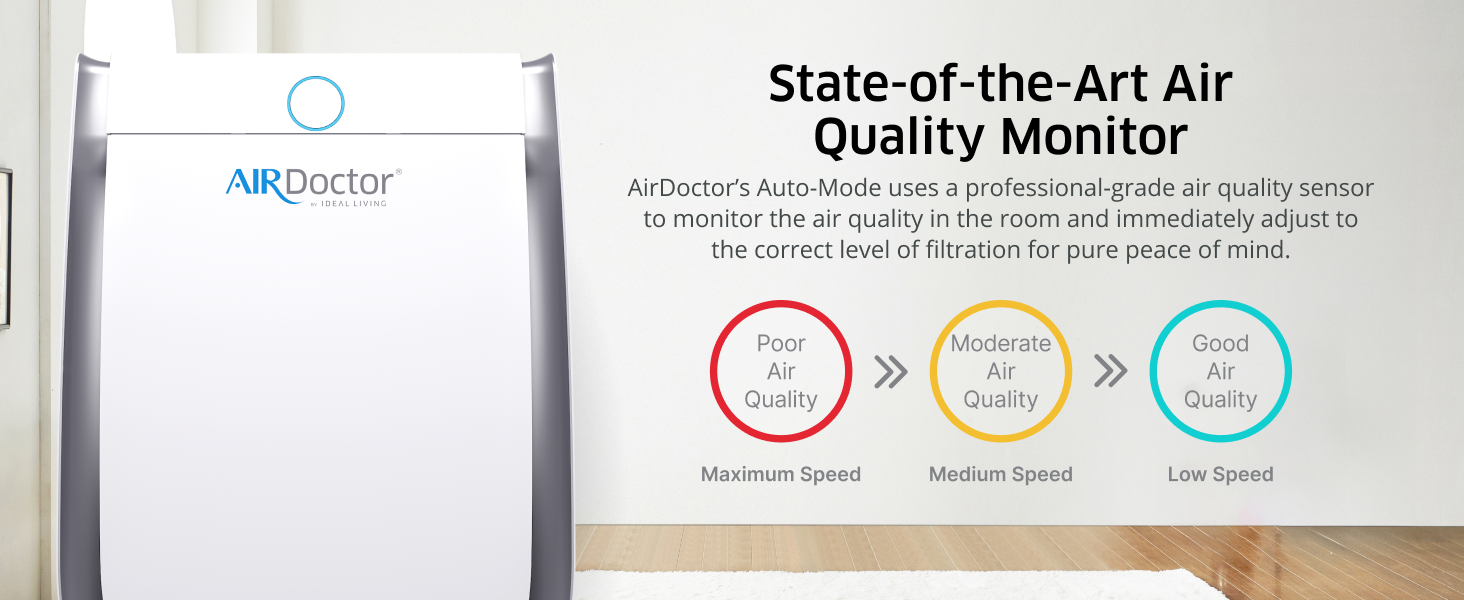
- Sensor-driven automation becomes useful only if you trust it enough to leave it alone.
This drift shows up in owner sentiment. Customer feedback cited by Live Science was broadly positive, with a 4.7/5 Amazon rating and 84% five-star reviews, and praise often centered on strong cleaning, quiet operation, and useful large-room performance. At the same time, negative feedback included complaints about odors from the unit and poor customer service, while Reddit discussion added a recurring note of caution around longevity and support outside warranty windows.
That mixed pattern tells me the AD3500 is not selling fantasy. It is selling a real performance tier with real ownership friction. For a serious purifier, that is often a healthier sign than universal praise.
The Memory Imprint That Actually Matters
The cleanest way I can put it is this:
An air purifier becomes truly effective when the airflow you can live with is still strong enough for the room you actually have.
That is the threshold.
Not the prettiest shell.
Not the biggest coverage claim.
Not the most dramatic filtration phrase.
The threshold is whether the machine’s usable behavior still clears the air fast enough after the novelty wears off.
That is why the right next question is not “Is the AirDoctor AD3500 impressive?” It is “Who actually crosses the threshold with it, and who does not?”
Transparency Note:
This analysis is not based on quick personal impressions.
It is derived from documented system behavior, verified user patterns, and the physical constraints of storage capacity.
The goal is to translate complex technical behavior into a realistic performance model that helps you make a clear decision