SWITCHBOT S20 REVIEW: YOUR FLOOR LOOKS CLEAN. THE MOP WATER SAYS OTHERWISE.
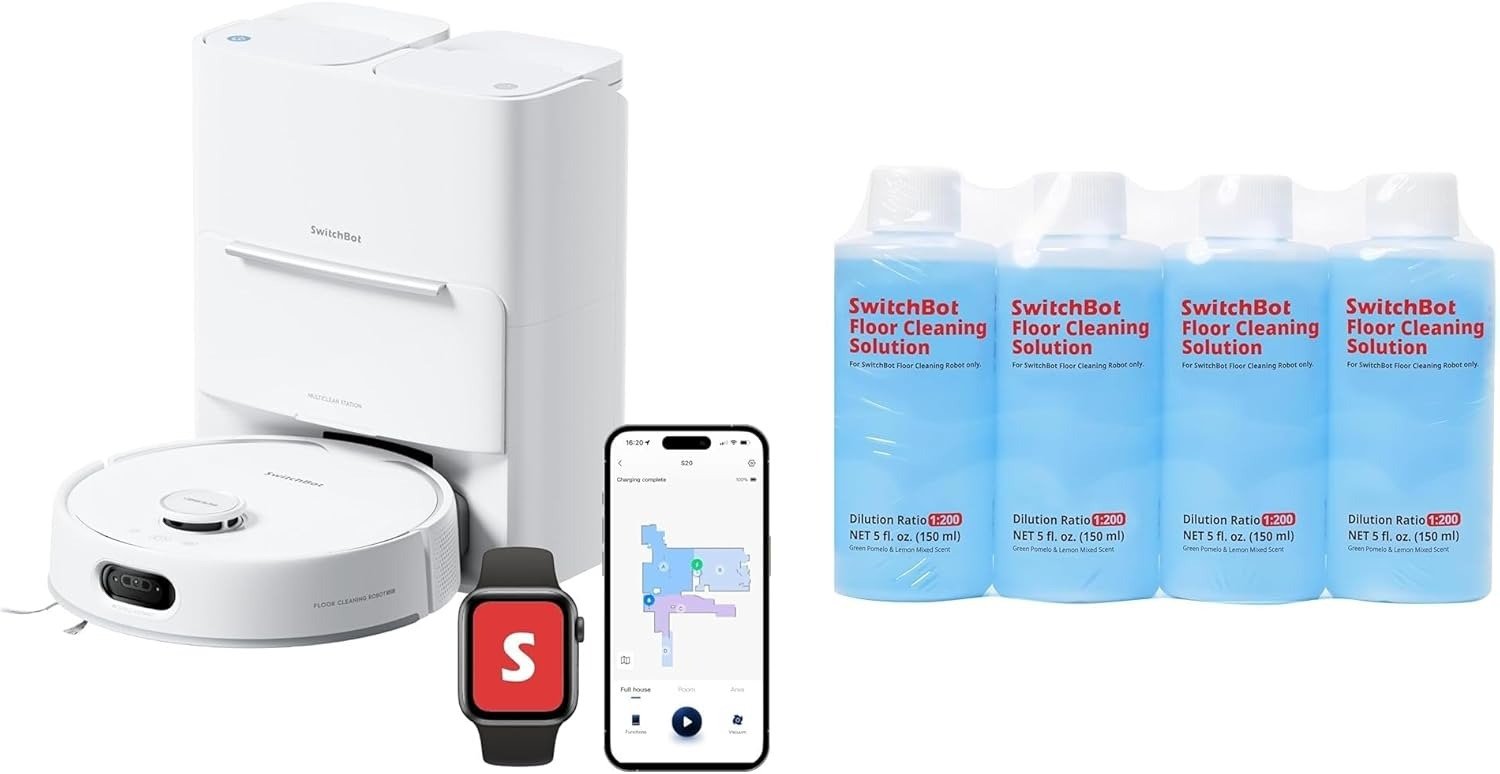
SWITCHBOT S20
I used to feel accomplished after mopping. The floor would shine, the house would smell like lemon cleaner, and I’d tell myself the job was done properly. Then one evening I actually looked into the bucket. The water wasn’t a little dirty — it was the color of weak coffee, and I had just dragged that exact water back and forth across every room in the house. That’s the moment the illusion breaks. A floor that looks clean and a floor that is clean are two different claims, and almost nobody checks which one they actually have.
This review exists because of that gap. I spent real time with the SwitchBot S20 (officially the SwitchBot Floor Cleaning Robot S20), cross-checked its numbers against independent testing, and read through what actual owners say once the new-gadget excitement wears off. What follows is the honest version — where this robot earns its price, where it doesn’t, and who should genuinely walk past it.
Robot Vacuum Mopping Problem: The Result Looks Fine. The Problem Isn’t.
Here’s the uncomfortable part of owning any mop, robot or human-powered: most of them don’t clean your floor so much as relocate the dirt on it. A flat pad or a cotton head picks up grime in one spot, carries it a few feet, and presses it back down somewhere else. The floor dries and looks even. Your eyes report success. Your feet, walking sockless past the fridge an hour later, sometimes report something else entirely.
Why does this keep happening even to people who mop often? Because “clean” gets judged visually — no streaks, a nice shine under the kitchen light — while the thing that actually matters, the water doing the lifting, never gets inspected. It’s the same reason a hotel room can look spotless and still not be one you’d want to see under a blacklight.
Robot Vacuum Daily Frustration: What You’re Feeling but Never Named
If you already own a basic robot vacuum with a mop attachment, you know a version of this feeling. You run it, the app shows a satisfying green checkmark, and the floor is dry within the hour. But there’s a nagging sense that you’re not actually finished — that you’ve just bought yourself a day or two before the film comes back, a little duller than before.
That’s not you being paranoid. That’s maintenance dread with no name attached to it — the quiet math you do before guests arrive: did I actually clean, or did I just make it look done in time? Naming that feeling matters, because it’s the entire reason the mopping category on robot vacuums exists, and it’s the exact gap the S20 was built to close.
Roller Mop vs Spinning Pads: The Hidden Mechanism Behind the Miss
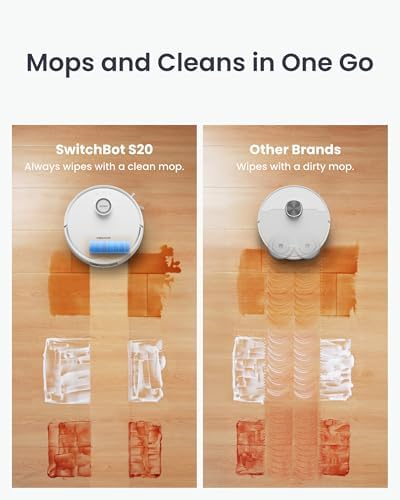
Most robot mops spin a pad or drag a cloth. It gets wet once, maybe gets a light rinse mid-cycle on nicer models, and otherwise works with whatever water it started with. Every square foot after the first gets a slightly dirtier pass than the one before it.
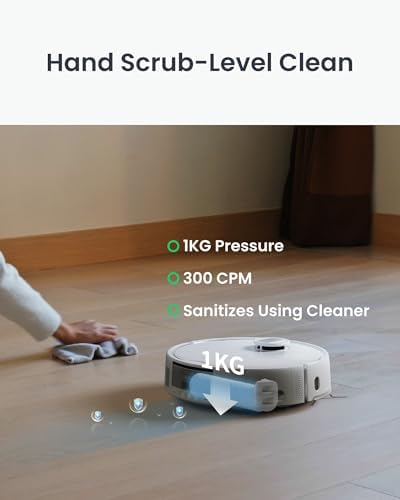
The S20 takes a different physical approach, called RinseSync™. Instead of a pad, it uses a rotating roller continuously fed clean water and scrubbed against a scraper bar as it turns — about 300 scrub cycles per minute, with roughly a kilogram of downward pressure doing the work. The dirty water gets siphoned into a separate tank in real time, so the roller touching your floor right now is close to the same cleanliness as the one that touched it thirty seconds ago. Small mechanical difference, large practical consequence: the floor isn’t just drying clean — the water doing the work stays clean too.
Quick spec snapshot, so you’re not taking my word for any of this:
| Spec | SwitchBot S20 |
|---|---|
| Suction power | 10,000 Pa |
| Mop system | RinseSync™ self-rinsing roller, ~1kg pressure, 300 scrubs/min |
| Navigation | LiDAR (LDS) + AI camera obstacle avoidance |
| Battery | 4,000mAh — up to 180 min vacuum-only, ~100 min combined vacuum+mop |
| Noise level | 60dB quiet mode, up to 69dB at max power |
| Auto-empty interval | Up to 90 days |
| Smart home | Matter 1.4, Apple Home, Alexa, Google Home, Home Assistant |
| Max threshold climb | 20mm (0.8 in) |
| Footprint | 365 x 365 x 115mm, ~5.5kg |
| Price | $799.99 MSRP; commonly discounted to $448–$550 |
| Warranty | 1 year (US) |
Suction Power and Carpet Cleaning: Where the Outcome Quietly Breaks
Here’s a threshold worth naming before you buy, because satisfaction quietly splits in two right here. At full 10,000Pa, the S20 pulls embedded dirt out of carpet convincingly. Drop it a notch to save battery or cut noise, and surface fluff still disappears — but the deeper, ground-in dirt in the fibers doesn’t move. Visually, both settings look like “done.” Only one of them actually is.
If your home is mostly hard flooring with a couple of low-pile rugs, this barely matters. If you’ve got kids, dogs, and wall-to-wall carpet in the bedrooms, it matters quite a bit — you’ll want carpet zones running at max suction, which also means more noise and shorter runtime there.
10,000Pa Suction Explained: Why Most Buyers Misread This Number
Every listing leads with its Pa number like it’s the only spec that matters, and that habit causes more bad purchases than anything else in this category. Suction is one input among several — brush design, how close the roller sits to the floor, and how intelligently the robot maps a room shape the outcome just as much. Testers who’ve run multiple flagship robots back to back say the same thing: it’s genuinely hard to feel a difference between 8,000Pa and 15,000Pa in daily use, but very easy to feel the difference between a mop that rinses itself and one that doesn’t.
So if you’re cross-shopping by suction number alone, you’re solving the wrong equation. Ask what the roller is made of and how it stays clean mid-run before you ask how many Pascals it claims.
| What buyers assume | What actually determines the result |
|---|---|
| A higher Pa number means a cleaner floor | Brush design, roller contact, and mapping matter just as much |
| Any spinning pad “mops” the same way | A pad that never rinses just redistributes dirty water |
| The priciest robot is the smartest one | Price often buys app polish and sensors, not raw cleaning power |
Best Robot Vacuum for Pet Hair and Mixed Floors: Who This Is Actually For
Strip away the marketing and the S20 is built for a fairly specific household — naming that honestly is more useful than pretending it fits everyone.
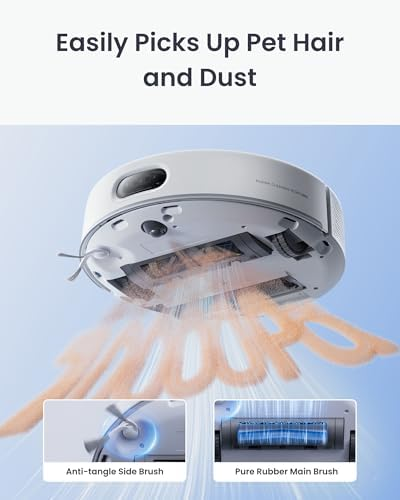
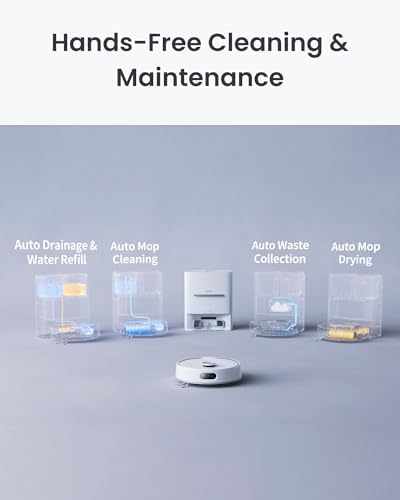
You’re likely a strong match if your floors mix hardwood, tile, or vinyl with some rugs — not wall-to-wall carpet. You’ve got a dog or cat shedding onto those floors and you’re tired of the anti-tangle brush on your last vacuum failing at its one job. You want a machine you touch every few months, not every few days — the 90-day auto-empty bag and tank system are built for that rhythm. And you’re either already living inside Apple Home, Alexa, or Google Home, or you want a robot that will slot into whichever one you pick, thanks to Matter 1.4.
SwitchBot S20 Noise and Size: Where the Wrong Fit Begins
None of this is worth much if I don’t also tell you where the S20 lets people down.
It’s a loud machine. Independent testing consistently puts it at 60–69dB depending on mode, and the self-empty cycle is sharp enough to interrupt a phone call in the next room. If the base station has to live near a bedroom or home office, that’s a real cost to weigh. It’s also physically large — 115mm tall and a full 365mm diameter, chunkier than several premium rivals that slide under lower furniture. Owners report it occasionally leaving its dock on its own in the evening to attempt a redock, for reasons that aren’t fully explained. And thresholds above roughly 20mm can trap it; rather than giving up and alerting you, it keeps trying until the battery dies, so a home with several tall thresholds means occasionally hunting down a stranded robot.
Edge and corner cleaning is another honest weak point — there’s no extending side arm like some competitors offer, so dust along baseboards can lag behind the rest of the floor.
| You’re a good fit if… | Look elsewhere if… |
|---|---|
| Your floors are mixed hardwood/tile with some rugs | Your home is nearly all deep-pile carpet |
| You want mopping that doesn’t just smear dirt around | You need whisper-quiet operation near a bedroom or office |
| You’re on Apple Home, Alexa, or Google Home already | Your doorways have thresholds taller than 20mm |
| You’re fine emptying a bag every 90 days, not daily | You need spotless corners with zero manual follow-up |
| You can catch it at a discount, not MSRP | You want the single quietest robot on the market at any price |
SwitchBot S20 Review: The One Situation Where It Becomes the Logical Choice
Put those two tables side by side and the decision usually sorts itself out without much persuading. If your actual daily problem is dirty mop water being pushed around your floor instead of removed from it, and your home is the mixed-floor, moderate-threshold kind described above, the S20 solves a real, specific problem rather than adding a gadget for its own sake.
Price is part of that logic, not separate from it. The listed $799.99 is a premium-bracket number, but the S20 rarely sells at that price for long — discounts into the $450–$550 range show up often enough that waiting a week or two for one usually beats paying MSRP the day you decide.
SwitchBot S20 Pros and Cons: What It Solves, Reduces, and Still Leaves to You
| It solves | It reduces | It still leaves to you |
|---|---|---|
| Dirty mop water being redistributed across your floor | How often you touch the machine (up to 90 days between empties) | Refilling/emptying tanks weekly on the manual water version |
| Guessing whether a floor is sanitary or just dry | Manual scrubbing of stuck-on messes | Replacing the dust bag every 1–3 months |
| Juggling separate vacuum and mop routines | Daily decision-making about when to clean which room | Occasionally rescuing it from a tall threshold |
SwitchBot S20 Verdict: The Final Decision, Compressed
Strip away the spec sheet and this comes down to one question: is your actual frustration the vacuuming, or is it the mopping — specifically, not trusting that “looks clean” means “is clean”? If it’s the second one, and your home matches the mixed-floor profile above, the SwitchBot S20 is solving the problem you actually have, not the one the marketing usually assumes you have.
If dirty mop water is the part that’s been bothering you, this is where the decision stops being vague:
SwitchBot S20 Review: Frequently Asked Questions
| Question | Answer |
|---|---|
| Is the SwitchBot S20 worth it at full price? | At $799.99 MSRP it’s a harder sell. At its common discounted price of $450–$550, the value case is much stronger. |
| How loud is the SwitchBot S20? | Around 60dB in quiet mode, up to 69dB at max suction, with the self-empty cycle being the loudest single moment. |
| Does it work with Apple HomeKit? | Yes, via Matter 1.4, alongside Alexa, Google Home, and Home Assistant. |
| How often do I need to handle the water tanks? | Roughly once a week on the manual tank version; the plumbed Auto-Fill & Drain version removes this step entirely. |
| Can it handle high thresholds or thick rugs? | It climbs up to 20mm comfortably. Taller thresholds can trap it, and thick carpet needs max suction to clean past the surface layer. |
| SwitchBot S20 vs Roborock — which is better? | Roborock’s flagship models generally navigate and vacuum slightly better; the S20 wins on hands-off maintenance and mopping hygiene, at a noticeably lower price. |
Transparency Note:
This analysis is built on aggregated real-world experience.
It extracts what repeatedly holds, what breaks, and what users uncover only after living with the system—then shapes it into a clear model you can use immediately.
Think of it as structured experience, refined and presented so you don’t have to learn it the hard way.
“A quick note: Don’t believe the star ratings, but trust personal experience. This article is a compilation of collected experiences”