BlueDri AS-550 Review: The Air Scrubber That Doesn’t Forgive Wrong Assumptions
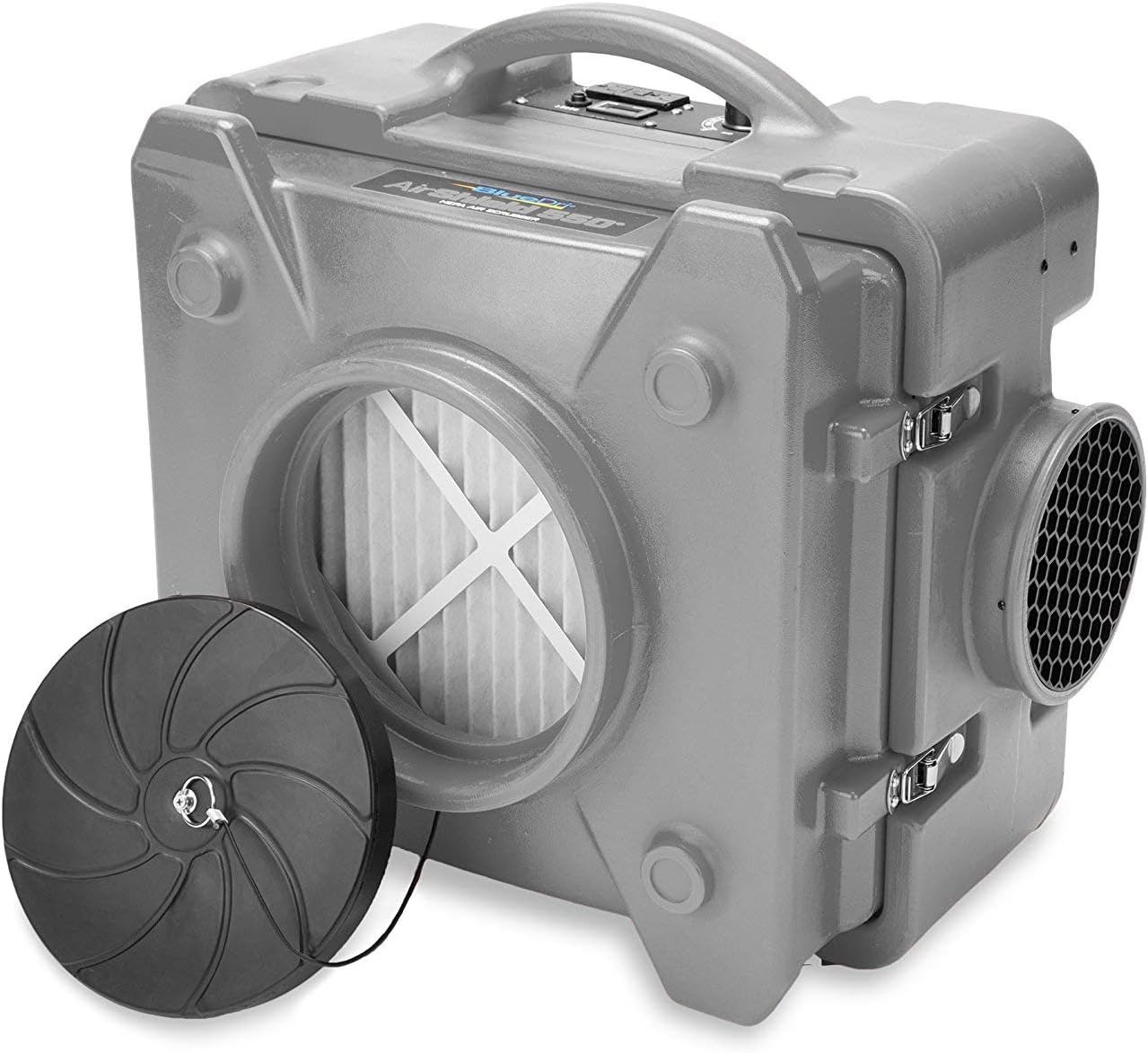
BLUEDRI AS-550
BlueDri AS-550 Performance Results: The Result Looks Fine. The Problem Isn’t.
I plugged in a regular home air purifier the morning after we found black mold running behind the drywall. The LED showed green. The room smelled neutral. Three weeks later, a remediation contractor walked in with a particle counter — and the air was still quietly contaminated in a way my nose had already stopped registering.
That failure pattern is the one most people never see coming. Not dramatic. Not obvious. Just an output that looks acceptable while the actual problem runs underneath it.
There is a category of air contamination — mold spores, demolition particulate, post-flood aerosols, silica from cut drywall — where consumer air purifiers don’t fail loudly. They process a fraction of the contaminated air, recirculate the rest, and display a reading that looks clean. The numbers say fine. The air isn’t.
The BlueDri AS-550 was designed for exactly that gap.
| Feature | Consumer Air Purifier | BlueDri AS-550 Air Scrubber |
|---|---|---|
| Airflow (CFM) | 50–150 CFM | 250–550 CFM (variable) |
| Air Changes/Hour (400 sq ft) | ~1–2 ACH | ~9 ACH |
| HEPA Efficiency | Varies by brand | 99.97% at 0.3 microns |
| Designed for Contamination Events | No | Yes |
| Negative Air Pressure Capable | No | Yes (with ducting) |
| Commercial Job Site Rated | No | Yes |
| Continuous Operation Design | No | Yes |
BlueDri AS-550 Noise and Real Specs: What You’re Actually Feeling but Not Naming
Why does the basement still feel heavy two days after the water extraction crew left? Why does your chest feel slightly tighter in the crawlspace even though the visible moisture is gone?
I’ve been in enough post-flood environments to recognize that sensation before I can put a number to it. There’s a dull, persistent weight in the air — the kind you stop noticing because it’s always there, the same way you stop hearing traffic outside your window after the first week.
What you’re dealing with is airborne particle density that hasn’t broken yet. The visible mess is gone. The particulate isn’t. And the only tool that changes this isn’t a machine with a quiet mode and a sleep timer — it’s one that can move 550 cubic feet of contaminated air through a True HEPA filter every single minute.
The AS-550 does that. At a volume that confirms it’s actually working.
| Operating Specification | Value |
|---|---|
| Maximum Airflow | 550 CFM |
| Minimum Airflow (low speed) | ~250 CFM |
| Noise Level at Full Speed, 1 meter | ~75 dBA |
| Motor | 1/3 HP |
| Dimensions | 15.25″ × 24″ × 23″ |
| Weight | ~39 lbs |
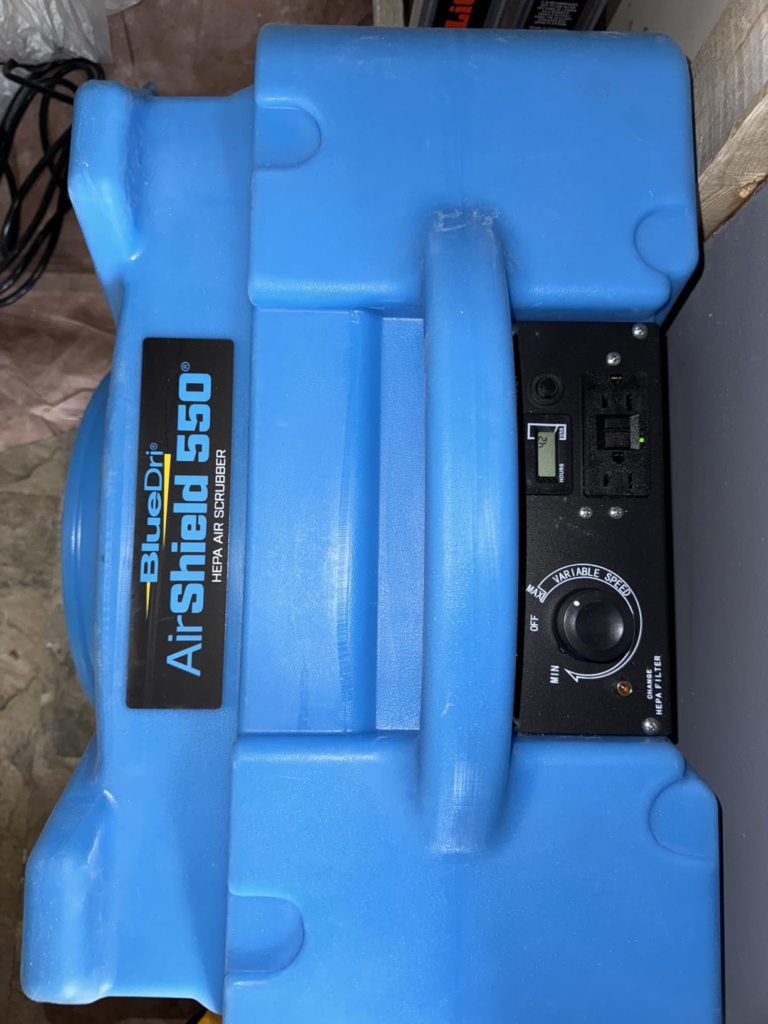
| Filter Change Alert | LED indicator |
| Runtime Tracking | Built-in hour meter |
| Power Connection | Daisy-chain GFCI port |
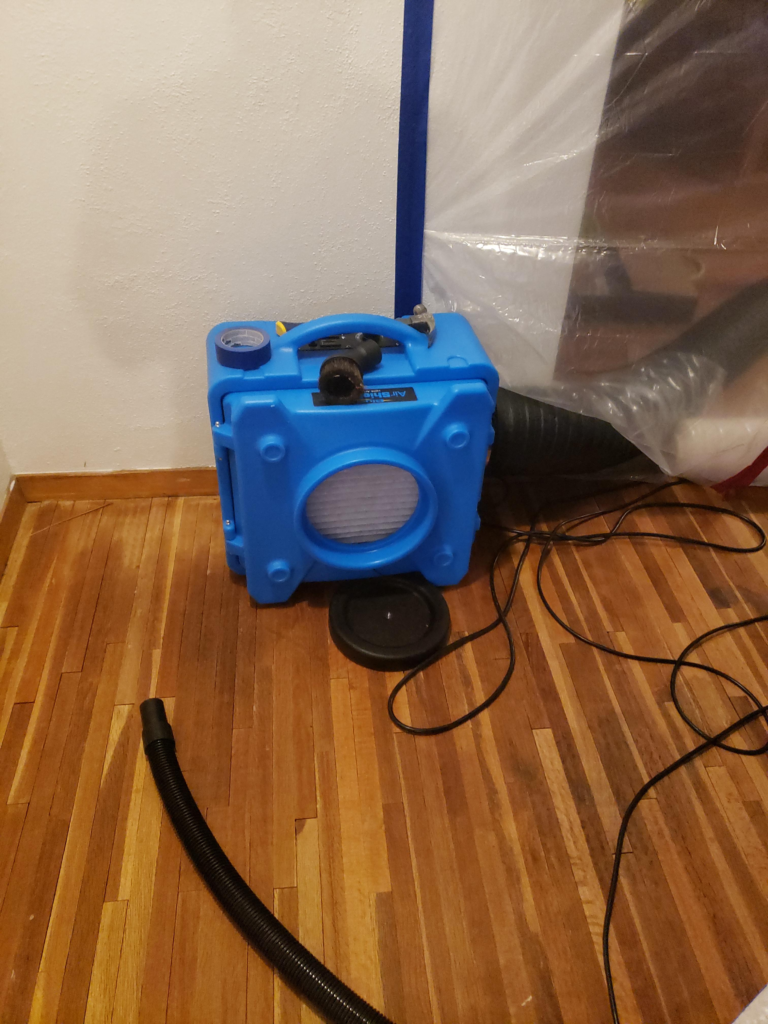
At 75 dB at one meter, this machine sounds like a vacuum cleaner running in the adjacent room. You cannot hold a normal conversation next to it at full speed. What most experienced owners discover is that routing exhaust through industrial ducting carries the wind noise away from the work zone — the area becomes significantly more manageable, and the sound travels to wherever the duct terminates.
That’s not a design flaw. That’s how industrial air management actually works.
BlueDri AS-550 Filtration System: The Hidden Mechanism Behind the Miss
Most air purifiers fail in contamination events not because they’re broken — but because they were engineered for a different density of problem.
Here’s the mechanism. A standard residential air purifier in a 400 sq ft room performs roughly 1–2 air changes per hour. In a clean apartment managing ordinary household dust, that’s sufficient. In an active mold remediation zone, a post-flood drying environment, or a space where drywall is being actively cut, that rate doesn’t touch the contamination rate. Particles are being re-aerosolized faster than the machine can process them.
The AS-550 achieves approximately 9 air changes per hour in that same 400 sq ft space. That difference isn’t incremental. It’s structural.
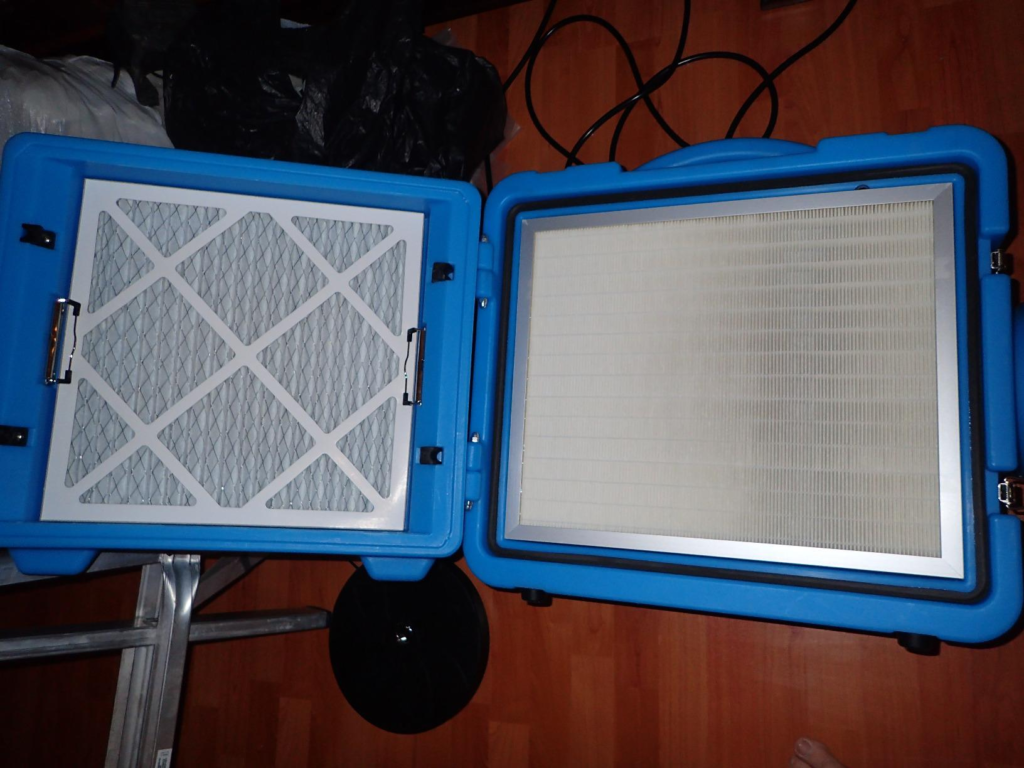
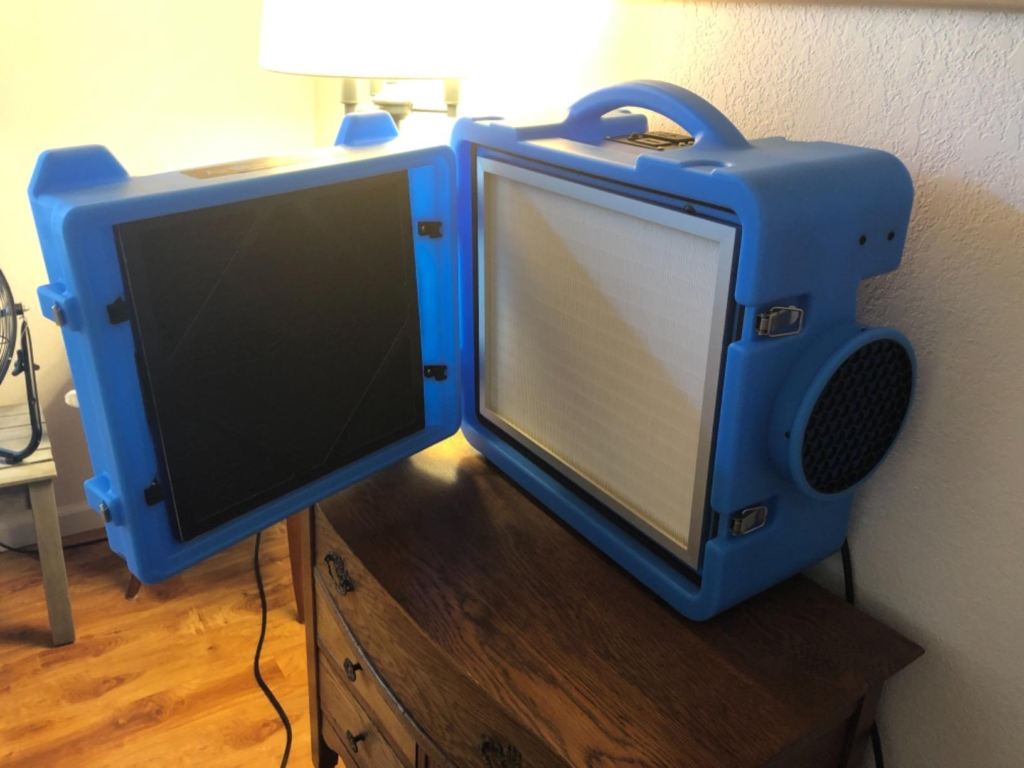
| Filtration Stage | What It Captures | Role in the System |
|---|---|---|
| Stage 1 — Pre-Filter | Large particles: drywall dust, pollen, lint, construction debris | Guards the HEPA from premature saturation |
| Stage 2 — True HEPA Filter | 99.97% of particles ≥ 0.3 microns: mold spores, silica, allergens | Core contamination arrest |
| Stage 3 — Carbon Filter (optional, not included) | VOCs, smoke odors, paint vapors, chemical fumes | Odor and chemical vapor control |
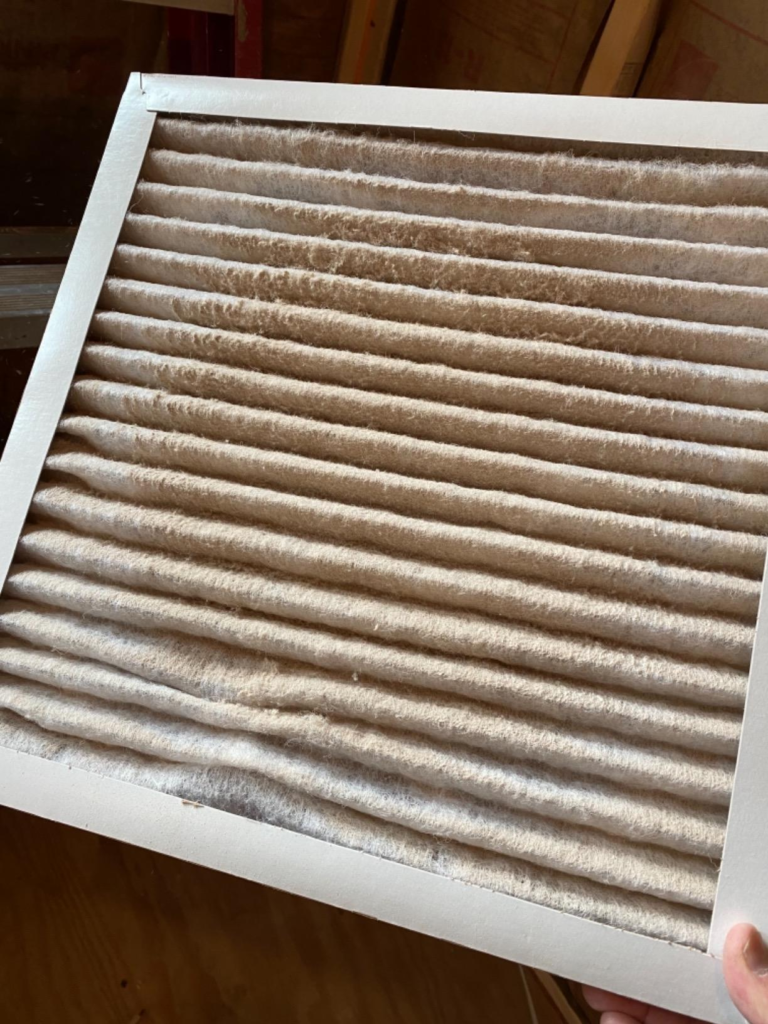
Why does the pre-filter matter as much as the HEPA in heavy environments? Because in active contamination — a bathroom with visible mold growth, a flooded basement mid-dry-out, a workshop running continuous drywall cuts — the HEPA filter would saturate in hours without it. One owner logged over 300 hours on the machine before the HEPA indicator light came on. The pre-filter needed replacement well before that point.
This progressive filtration architecture is what separates the AS-550 from household units. Not the HEPA specification alone. The system — the ability to sustain that specification under real contamination load over real time.
BlueDri AS-550 CFM and Coverage: The Threshold Where the Outcome Quietly Breaks
There is a specific density point — I call it the contamination threshold — where air quality stops being a comfort problem and becomes a containment problem.
Below that threshold, ventilation and routine purification can handle it. You open a window. You run a decent residential unit. The air improves within a day or two.
Above that threshold, those tools don’t fail loudly. They just stop mattering. The particle count stays elevated. Mold spores keep cycling. Silica dust stays in suspension. The person working in that space keeps breathing it — not because the purifier is off, but because its airflow is structurally insufficient to turn over the contaminated volume fast enough.
The AS-550’s effective threshold: any space where a visible contamination event is active — demolition, mold discovery, flood recovery, fire restoration — within a target area up to 1,400 square feet.
| Coverage Scenario | Required CFM | AS-550 Performance |
|---|---|---|
| Single contaminated room (200–400 sq ft) | 200–400 CFM | Excellent — ~9+ ACH |
| Medium remediation zone (400–800 sq ft) | 400–600 CFM | Strong — 4–5 ACH |
| Large contaminated area (800–1,400 sq ft) | 600–900 CFM | Adequate — 2–3 ACH |
| Industrial or multi-room site (>1,400 sq ft) | 900–2,000+ CFM | Insufficient — multiple units required |
One unit handles one serious room well. The built-in GFCI daisy-chain port means multiple AS-550 units can be linked on the same circuit for larger sites — stackable during transport, chainable during operation — without running separate extension lines across the job.
BlueDri AS-550 vs Dri-Eaz HEPA 500: Why Most Buyers Misread This Too Early
Why do people buy the AS-550 expecting a premium home air purifier and then feel let down?
Because the product listing mentions “homes, schools, and hospitals.” That phrase lands in a buyer’s mind as: this is a high-end purifier for sensitive environments. They picture a quiet bedroom. They picture manageable daily use. They imagine their allergy symptoms improving throughout the week.
What the AS-550 actually is: a portable commercial air scrubber that becomes the right tool in a home when that home has an active contamination event in progress.
The comparison trap is measuring it against residential air purifiers on noise and convenience. It loses that comparison every time. 75 dB is incompatible with a bedroom. 39 lbs is too heavy for casual daily repositioning. No app, no Wi-Fi, no sleep mode, no quiet setting.
But compare it where it was actually built to compete:
| Metric | Dri-Eaz HEPA 500 | BlueDri AS-550 | VEVOR 550 CFM |
|---|---|---|---|
| Maximum CFM | 500 | 550 | 550 |
| Filtration Stages | 2 | 2–3 (carbon optional) | 3 |
| Roto-Mold Housing | Yes | Yes | No |
| Daisy Chain Port | Yes | Yes | Varies |
| Hour Meter Display | Yes | Yes | No |
| Approximate Price Range | $500–$900 | $400–$700 | $250–$400 |
| Housing Warranty | 5 years | 5 years | 1 year |
| Pre-Filter Accessibility | Easy | Moderate | Easy |
The AS-550 sits solidly mid-tier by professional restoration standards — above budget clones, below the Dri-Eaz premium line. One verified buyer purchased it specifically as a “cheaper alternative to the Dri-Eaz HEPA 500,” used it on a professional-grade restoration project, confirmed it handled the job, and noted only that pre-filter changes were slightly less convenient than on the Dri-Eaz.
That’s the honest placement. Not the strongest machine in its class. A reliable, durable performer for the specific contamination work it was designed to do.
BlueDri AS-550 Ideal Users: Who Is Actually Inside This Problem
I keep encountering a predictable set of people when this machine becomes the right answer.
The restoration contractor handling three to five flood jobs a month who needs a scrubber that won’t saturate its HEPA in a single eight-hour shift. The homeowner who opened a wall during renovation and found black mold running deeper than expected, and now needs the spore count managed while the remediation happens around them. The renovation company cutting drywall in an occupied building who needs to control dust migration between floors — not as a preference, but as a liability boundary. The crawlspace crew spending six hours under a house who wants the air at the source to be something other than a sustained exposure risk.
What all of these people share is not a desire for better ambient daily air. They need air containment during a defined event.
| User Type | Why the AS-550 Fits |
|---|---|
| Water damage restoration crews | 550 CFM handles post-flood particulate load; daisy chain enables multi-unit coverage on one circuit |
| Mold remediation specialists | Negative air mode via ducting; True HEPA captures spores continuously at 99.97% |
| Renovation and demolition contractors | Pre-filter handles heavy debris load; hour meter tracks exact maintenance intervals |
| Crawlspace and attic workers | Portable and stackable; can be placed directly at the contamination source |
| Homeowners in active mold or flood remediation | Designed for continuous operation; pre-filter prevents rapid HEPA saturation under load |
| Painters and coaters in enclosed spaces | With carbon add-on: VOC and fume control in poorly ventilated environments |
The common thread across every row is the word event. Not routine. Not maintenance. A specific contamination event with a defined start, a known cause, and a measurable end condition.
BlueDri AS-550 Wrong-Fit Scenarios: Where Wrong-Fit Begins
Here’s where the product page doesn’t serve the buyer clearly enough, and where I’ll be direct.
If you’re buying the AS-550 because your allergies are bothering you in your apartment, this is the wrong machine. Not because it won’t clean the air — it will. But you’ll run it at 75 dB in a bedroom and sleep badly, the pre-filter replacement schedule will outlast your patience by week three, and a purpose-built residential unit would have managed your actual problem at a fraction of the ongoing cost and none of the noise.
If you’re buying it because your HVAC isn’t keeping up with daily dust load and you want better daily indoor air quality — same answer. A consumer unit from Blueair, Coway, or similar handles routine residential air quality at a fraction of the noise and maintenance burden.
| Wrong-Fit Scenario | Why It Fails Here |
|---|---|
| Daily bedroom or living room air quality | 75 dBA too loud; no quiet mode; overkill for routine residential particulate levels |
| Mild seasonal allergy management | Poor cost-to-benefit compared to purpose-built consumer units designed for this |
| Small office daily air quality | Noise disrupts normal conversation; size and weight impractical for frequent repositioning |
| Light dust from occasional cleaning or cooking | Pre-filter saturates disproportionately to the actual particle load |
| Odor control without carbon filter purchase | Carbon filter not included; odor performance without it is limited |
The regret profile is consistent: a buyer purchases this thinking it’s a heavy-duty home air purifier, spends the next month frustrated by the noise, discovers the ongoing filter cost, and ends up with a 39-pound machine occupying floor space it can’t justify.
Annual filter costs in demanding environments run $250–$800 depending on contamination intensity and frequency of use. In a clean home with low particulate load, that number drops — but so does the justification for owning the machine in the first place.
BlueDri AS-550 HEPA Air Scrubber: The One Situation Where This Product Becomes Logical
If you’ve ever been in a basement two days after a flood — the air still carrying that heavy, metallic-sweet smell that sticks to your jacket, the particle density catching the beam of a flashlight in a way that’s hard to ignore — you know the exact situation I’m describing.
Or on a mold remediation job where a contractor has opened the wall cavity and the spore count in the room is being actively managed in real time. Or doing drywall installation in a building where other floors are still occupied and dust containment isn’t optional — it’s the difference between a clean job and a callback.
In those situations, the AS-550 stops being a choice and becomes the obvious tool.
It delivers 550 CFM through a True HEPA filter. It can be configured as a negative air machine — pulling contaminated air out of a contained zone through ducting and exhausting it away from the work area — which is the standard protocol for mold remediation containment. It runs continuously without burning through its HEPA filter because the pre-filter is absorbing the bulk of the debris load first. The hour meter logs every operating hour so you know exactly when maintenance is due. The LED indicator flags pre-filter replacement before the HEPA takes the damage.
At $400–$700, the economics close quickly: daily commercial equipment rental rates for equivalent air scrubbers run $80–$150. A two-week remediation project costs more to rent than to own.
That is the moment of logical authorization. Not “I want cleaner air.” It’s “I have a contamination event and I need a machine that can manage it at commercial throughput.”
BlueDri AS-550 Pros and Cons: What It Solves, What It Reduces, and What It Still Leaves to You
The difference between a tool that earns trust and one that creates resentment is almost always calibration. Here’s the honest accounting.
What the AS-550 solves: Airborne contamination density in spaces up to 1,400 sq ft during active remediation or construction events. Mold spore concentration during containment protocols. Fine silica and drywall dust in renovation zones. Post-flood aerosol load during drying phases. Smoke and fume presence when the optional carbon filter is added.
What it reduces: Long-term particulate exposure risk for workers in heavy contamination environments. HEPA filter burn rate compared to single-stage filtration under the same load. Odor persistence — partially without the carbon add-on, significantly with it.
What it still leaves to you:
| Remaining Responsibility | What This Means in Practice |
|---|---|
| Pre-filter monitoring and replacement | Replace on a regular schedule in high-load environments — don’t wait for the HEPA indicator light |
| Carbon filter sourcing | Sold separately; necessary for any job involving odors, paint vapors, smoke, or VOCs |
| Source contamination removal | The machine manages airborne particles — mold on a surface requires physical remediation separately |
| Noise management in occupied spaces | Use industrial ducting to redirect exhaust and wind noise away from the work area |
| Coverage scaling for large sites | One unit is effective for ~1,400 sq ft; larger sites require multiple daisy-chained units |
The AS-550 is not a remediation plan. It is one component of one. Mold on the structure still requires physical removal and moisture source correction. The machine controls the airborne dimension of the problem while that other work happens.
Buyers who understand this boundary use the machine correctly and don’t regret it. Buyers who expect it to resolve the full problem on its own end up disappointed — not because the AS-550 failed, but because they misjudged what the machine’s job was.
BlueDri AS-550 Review — Final Compression
Here is the single honest sentence that contains everything above:
The BlueDri AS-550 is a commercial-grade portable air scrubber that performs exactly as designed inside active contamination events — mold remediation, flood restoration, demolition dust control, fire damage recovery — and performs poorly as a substitute for a residential air purifier in a quiet daily-use living space.
If you’re managing a contamination event in a space up to 1,400 sq ft, the logic is straightforward: the airflow holds up, the filtration system was built for sustained load, and the buy-versus-rent economics close within a single project.
If you’re buying this for daily home air quality, the decision belongs elsewhere. A purpose-built residential unit handles your actual problem with less noise, simpler maintenance, and lower long-term cost.
For everyone inside the right problem: this machine becomes obvious once the contamination threshold becomes visible. The decision stops being uncertain the moment the problem becomes concrete.
Frequently Asked Questions — BlueDri AS-550 Review
| Question | Answer |
|---|---|
| Is the BlueDri AS-550 actually worth it for home use? | Only if “home use” means an active event — mold, flooding, or renovation with heavy particulate. For routine daily residential air quality in a clean space, it’s oversized, too loud, and carries higher ongoing filter costs than purpose-built consumer units designed for that use case. |
| How loud is the BlueDri AS-550 in real conditions? | At full speed with no ducting, independently measured at approximately 75 dBA at one meter. That’s comparable to a vacuum cleaner running in the adjacent room. At lower speeds, fan noise drops but a motor hum may become more noticeable. Routing exhaust through industrial ducting moves most of the wind noise to the duct terminus — a practical solution for occupied work areas. |
| Does the AS-550 come with a carbon filter? | No. The unit ships with the pre-filter and HEPA filter only. The carbon filter is a separate purchase and is essential for applications involving odors, paint vapors, chemical fumes, or smoke. |
| What does annual maintenance cost look like? | In demanding environments — daily job site operation or extended remediation — expect $250–$500 per year for filter replacement. Heavy industrial use can push costs toward $800 annually. Third-party HEPA replacements (16 × 19 × 2 inches, F301H-compatible) are widely available at significant savings over OEM pricing. |
| Can the AS-550 be configured as a negative air machine? | Yes. With a separate 8-inch outlet and 12-inch inlet industrial duct, the AS-550 can pull contaminated air out of a contained zone and exhaust it away from the work area. This is the standard setup for mold remediation containment protocols and the configuration most professional crews rely on. |
| How does the BlueDri AS-550 compare to the Dri-Eaz HEPA 500? | The AS-550 offers slightly higher maximum CFM (550 vs. 500) at a lower price point. The Dri-Eaz wins on pre-filter accessibility and overall ease of routine maintenance. For professional crews cycling the machine through multiple jobs per week, the Dri-Eaz is often the preferred choice. For single-project owners or smaller restoration operations, the AS-550 delivers comparable core performance at a meaningful price difference. |
| What does “1,400 sq ft coverage” actually mean in real conditions? | In a single contaminated room of 400 sq ft, the AS-550 achieves approximately 9 air changes per hour — highly effective for active contamination control. At 1,400 sq ft, that drops to around 2 air changes per hour, adequate for maintenance air quality but insufficient for heavy active contamination. Scale your deployment to contamination density, not just square footage. |
| Can multiple AS-550 units be connected together on one site? | Yes. The built-in GFCI daisy-chain port is specifically designed for this. Multiple units can be linked in sequence on the same circuit — the intended solution for large-area coverage or high-intensity contamination environments that exceed a single unit’s effective throughput. |
Transparency Note:
This analysis is built on aggregated real-world experience.
It extracts what repeatedly holds, what breaks, and what users uncover only after living with the system—then shapes it into a clear model you can use immediately.
Think of it as structured experience, refined and presented so you don’t have to learn it the hard way.
“A quick note: Don’t believe the star ratings, but trust personal experience. This article is a compilation of collected experiences”