Why Robot Vacuums Feel “Inconsistent” (It’s Usually Not Random—It’s a Variance Window)
ANALYSIS FRAMEWORK
There’s a moment I’ve learned to recognize: I look down at the floor after a “successful” robot run, and it’s almost clean—yet somehow not satisfying. A few crumbs remain near the baseboard. A strip of pet hair survives at the rug edge. The mop pass leaves faint streaks in one room and does nothing in another.
At first, it feels like randomness.
But after digging into how modern robot vacuum–mop combos are built—and how people describe their real-life weeks with them—I stopped calling it “random.” What most of us experience is a variance window: a measurable performance band that stays stable under certain usage loads, then compresses under heavier patterns until the same robot feels inconsistent.
And once you see the window, you can predict the drift.
The Core Mechanism Most People Miss: “Performance Is a Range, Not a Point”
A robot vacuum isn’t a single behavior. It’s a stack of subsystems that each has its own tolerance:
- navigation precision (how it decides where to go),
- suction and airflow stability (how it pulls debris),
- brush/roller behavior (how it moves debris into airflow),
- dust handling (how it stores and ejects debris),
- and, if it mops, contact physics (how much pressure and water control it can actually apply).
When any one layer drifts—slightly—your results vary.
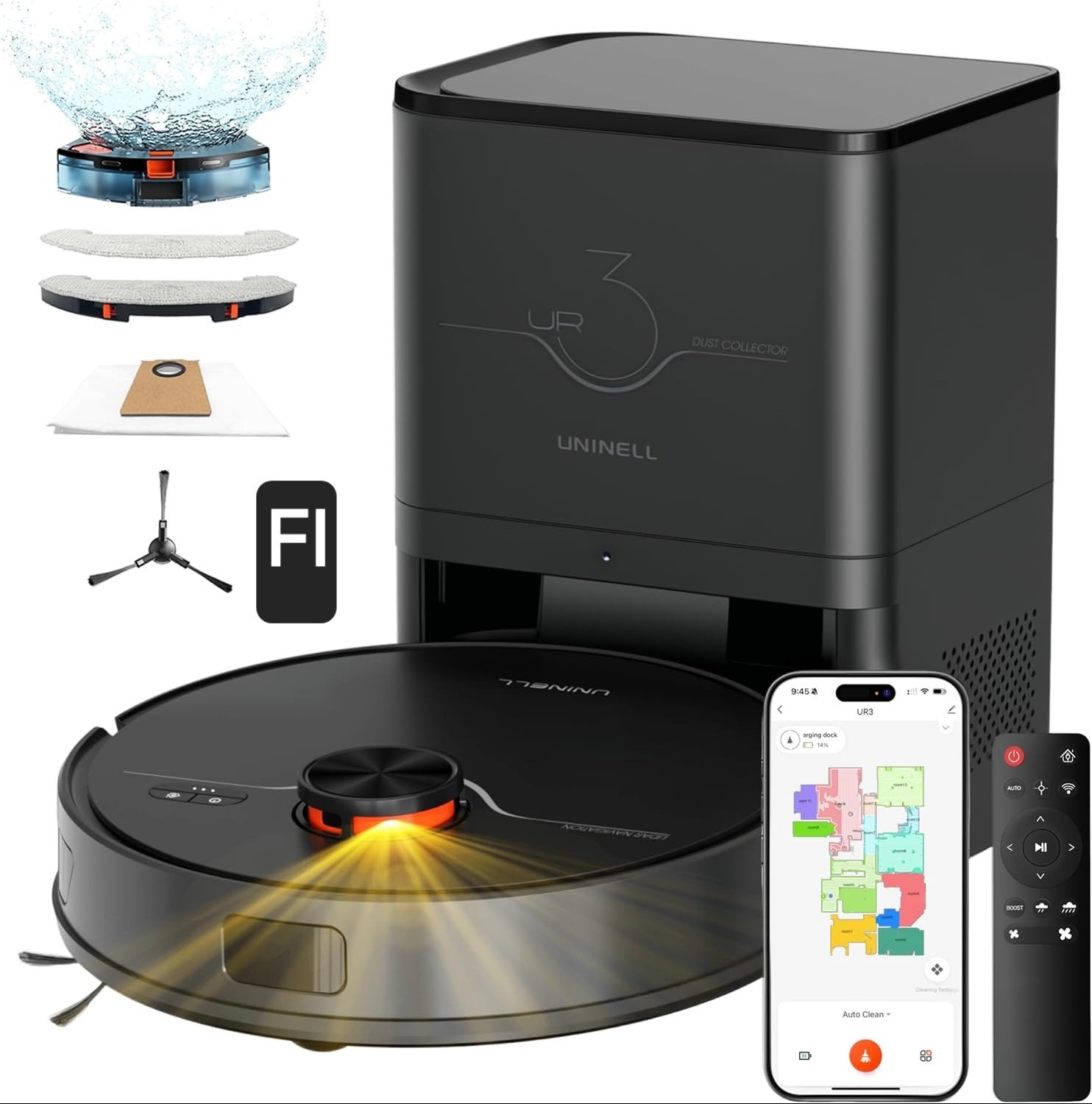
That’s why models that emphasize LiDAR mapping + room-level control + no-go/no-mop zoning often feel more “stable” in the early stage: they reduce navigation variance first. The uninell UR3 class, for example, is positioned around 360° LiDAR mapping, multi-floor maps (up to 5), no-go/no-mop zones, and room selection, which is exactly the set of tools that reduces the “random walk” problem.
But navigation stability doesn’t automatically mean cleaning stability—because cleaning drift is usually caused by load.
The 4 Places Variance Is Born (Even When the Robot Is “Working Fine”)
Variance Source #1 — Edge Physics (The Baseboard Strip That Keeps Surviving)
If you’ve ever watched your robot approach a wall, you’ve seen the truth: it doesn’t clean edges the way you do.
Humans press a nozzle into corners. Robots glide. Even with “edge cleaning” claims, the result is constrained by:
- side brush reach,
- chassis clearance,
- the suction mouth geometry,
- and how confidently the robot hugs edges without collision.
LiDAR helps here indirectly: with methodical mapping, it’s less likely to “panic bounce” away from edges and more likely to run consistent wall-follow passes. Users often describe this as the robot weaving around chair legs rather than charging into them—exactly the behavioral difference that reduces missed strips.
But corners are still a physics problem. So edge variance is often the first “inconsistency” people notice—because it’s visible.
Variance Source #2 — Carpet Transitions (Auto-Boost Helps, But It Also Reveals Drift)
Carpets are where robot vacuums get exposed.
On hard floors, even moderate suction looks good. On carpet, the same suction suddenly feels weak unless the robot:
- detects the carpet correctly,
- boosts suction reliably,
- and keeps the brush effective under fiber resistance.
The UR3-style spec stack explicitly leans on Auto Carpet Boost (with “200% increase” language) and high suction claims (7000Pa).
But here’s the hidden part: carpet boost can’t fix airflow loss caused by micro-clogs, filter loading, or hair wrapping. It can only increase motor demand. That’s why users report “great suction” early, then later describe runs that sound powerful but leave embedded debris behind—because the system is now compressing inside a narrower airflow window.
This is not “failure.” It’s performance compression under load.
Variance Source #3 — Hair Load (Where “Tangle-Free” Either Saves You… or Becomes Marketing)
Pet hair creates two kinds of drift:
- Brush wrap drift: the roller slowly becomes a hair rope, reducing agitation and pickup.
- Airflow drift: hair + fine dust load filters faster than you expect.
The UR3 positioning explicitly targets this with a tangle-free roller brush plus a self-emptying station designed to reduce daily maintenance.
And psychologically, this matters: when people buy a self-emptying robot, they are not purchasing suction—they’re purchasing friction removal. The promise is “I don’t have to think about it.”
So the moment it needs manual de-tangling, it feels like betrayal—even if the robot is still technically “working.”
That’s why the emotional complaints about robots often sound harsher than the mechanical issue itself.
Variance Source #4 — Mopping Reality (Mopping Is Not Cleaning Pressure—It’s Controlled Dampness)
This is where expectations destroy satisfaction.
A robot mop attachment is usually a damp pad being dragged with minimal downforce. Even happy owners on robot vacuum forums say it plainly: it’s closer to running a wet cloth than actually scrubbing.
So what makes it feel inconsistent?
- Water flow settings vary by room and floor type.
- The pad gets dirty mid-run and starts streaking.
- “No-mop zones” are necessary to prevent carpet contamination (and that creates patchwork coverage).
- If you run it less frequently, each run feels weaker because it can’t remove built-up grime in one pass.
The UR3 feature set actually supports the right behavior here (customizable water flow by room, no-mop zones), but the variance window still exists because mopping is inherently load-sensitive.
The Psychological Trap: Why Humans Call Variance “Randomness”
The Brain Doesn’t Track Load—It Tracks Betrayal
If I vacuum manually, I feel the resistance change. I adjust. I apply more passes where it’s dirty.
A robot removes my feedback loop.
So when the outcome differs, I don’t say: “Today’s debris profile and frictional load were higher.”
I say: “It’s inconsistent.”
That’s not irrational. It’s how humans judge systems they can’t “feel.”
Self-emptying models amplify this effect because they promise reduced friction for weeks (e.g., a 3.5L station marketed as ~90 days). When reality interrupts that promise—bag full sooner, hair wrap, a clogged filter—the disappointment is psychological before it’s technical.
The “First Week Halo” (Why Early Reviews Sound Like a Different Product)
In the first week:
- the filter is clean,
- the brush is fresh,
- the map is new and exciting,
- and you’re watching it like a gadget.
So early users describe smooth navigation, fast mapping, quiet operation, and “surprisingly strong suction.” That tone appears strongly in the Amazon UK sentiment blocks—easy setup, quick mapping, obstacle avoidance, value-for-money.
Weeks later, attention shifts:
You stop watching it.
You just notice what it missed.
The system is now working under accumulated micro-load.
This is where the variance window compresses, and “inconsistency” begins.
The Measurable Variance Window (A Simple Way I Now Predict My Own Outcomes)
Band 1 — Stable Window (Light-to-Moderate Load)
In this band, the robot feels “smart” and reliable.
Typical conditions:
- daily or near-daily runs,
- mostly hard floors,
- limited hair load,
- routine self-empty cycles,
- minimal wet mopping expectations.
This is where LiDAR navigation shines: methodical routes reduce missed areas, and room selection becomes genuinely useful.
Band 2 — Compressed Window (Moderate-to-Heavy Load)
Here the robot still “works,” but results vary by room.
Typical conditions:
- pets shedding heavily,
- rugs and carpet transitions,
- longer intervals between runs,
- mopping on kitchen grime,
- more obstacle clutter (cords, toys, chair forests).
The robot’s behavior often still looks correct (mapping is fine), but cleaning feels uneven because airflow and brush effectiveness start drifting.
Band 3 — Drift Window (Accumulated Micro-Load)
This is where people start saying: “It used to be great.”
Typical conditions:
- filter loading,
- roller wrap,
- dust path buildup,
- base station bag filling faster than expected,
- and higher debris density per run.
The robot becomes “inconsistent” not because its brain broke—but because the cleaning system is now operating inside a narrower effective range.
What People Praise vs. What They Complain About (Without Pretending Every Opinion Is a Fact)
What Praise Usually Signals (Tier 1 + Tier 2 Alignment)
When users praise a robot like this category, they usually praise:
- fast, accurate mapping and obstacle behavior (a LiDAR signature),
- hands-free convenience of a self-empty station (reduced daily friction),
- value-for-money compared to premium brands (expectation framing),
- and “quiet enough” operation (important for daily scheduling).
These align with Tier 1 experiences (what they felt) backed by Tier 2 explainers (why it happens: LiDAR, scheduling, zoning).
What Complaints Usually Signal (Variance Window Compression)
Complaints in this category tend to cluster around:
- mopping being “light” (physics),
- hair wrap maintenance (load reality),
- Wi-Fi setup constraints (some models are 2.4GHz-only, which surprises people),
- and “missed spots” that are often edge/corner or carpet-transition variance.
Notably, on robot vacuum forums, owners who like budget LiDAR bots still often warn that mopping expectations must be realistic—again reinforcing the idea that satisfaction depends on matching the variance window to the user’s load profile.
The Quiet Truth: Your Home Pattern Is the Real Controller
Why Two Homes Can Produce Opposite “Truths” About the Same Robot
If I run a robot daily on hard floors, it feels premium. If I run it twice a week in a pet-heavy home with rugs, it can feel erratic.
Same robot. Different load.
That’s why reviews look contradictory. They’re not lying. They’re reporting different variance bands.
Once you accept that, you stop hunting for a “perfect robot” and start hunting for a robot whose stable window matches your life.
The One Action That Reduces “Inconsistency” More Than Any Feature
Frequency Beats Power
High suction claims are seductive. But the biggest stabilizer is run frequency.
Daily runs:
- keep debris density low,
- reduce hair wrap intensity per session,
- reduce filter loading spikes,
- and make mopping feel more consistent because it’s maintaining, not fighting buildup.
This is why even budget robot owners who are happy often say: “Run it daily and the floors stay clean.”
That’s not brand loyalty. That’s load management.
Where the Decision Article Begins (And Where the Network Article Must Stop)
At this point, the web has done its job:
it captured the informational intent,
mapped the causality,
and defined the variance window.
Now the next step is compatibility selection (who fits the stable window vs. who will compress into drift).
That belongs in the Decision Article, not here.
If you want the compatibility split and the measurable “fit filter,” I continue here →
**This analysis is based on aggregated user feedback, verified buyer reviews, and technical documentation. It is designed to provide structured clarity rather than personal opinion**

One Comment