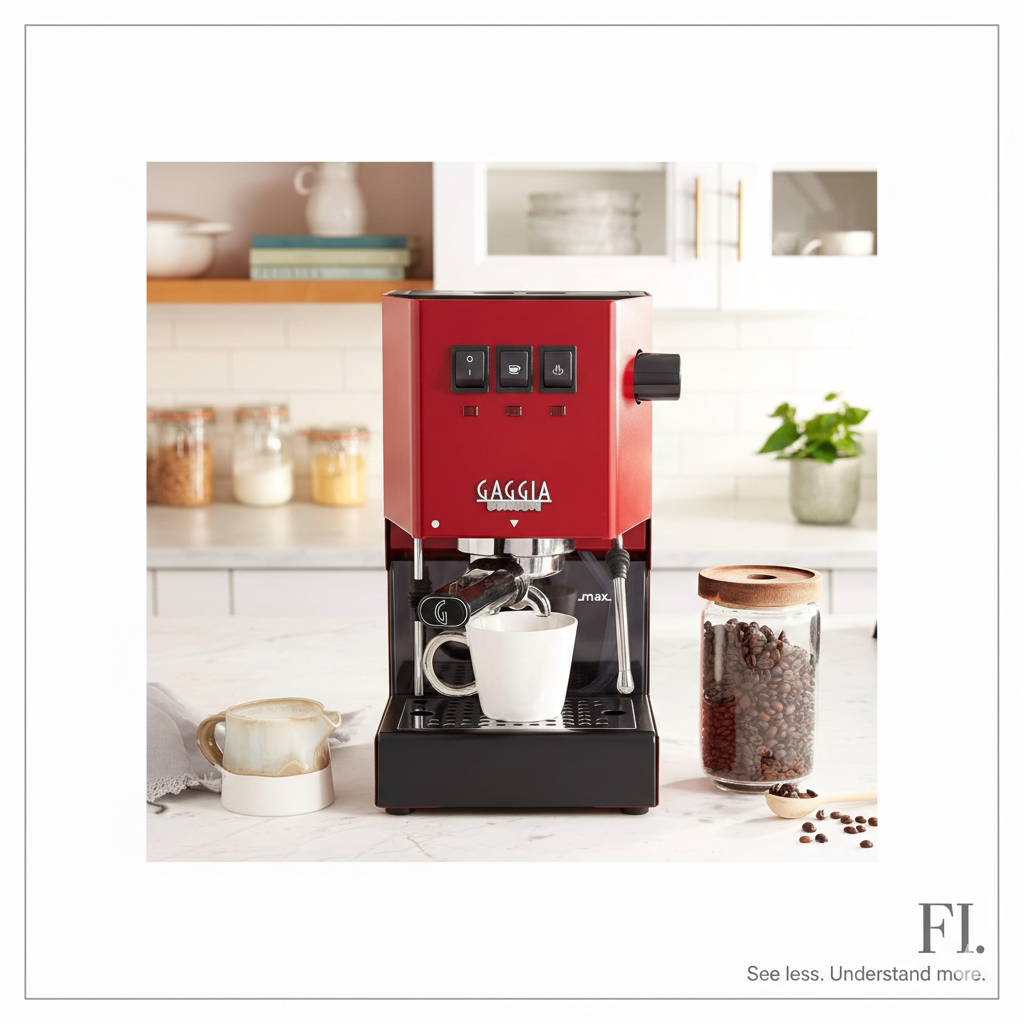
The Stability Problem in Entry-Level Semi-Automatic Espresso Machines
ANALYSIS FRAMEWORK
I don’t judge these machines by how “good” a single shot can be. I judge them by how often the shot stays coherent when real life shows up: different beans, different mornings , different pacing, and the small mistakes you only notice after the cup is already in your hand.
In this tier, the promise is seductive: café-style parts and manual control without café-level complexity. The reality is more specific. What you’re actually buying is a workflow. And the workflow either stabilizes your results—or quietly destabilizes them.
The Equilibrium Gap — Why Results Drift Even When You Don’t Change Anything
Most people expect repetition: same dose, same grind, same yield, same taste. Then they meet the operational reality: the machine’s internal state is not a fixed point. Heat moves. Pressure behavior shifts with puck resistance. Steam use changes the system before the next shot.
That mismatch is the gap. Not “bad quality.” Not “user error.” Just a system whose state changes faster than your expectations.
Once you see that, the goal changes: you stop chasing the mythical perfect extraction and start engineering stability.
The 4–7 Criteria That Actually Predict Stability
When I evaluate this category, I rely on measurable signals—because vague ideas like “build quality” don’t tell me whether tomorrow’s espresso will taste like today’s.
- Thermal repeatability (not just warm-up time)
Does the brew temperature behave predictably from shot to shot, especially after steaming or idle time? - Pressure behavior under real puck resistance
Does the machine push too aggressively, increasing channeling risk, or does it behave in a calmer, more controllable range? - Portafilter ecosystem and puck geometry
A 58mm workflow can be an advantage, but only if it reduces variability rather than adding it. Basket quality and puck depth matter more than most people admit. - Steam performance as a time-and-attention tax
Milk texture is not only about “power.” It’s about how long you’re managing the wand, how quickly you transition back to brewing, and how much that transition destabilizes the next shot. - Daily usability constraints
Cup clearance, drip-tray geometry, scale fit, reservoir access—these sound minor until they become daily friction. - Serviceability and longevity signals
Not because you want to mod. Because long-term stability often depends on how easily the machine can be maintained without turning ownership into a project.
Hidden Technical Factors People Only Learn After Weeks
A spec sheet won’t tell you how fast temperature swings show up in the cup. It won’t show you how a small boiler (typical in this class) makes the system more sensitive to timing. It also won’t warn you that “manual” control can mean “manual compensation.”
This is where owners split into two groups:
- those who accept the rhythm and gain control over it
- those who want the machine to hold the rhythm for them
Neither group is wrong. They’re just solving different stability problems.
Market Reality — Why Opinions Polarize in This Category
Online sentiment tends to look inconsistent because people aren’t evaluating the same thing.
Some are evaluating:
- “Can this machine produce legitimate espresso with the right prep?”
Others are evaluating:
- “Can I get stable results without adopting a routine?”
So the same machine becomes “a tank” in one narrative and “too finicky” in another—because the real variable isn’t the machine alone. It’s the stability contract you’re willing to sign.
Controlled Curiosity — The One Question That Decides Everything
Before you look at any specific model, answer this quietly:
Do you want stability to come from electronics and automation…
or from mechanics and repeatable habits?
That single answer filters the entire market faster than any “best under $X” list ever will.
A Natural Next Step When You’re Ready to Apply the Criteria
When you want to see these criteria applied to one specific machine—without comparisons and without hype—start here: 🔗 [LINK: complete decision analysis]
One Comment