BLUETTI Charger 1 — Structural Decision Review for Alternator Charging
DECISION ANALYSIS
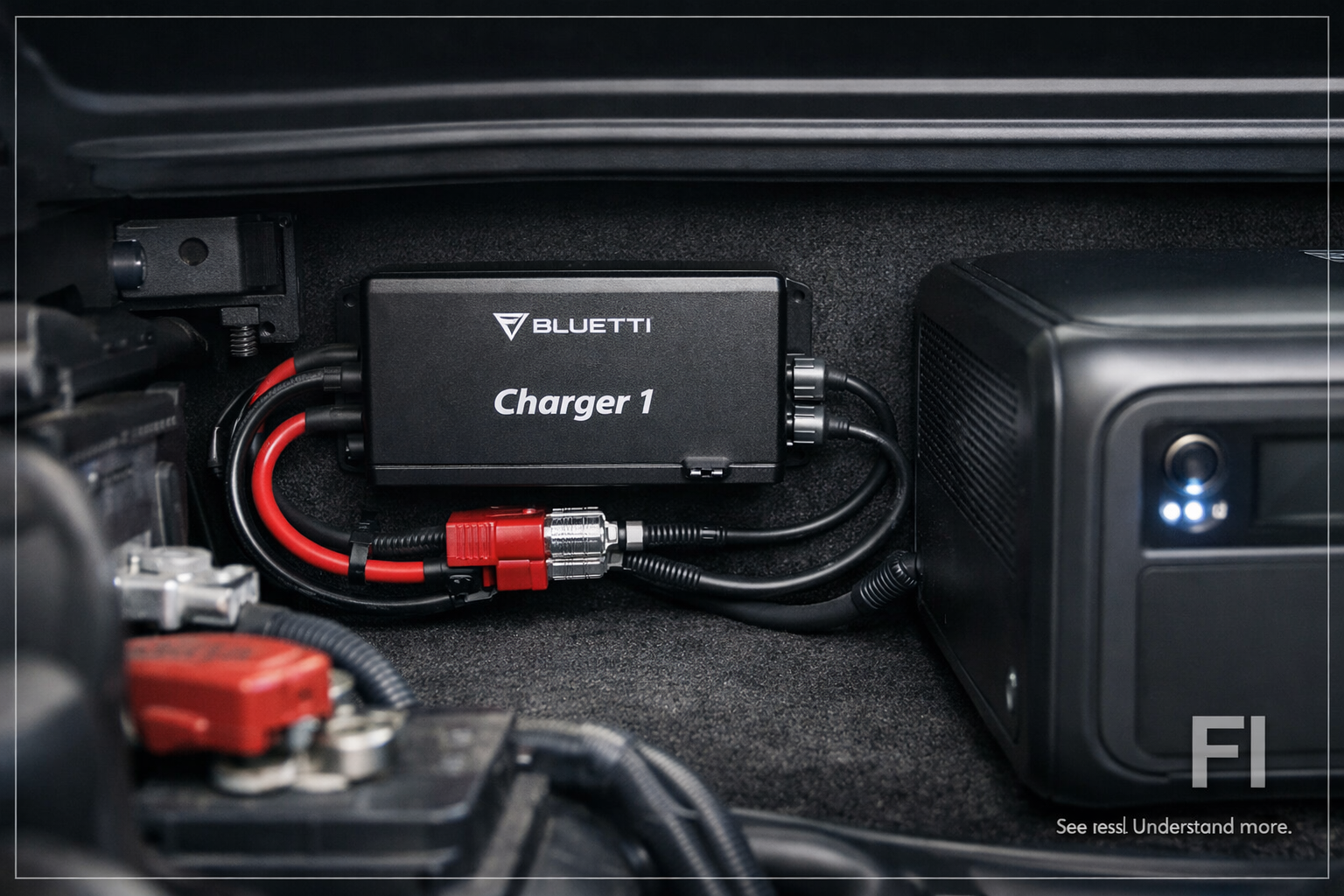
“BLUETTI Charger 1 DC-DC alternator charger mounted inside a vehicle and wired to a portable power station.”
Opening Decision Context
In the Network Article, I defined the equilibrium gap in vehicle charging: slow 12V recovery, smart alternator inconsistency, and low-level starter battery anxiety.
Here, I apply those criteria to one product only: BLUETTI Charger 1, positioned as an alternator charger for portable power stations.
This is not a feature summary. It is a structural test: does it convert alternator output into controlled, predictable energy without relocating instability elsewhere?
Fit Summary — Alignment Before Excitement
BLUETTI Charger 1 aligns structurally with users who:
- Drive long enough for high-watt alternator charging to matter.
- Operate medium to large portable power stations that outgrow 12V socket charging.
- Own vehicles with smart alternators and want D+ engine-run synchronization.
- Prefer automatic voltage-based battery protection over manual oversight.
It does not align well with:
- Short-distance urban drivers.
- Users unwilling to perform direct battery wiring.
- Those seeking plug-and-play simplicity.
This is infrastructure, not convenience hardware.
Technical Analysis — Spec → Behavior → Outcome → Effect
Primary Charging Architecture (Up to 560W DC-DC)
Spec: Up to 560W DC-DC alternator charging output.
Behavior: Converts vehicle alternator energy into regulated power suitable for a portable power station.
Outcome: Extended drives produce meaningful percentage recovery rather than marginal gain.
Effect: The repeated “Why is it barely charging?” loop weakens.
Smart Alternator Compatibility (D+ Engine-Run Signal)
Spec: D+ signal integration for engine-state detection in smart alternator vehicles.
Behavior: Charging logic activates with engine-run state instead of fluctuating unpredictably.
Outcome: Reduced compatibility uncertainty in modern vehicles.
Effect: Fewer verification checks during transit.
Starter Battery Protection (Automatic Voltage Monitoring)
Spec: Built-in voltage detection with auto cut-off behavior.
Behavior: Disengages when starter battery voltage drops below operational threshold.
Outcome: Prevents unintentional starter battery depletion.
Effect: The quiet anxiety around ignition-off drain reduces structurally.
App Monitoring and Output Adjustment
Spec: App-based visibility and adjustment capabilities.
Behavior: Users can observe charging status rather than assume it.
Outcome: Faster diagnosis if wiring or vehicle behavior affects performance.
Effect: Charging becomes measurable infrastructure, not a blind connection.
Installation Architecture (Direct-to-Battery Model)
Spec: High-current installation model requiring direct battery connection.
Behavior: Charging stability depends on disciplined cable routing and mounting.
Outcome: Performance is structurally tied to installation quality.
Effect: Equilibrium shifts from “charging uncertainty” to “installation precision.”
Contextual Specification Block (CSB — Extraction Layer)
- Up to 560W DC-DC alternator charger output
- D+ smart alternator engine-run synchronization
- Automatic starter battery voltage protection
- App-based monitoring and configuration
- Direct-to-battery high-current installation architecture
- Designed for cars, SUVs, and RV charging systems
Use-Case Fit — Where It Feels Structurally Coherent
Overlanding and Vanlife
Long travel days convert engine runtime into practical energy recovery.
RV Transit Charging
Complements solar systems by leveraging drive-time alternator output.
Emergency Readiness
Starter battery protection reduces exposure to single-point drain scenarios.
Urban Commuting
Limited structural benefit due to short engine runtime.
Trade-Offs and Constraints — Where Friction Can Relocate
Installation Complexity
Firewall routing, cable management, and mounting discipline are mandatory. Poor installation degrades stability.
Vehicle Electrical Variability
While D+ logic improves compatibility, vehicle electrical systems vary. Pre-install validation remains necessary.
Thermal Placement Requirements
DC-DC chargers require adequate airflow and stable mounting to maintain reliability.
Cost-to-Usage Ratio
If alternator charging is occasional, the infrastructure depth may exceed practical benefit.
Observational Validation Layer (OVL)
Technical Claim Reinforced — High-Power Alternator Charging Improves Recovery During Transit
In vehicle-focused owner discussions involving large portable power stations, multiple users reported that traditional 12V socket adapters failed to meaningfully recharge capacity during extended drives.
This observed pattern aligns with the structural advantage of a dedicated 560W DC-DC alternator charging architecture.
Technical Claim Reinforced — Starter Battery Protection Reduces Anxiety in Smart Alternator Vehicles
In discussions among owners of modern smart alternator vehicles, recurring concerns centered around inconsistent charging behavior and potential starter battery drain when using unmanaged charging solutions.
This field-observed pattern supports the importance of integrated voltage monitoring and engine-run synchronization.
Pricing Logic — Infrastructure vs Accessory
BLUETTI Charger 1 is priced as a charging control system, not a passive cable. The cost reflects conversion electronics, engine-run logic, and voltage management architecture.
If your existing setup already feels stable, this may exceed necessity. If instability recurs during travel, pricing maps directly to structural correction.
Verdict — Does It Close the Equilibrium Gap?
Within the correct usage profile, yes.
BLUETTI Charger 1 addresses:
- Underpowered 12V charging limitations
- Smart alternator synchronization gaps
- Starter battery drain uncertainty
It transforms alternator charging from opportunistic to controlled.
However, closure depends on installation execution. If installed with proper routing, protection, and validation, it becomes invisible infrastructure. If installed casually, instability migrates rather than disappears.
Forward Product Link
For official specifications and compatibility details, visit the product page: 🔗





One Comment