Wi-Fi 7 Mesh Systems: The Structural Shift That Finally Solves Home Network Instability
ANALYSIS FRAMEWORK
Opening Context Section — Why Faster Internet Alone Never Solves Instability
Most people upgrade their internet plan expecting faster speeds to fix their network frustration. Yet the core problem often remains unchanged: instability.
The symptoms are universally familiar:
• video calls freeze without warning
• streaming quality fluctuates between rooms
• smart home devices disconnect unpredictably
• network performance collapses under load
This is not caused by insufficient internet speed. It is caused by structural limitations inside the home network.
Traditional routers operate from a single transmission point. Signal strength degrades across distance, walls, and interference. The result is not slow internet—but inconsistent connectivity.
Wi-Fi 7 mesh systems exist specifically to eliminate this structural weakness.
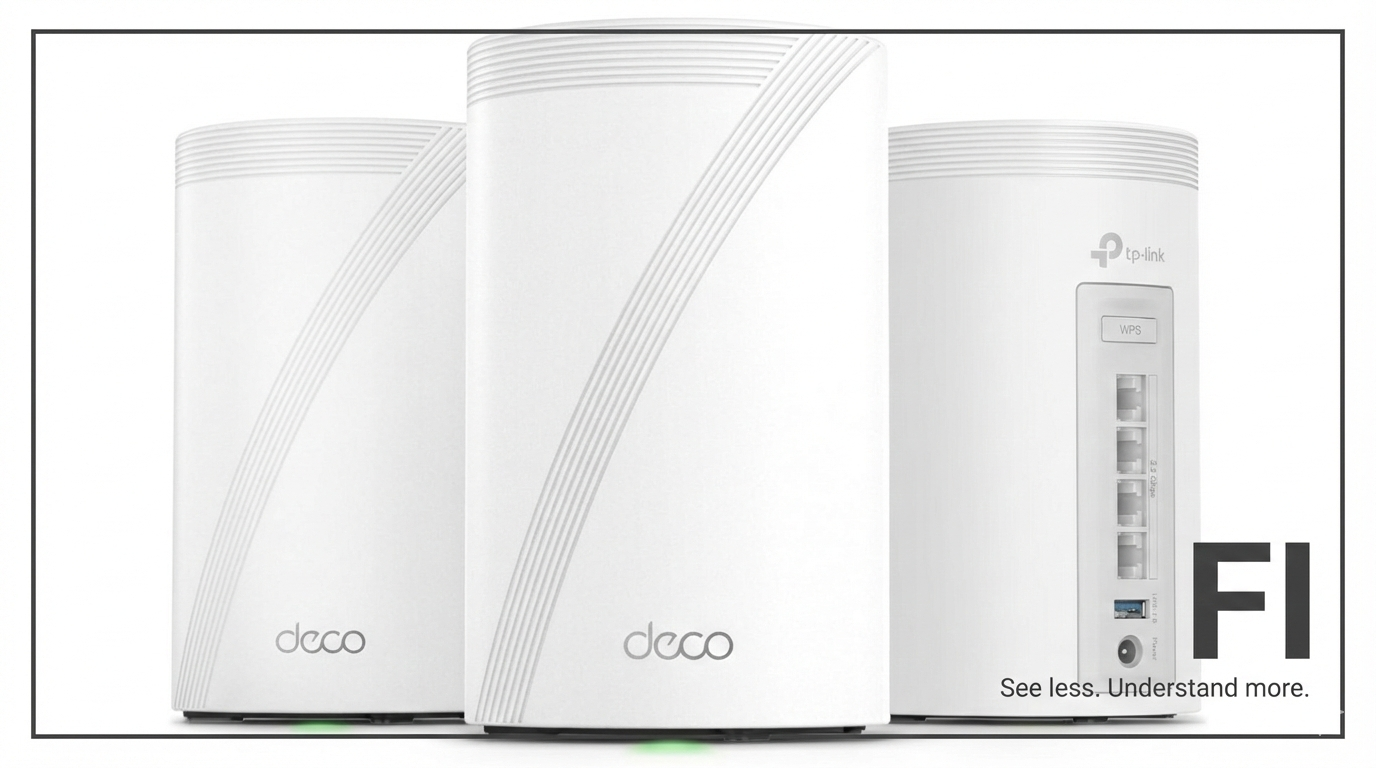
Tri-band Wi-Fi 7 mesh systems such as the BE10000 class deliver combined wireless throughput approaching 10Gbps while distributing signal intelligently across multiple coordinated nodes. ([TP-Link][1])
This architectural shift transforms network stability—not just speed.
Core Structural Explanation Section — Why Mesh Architecture Fundamentally Changes Network Behavior
Mesh networking replaces the single-origin transmission model with a distributed node system.
Each node operates as part of a unified network intelligence structure.
Instead of forcing all devices to communicate with a single router, mesh systems dynamically route devices to the most stable and efficient node.
Tri-band Wi-Fi 7 mesh systems operate simultaneously across three independent frequency layers:
2.4 GHz Layer — Maximum penetration and device compatibility
5 GHz Layer — High-speed general connectivity
6 GHz Layer — Ultra-low interference, high-capacity transmission
The addition of the 6GHz spectrum is critical. It provides clean, congestion-free bandwidth unavailable in older Wi-Fi generations. ([TP-Link][1])
This allows mesh systems to operate without internal spectrum congestion.
The result is structural stability under real-world load conditions.
Hidden Technical Factors Section — The Engineering Variables That Actually Determine Stability
Most buyers focus on advertised speed ratings. In reality, stability depends on deeper infrastructure capabilities.
Multi-Link Operation Enables Continuous Connectivity
Wi-Fi 7 introduces Multi-Link Operation (MLO), allowing devices to maintain simultaneous communication across multiple frequency bands.
Instead of depending on a single signal path, devices maintain parallel connections, reducing latency spikes and improving reliability.
This dramatically improves connection consistency under real-world interference conditions. ([TP-Link][1])
Multi-Gig Infrastructure Removes Internal Bottlenecks
Modern mesh systems include multi-gig Ethernet ports capable of exceeding traditional gigabit limits.
This eliminates one of the most common structural bottlenecks.
Systems like the BE10000 mesh class include multiple 2.5GbE ports per node, enabling both high-speed wired backhaul and full network capacity utilization. ([Newegg.com][2])
Without this capability, internal network throughput collapses under load—even when wireless speed is theoretically higher.
Device Capacity Determines Network Longevity
Modern homes often contain dozens or hundreds of connected devices.
Wi-Fi 7 mesh systems support over 200 connected devices simultaneously without degrading performance.
This capacity prevents performance collapse as device density increases.
Market Reality Section — How Users Actually Experience Wi-Fi 7 Mesh Systems
The psychological impact of mesh upgrades follows a consistent pattern.
Users upgrading from traditional routers often experience dramatic stability improvements.
Reports consistently highlight:
• stable connectivity across entire homes
• elimination of dead zones
• improved performance during simultaneous usage
Real-world deployments show stable coverage even across large homes exceeding 7000 sq ft, with reliable performance indoors and outdoors. ([Roon Labs Community][4])
From a technical perspective, independent testing confirms Wi-Fi 7 mesh systems deliver dramatically higher throughput and improved reliability compared to previous generations. ([Tom’s Hardware][5])
This reflects structural architecture—not incremental improvement.
Performance Reality Section — Why Wi-Fi 7 Represents a Structural Evolution
Wi-Fi 7 mesh systems introduce multiple architectural advancements simultaneously:
• tri-band spectrum separation
• 320MHz ultra-wide channels
• Multi-Link Operation
• multi-gig Ethernet infrastructure
• intelligent mesh coordination
These systems can cover up to 7,600 square feet and maintain stable performance across extremely large residential environments.
The practical outcome is not just higher peak speed—but dramatically improved stability and reliability.
This is the true purpose of mesh architecture.
Decision Transition Section — When Structural Evaluation Becomes Necessary
At this point, the decision is no longer whether mesh networking works.
It is whether a specific system’s architecture aligns with your home’s physical structure, device density, and throughput demands.
The determining structural variables include:
• tri-band spectrum efficiency
• multi-gig infrastructure capability
• mesh coordination stability
• backhaul efficiency
• long-term scalability
These structural characteristics determine whether instability is merely reduced—or completely eliminated.
To understand how these engineering principles apply to a real Wi-Fi 7 mesh architecture, continue to the full technical evaluation:
For credibility, we analyze technical data and user experiences to provide you with insights that you may not find in official manuals.