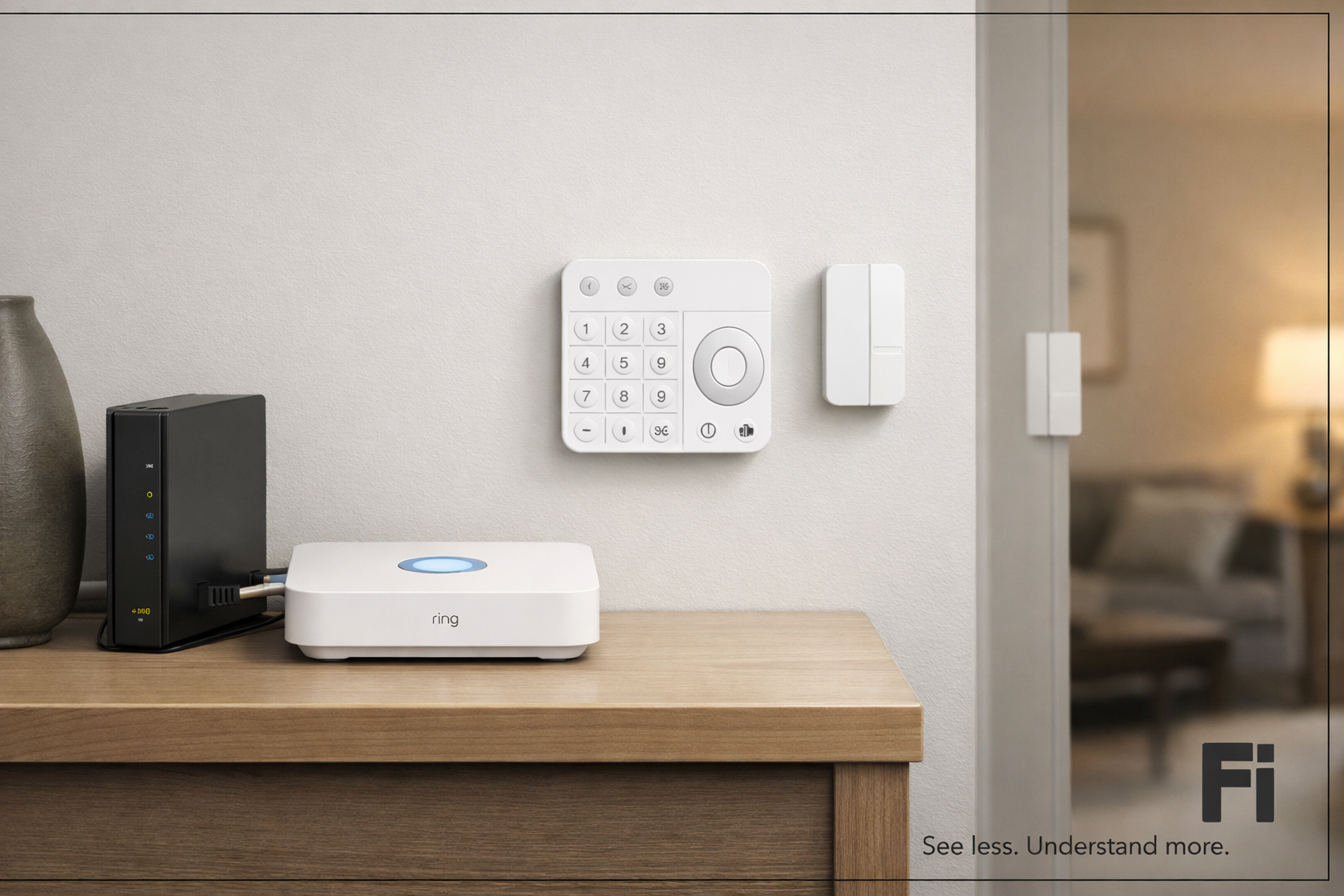
Ring Alarm Pro 8-Piece Kit — Full Technical Decision Evaluation
DECISION ANALYSIS
Decision Context — What You Are Truly Deciding
At this point, the question is no longer whether DIY security systems are effective. That uncertainty has already been resolved by the market. Modern alarm systems, including Ring Alarm Pro, are technically reliable.
The real decision is deeper and more structural.
You are deciding whether the Ring Alarm Pro 8-Piece Kit should become part of your home’s infrastructure layer, not just an accessory attached to it.
This distinction matters more than most buyers initially realize.
When a system operates at the infrastructure level, it influences three continuous conditions:
- environmental stability
- network continuity
- psychological sense of control
The product is not something you occasionally interact with. It becomes something your home quietly depends on.
Primary keyword integrated naturally: Ring Alarm Pro 8-Piece Kit
Semantic variations included naturally: Ring Alarm Pro system, smart alarm base station, home security hub with router, DIY smart security system
Technical Analysis — Real Performance and Structural Stability
Base station behavior under continuous operation
The base station is designed for persistent uptime, not intermittent use.
This difference defines the system’s operational profile.
Devices designed for persistent uptime prioritize:
- thermal stability
- signal consistency
- predictable internal state
In real-world conditions, systems that maintain stable internal state produce fewer unexpected behaviors.
This is one of the strongest technical characteristics of the Ring Alarm Pro architecture.
It is engineered to behave like infrastructure, not like a disposable consumer gadget.
Sensor communication reliability and behavioral trust
Security systems ultimately succeed or fail based on one invisible metric: trust consistency.
When sensors behave predictably, users stop thinking about them. That is the ideal state.
The Ring Alarm Pro sensor ecosystem is optimized for:
- low-power stability
- consistent signal reporting
- predictable trigger behavior
This reduces false alarms and increases psychological confidence over time.
Trust in the system grows not from dramatic events, but from uneventful continuity.
Router integration impact — the defining structural advantage
This is the system’s most important structural characteristic.
The Ring Alarm Pro base station can function as a Wi-Fi 6 router, placing alarm logic and connectivity logic inside the same control layer.
This reduces dependency fragmentation.
Fragmentation is the hidden cause of many smart home failures.
When multiple independent systems must coordinate, instability risk increases.
Consolidation reduces coordination failure probability.
However, this consolidation also means the device occupies a central position in the home’s network hierarchy.
This is not inherently good or bad.
It is structurally powerful.
But structural power only benefits environments aligned with its intended role.
Use Case Fit Analysis — Where the System Performs Optimally
Strongest alignment environments
The Ring Alarm Pro 8-Piece Kit performs exceptionally well when deployed in environments where it can operate as intended.
This includes:
- apartments
- small to medium homes
- households upgrading older routers
- users building a new smart home foundation
- users prioritizing system cohesion over manual network control
In these environments, the system behaves as a stable control center.
The experience feels unified and predictable.
Partial alignment environments
The system remains technically sound, but its structural advantage becomes less decisive in environments such as:
- advanced mesh network households
- users with enterprise-grade router preferences
- environments requiring deep network customization
In these cases, the security capability remains strong, but the router consolidation advantage becomes less meaningful.
The system is still functional.
It is simply less transformational.
Competitive Positioning — Structural Advantage vs Structural Independence
Most alarm systems exist as isolated devices connected to an external network layer.
Ring Alarm Pro integrates that network layer.
This produces a different system topology.
Instead of:
security device → router → internet
It becomes:
security device + router → internet
This reduces communication layers.
Fewer layers generally produce fewer instability vectors.
This structural consolidation is the system’s defining engineering decision.
Pricing Logic — Understanding Long-Term Ownership Reality
The hardware purchase establishes the physical infrastructure.
Optional service layers extend operational continuity, remote access, and monitoring capabilities.
This reflects a broader shift in security architecture across the industry.
Security systems are no longer single-purchase objects.
They are persistent operational systems.
The cost model reflects ongoing operational continuity rather than isolated ownership.
This is consistent with infrastructure-class products.
You can review the technical specifications and official live prices on Amazon here.
Verdict — Final Structural Decision Outcome
The Ring Alarm Pro 8-Piece Kit is not simply a sensor package.
It is an infrastructure consolidation device.
Its strongest advantage is structural cohesion.
By combining alarm coordination and network management inside one controlled environment, it reduces systemic fragmentation and increases operational continuity.
This advantage becomes most meaningful when the system is allowed to operate at the network center.
In environments aligned with its intended role, the system produces a stable, predictable, and psychologically reassuring experience.
In environments misaligned with its structural design, its advantages remain present but less pronounced.
This is not a universal product.
It is a structurally powerful product when environmental alignment exists.
You can review the full product page, technical specifications, and current availability here →

One Comment