Your Speed Can Look Great and Still Feel Wrong
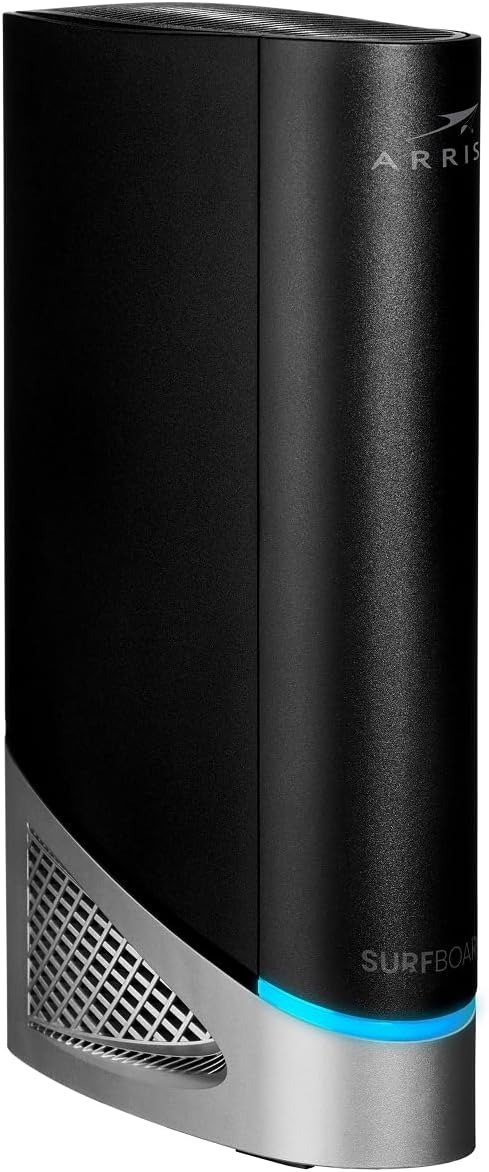
ARRIS SURFboard G54
A home network can lie to you with a straight face. The speed test flashes a fat number. The app says everything is healthy. The box promises Wi-Fi 7, multi-gig, quad-band muscle, and enough coverage to swallow a big house whole. Then the real evening begins: a lag spike during a match, a smart display that hesitates, a room that feels one wall farther away than it should, and that low, annoying suspicion that your internet is not broken enough to fail cleanly—just broken enough to keep stealing your attention. That is the kind of problem the ARRIS SURFboard G54 is trying to solve: one tall box, one cable line, one modem-router combo built around DOCSIS 3.1, quad-band Wi-Fi 7, one 10GbE port, and four 1GbE ports, aimed at cable plans up to roughly 2.5 Gbps. Officially, it supports major cable providers including Xfinity, Cox, and Spectrum. On Xfinity’s published compatibility list, it is approved for up to 2.34 Gbps down and up to 474 Mbps up.
The Result Looks Fine. The Problem Isn’t.
What struck me first about the G54 is not the headline feature. It is the promise hiding underneath it: fewer boxes, fewer failure points, fewer excuses. That matters because most people are not buying a modem-router combo to chase laboratory bragging rights. They are buying to stop a domestic nuisance. They want the rented gateway gone. They want the shelf less crowded. They want one device that can carry streaming, work calls, game downloads, cameras, phones, and the quiet swarm of background devices without turning every small disruption into a ritual of reboots and blame. That is the emotional shape of this category. Not excitement. Fatigue.
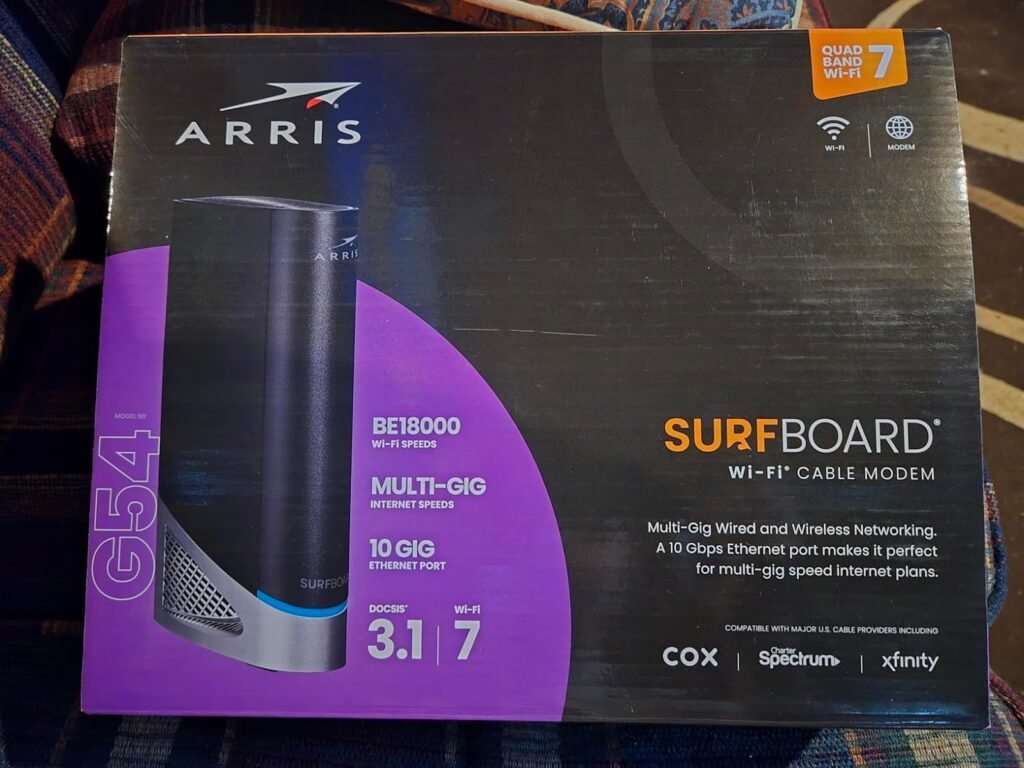
And the G54 does have a real technical case on paper. ARRIS positions it as a BE18000 Wi-Fi 7 cable gateway with a DOCSIS 3.1 modem, 32×8 DOCSIS 3.0 channels plus 2×2 OFDM DOCSIS 3.1 channels, one 10GbE port, and four gigabit LAN ports. The attraction is obvious: if your internet arrives over cable, and you do not want to assemble a separate modem plus separate router stack, this is one of the few retail devices trying to compress the whole decision into a single chassis.
What You’re Actually Feeling but Not Naming
The friction usually is not “my Wi-Fi is slow.” That is too blunt. The real feeling is more specific. It is the drag of unstable normalcy. Pages do load—but not crisply. Video does start—but with that half-second throat-clear before it settles. A smart home does respond—but with enough delay to make the house feel less intelligent than advertised. When people describe this badly, they shop badly. They chase a bigger standard, a louder speed label, a newer generation badge. They end up buying a symbol. What they needed was a better fit.
That is why the G54 is a compatibility product before it is a glamour product. If your pain is caused by old rented equipment, an aging DOCSIS gateway, weak ISP hardware, or the simple mess of too many separate boxes doing average work, the G54 feels like a clean answer. If your pain is actually a giant house, weird floorplan, difficult wall materials, or a need for advanced tuning and multi-node coverage, then a single all-in-one gateway can look impressive and still miss the real wound. RTINGS’ current large-home and mesh guidance leans toward expandable mesh when coverage is the actual bottleneck, not a single standalone box with a heroic coverage claim.
The Hidden Mechanism Behind the Miss
Most modem-router combo mistakes come from collapsing three separate jobs into one fantasy: signal intake, local routing, and whole-home wireless distribution. The G54 combines all three, and that is precisely why it can be either elegant or limiting.
When it fits, the design is efficient. There is less sprawl. Fewer power bricks. Fewer Ethernet decisions. Less friction during initial setup. ARRIS explicitly pitches the device around app-based setup and management, and Amazon’s listing leans hard into the “plug it in, use the app, activate, move on” story.
When it misses, it misses because the combo format stops being a convenience and starts being a ceiling. Independent review coverage from Dong Knows flagged exactly that tension: reliable broadband behavior, good range, but modest Wi-Fi throughput relative to the class, only one multi-gig port, no router/AP mode, no advanced features like QoS, VPN, link aggregation, or web-based remote management, and at launch, a frustrating security and app-management approach that got in the way of what should have been a premium experience. That is not cosmetic criticism. That is architectural criticism.
The Threshold Where the Outcome Quietly Breaks
Here is the quiet line I would draw.
The G54 starts to make sense when all three of these are true:
| Condition | What it really means | Why it matters |
|---|---|---|
| You use cable internet from a supported ISP | Xfinity, Cox, Spectrum, and similar supported cable providers | The modem half of the device is only valuable if your provider will provision it cleanly |
| Your home can realistically live on one gateway | Not a sprawling, coverage-hostile layout that really wants mesh | A single-box gateway cannot cheat physics just because the carton says 5,000 sq ft |
| You want simplicity more than deep control | Fast setup, fewer devices, less shelf clutter | The G54 gives convenience, but not the advanced router toolset power users often expect |
That is the threshold. Not “Do you want Wi-Fi 7?” Almost nobody needs Wi-Fi 7 in the abstract. The real question is uglier and more useful: Do you need a premium one-box cable gateway more than you need modular control?
Why Most Buyers Misread This Too Early
Because the label does the seduction for them.
Wi-Fi 7. Quad-band. BE18000. 10GbE. Those words hit the eye like chrome. They make the device feel future-proof before the buyer has done the harder work of matching the box to the house, the ISP, the devices, and the kind of frustration actually happening at 8:17 p.m. when three people are online and the network suddenly feels sticky.
May I be blunt? Most buyers misread this category by assuming the newest radio standard is the fix. It often is not. Dong Knows’ review found the G54 reliable with good range in testing, but also called the 5,000 sq ft marketing claim “wishful thinking” and described Wi-Fi throughput as mixed. Meanwhile, Best Buy’s customer summary trends positive on speed, signal, and coverage. Put together, that paints a very specific picture: this is not a disaster box; it is a fit-sensitive box. In the right house, people are pleased. In the wrong house or wrong expectation set, the premium price makes every compromise louder.
Who Is Actually Inside This Problem
I would place the real buyer in a narrow band.
You are inside this problem if you have cable internet, want to stop renting ISP gear, prefer one device instead of a modem-and-router stack, need strong everyday throughput, and do not care about enthusiast-grade router features. You probably live in a medium-size to moderately large home, not a monster layout full of dead zones. You want fewer moving parts. You want a cleaner reset. You want the network to stop behaving like a moody appliance.
You are especially inside it if your current pain is practical rather than obsessive: too many boxes, dated Wi-Fi, weak ISP gateway behavior, or the need to support a busy household with one better central device. User feedback snapshots from Best Buy and ARRIS community posts repeatedly praise speed gains, broader coverage, and more stable day-to-day behavior in homes where the placement is sensible and the buyer is not expecting enterprise-grade knobs.
Where Wrong-Fit Begins
Wrong-fit starts earlier than people think.
It starts if you need voice service. The G54 is data-only, and retailer documentation notes it is not compatible with digital voice services.
It starts if your house really needs mesh. A single tall gateway can be competent without being magical. RTINGS’ current recommendations for large homes and whole-home coverage still favor expandable mesh systems because coverage problems are usually topology problems, not branding problems.
It starts if you are the type of user who notices missing router features more than you enjoy setup simplicity. Dong Knows specifically called out the lack of QoS, VPN, link aggregation, remote web management, AP mode, and 160MHz channel width on the 5GHz bands. That list matters because it tells me exactly who will become irritated after the honeymoon. Not the casual family buyer. The tweaker. The optimizer. The person who buys a premium networking device and expects levers.
And wrong-fit can also begin at the ISP edge. Scattered user reports have described loaded latency, provisioning friction, and IPv6-related setup trouble on Xfinity, even while other users report smooth activation. I would not treat those threads as universal condemnation. I would treat them as a reminder that cable equipment lives or dies at the intersection of hardware, firmware, and provisioning—not just the badge on the front.
The One Situation Where This Product Becomes Logical
The G54 becomes logical in one very specific situation:
You want to replace ISP cable gear with one premium retail box, your home can be served by one central gateway, and you value consolidation more than advanced router tinkering.
That is the moment the product stops being a shiny spec object and starts being a clean structural decision.
Not because it is flawless.
Because it removes the right friction.
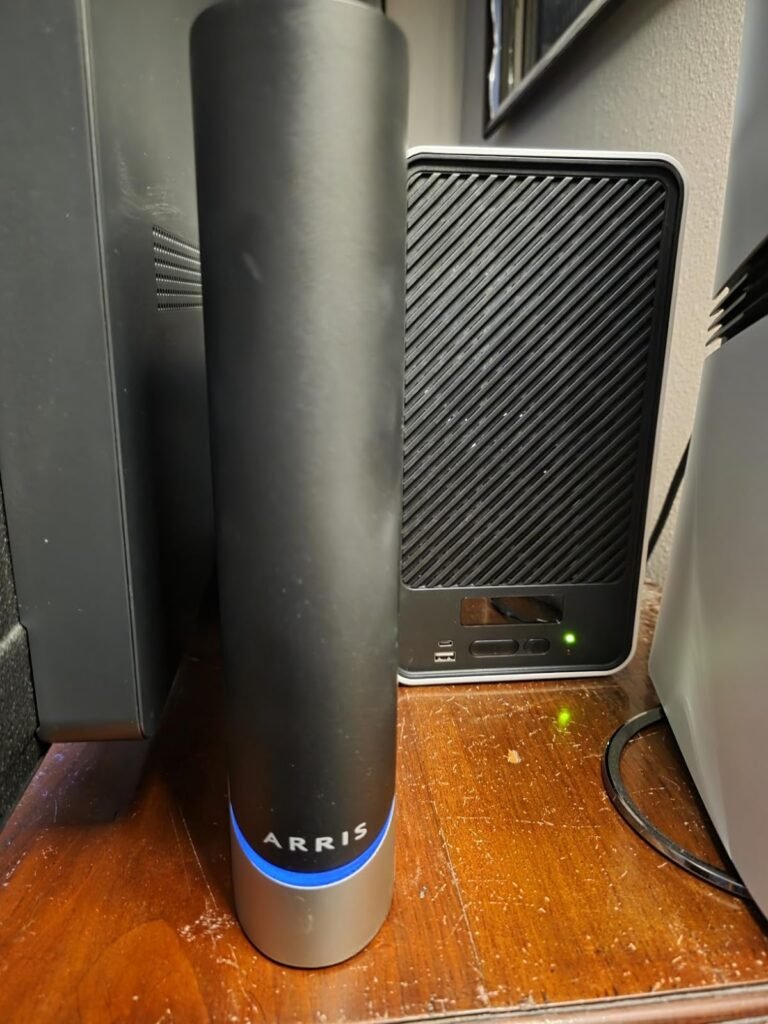
What I like here is the compression. One modem. One router. One app path for setup. One 10GbE port for the device that matters most. One chance to retire the old rental hardware and stop stacking compromises on compromises. Even the pricing logic, while not light, becomes easier to defend when you realize ARRIS is selling a DOCSIS 3.1 modem and a Wi-Fi 7 gateway in one box rather than pretending a budget combo can do premium work. Dong Knows’ bottom line was similar in spirit: oddities aside, it can still be a sensible rental replacement for cable users who want a single broadcaster.
What It Solves, What It Reduces, and What It Still Leaves to You
Here is the clean version.
| What the G54 solves | What it reduces | What it still leaves to you |
|---|---|---|
| Replaces separate cable modem + router with one device | Shelf clutter, cable clutter, setup fatigue | Correct placement still matters |
| Supports modern cable plans up to about 2.34–2.5 Gbps depending on provider guidance | Obsolescence pressure from older gateways | ISP provisioning and firmware behavior can still affect the experience |
| Brings quad-band Wi-Fi 7 and a 10GbE port into a combo format | The feeling that your rented gateway is the obvious weak link | It does not turn a large, coverage-hostile home into a mesh system |
| Gives a premium one-box option for supported cable households | Decision fatigue from piecing together a modem and router separately | It is not built for buyers who want deep router controls or voice support |
That last column is where trust lives. The G54 is not the universal answer. It is a disciplined answer.
Final Compression
After pulling apart the specs, the compatibility data, the independent review criticism, and the owner feedback, my read is simple: the ARRIS G54 is not a broad “best for everyone” gateway. It is a strong fit for a narrow person. A cable-internet household. A supported ISP. One-box preference. Central placement. No appetite for modular networking homework. No need for voice. No obsession with advanced controls. Inside that boundary, the G54 stops looking expensive and starts looking tidy, fast, and justified. Outside it, the same box can feel like an overbuilt shortcut that still leaves the real problem sitting in the walls.
If that is the condition you are actually dealing with, this is the logical next step
Transparency Note:
This analysis is not based on quick personal impressions.
It is derived from documented system behavior, verified user patterns, and the physical constraints of storage capacity.
The goal is to translate complex technical behavior into a realistic performance model that helps you make a clear decision.
“A quick note: Don’t believe the star ratings, but trust personal experience. This article is a compilation of collected experiences”