Your Yard Looks Covered — Until the System Starts Asking for You
Arlo Pro 6
You usually notice the problem too late.
Not when the video looks bad.
Not when the spec sheet looks thin.
That part is easy.
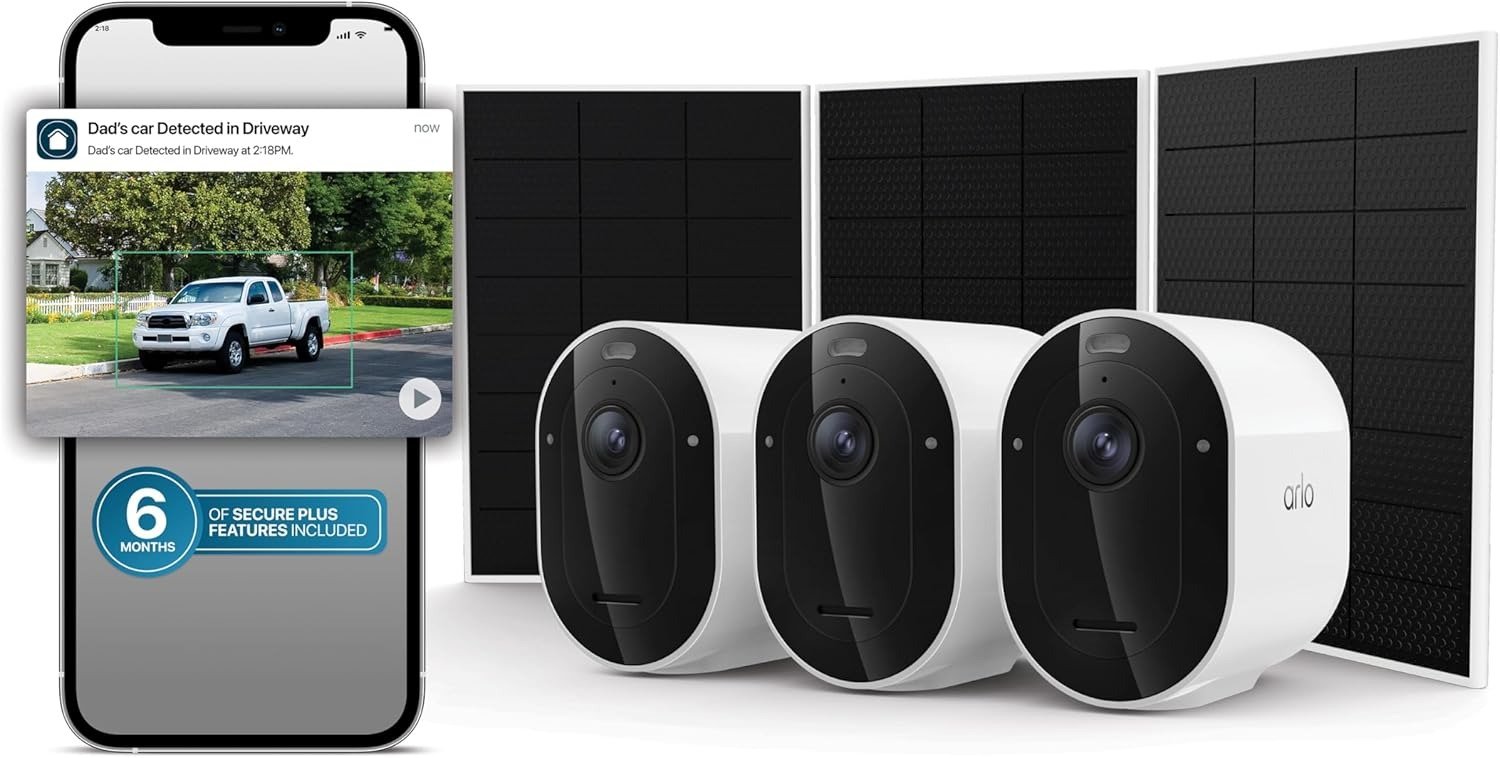
The real break starts when the camera is technically working, yet the system keeps asking for your attention anyway. A battery camera that needs frequent intervention does not feel wireless. A solar setup that reduces charging stops feeling like an accessory and starts becoming the condition for the product to make sense. That is the line I kept coming back to while breaking down this Arlo bundle: three Pro (6th Gen) cameras, three solar chargers, and a six-month Arlo Secure Plus plan. On paper, it gives you 2K HDR, a 160° field of view, color night vision, dual-band Wi-Fi, two-way audio, and a swappable battery. The bundle has also been selling materially below its earlier highs, with recent tracked pricing around $370.99 after earlier peaks near $529.99.
The Result Looks Fine. The Problem Isn’t.
A lot of outdoor cameras fail in a boring way: not by producing unusable footage, but by quietly adding friction to ownership.
That is why Arlo is attractive in the first place. The image stack is legitimately strong for this class. The Pro 6 carries 2K HDR, color night vision, and a wide 160° diagonal view, while reviewers looking at the Pro 5S—the platform this model builds on—consistently praised the video quality. Tom’s Guide called the Pro 5S clear and crisp, and WIRED went further, describing the line as premium hardware with stronger battery life and better color night vision than the prior model. T3’s review of the Pro 6 says the video quality remains effectively the same 2K HDR level as its predecessor.
So the glossy first impression is real.
The trouble is that security cameras are judged in the gaps between events.
How often you think about them.
How often you wait on them.
How often you compensate for them.
That is where “looks good” stops being enough.
What You’re Actually Feeling but Not Naming
Most people do not say, “My camera failed my maintenance threshold.”
They say simpler things.
It takes too long to load.
It dies faster than I expected.
I do not want to climb up there again.
I thought wireless meant I could forget about it.
That last sentence is the one that matters.
When I read through official docs, review coverage, and user complaints, the recurring tension was not image clarity. It was intervention burden. Arlo itself positions the solar charger as a way to keep batteries charged with direct sunlight for “24/7 protection,” and the charger is officially compatible with the Pro 6 and Pro 5S families. Meanwhile, user feedback on Pro 5S repeatedly circles around battery expectations, loading delays, and the annoyance of accessory costs when you want a truly fixed outdoor install. Best Buy reviewers mention quicker-than-expected battery drain and slow camera loading, while another specifically complains that the included cable is indoor-rated, short, and effectively pushes outdoor users toward extra spend. Reddit feedback echoes the same pattern, with complaints about live-view delay even on strong home networking.
That unnamed feeling is not “bad camera.”
It is ownership drag.
The Hidden Mechanism Behind the Miss
Here is the inconvenient part: most buyers judge outdoor cameras by the image first when the actual system breaks later through power logic, cloud logic, and response logic.
Arlo’s architecture is strong where many wireless cameras are weak. The Pro 6 adds up to 15% more battery life than Pro 5, uses USB-C charging, supports both 2.4 and 5 GHz Wi-Fi, and can connect directly to a router without a SmartHub. It also averages about 2 Mbps upload bandwidth per camera, which matters more than people think when you start stacking multiple units around a home. But Arlo also states that 2K cloud recording beyond the included trial requires renewing Arlo Secure unless you use local storage through a SmartHub. In other words, image quality is only one layer of the experience. The real mechanism is this: good footage plus recurring dependency equals a different product than good footage plus low-touch ownership.
That is the hidden variable many people miss.
They think they are buying three cameras.
They are actually buying a surveillance routine.
The question is whether this bundle reduces that routine enough to justify itself.
The Threshold Where the Outcome Quietly Breaks
The threshold is not night vision.
It is not field of view.
It is not even raw battery life by itself.
The threshold is this:
A battery camera stops feeling premium when coverage quality depends on repeated manual recovery.
That recovery can be charging.
It can be reconnecting.
It can be waiting on live view.
It can be managing what happens after the trial ends.
This is why the solar panels matter more here than they would on a cheaper camera. On Arlo, the premium does not only buy hardware; it buys the expectation of lower friction. When the system still needs you often, the premium starts turning against itself. That is also why recent reviewers remain split in a very predictable way: excellent image quality and smart features on one side, high purchase cost and ongoing cost on the other. Tom’s Guide praised the visuals and automations but warned about subscription pricing. Expert Reviews called the Pro 6 clever but expensive to buy and run. Security.org says the 6th Gen meaningfully improves battery life over the 5S, but it still frames the upgrade in the language of refinement, not reinvention.
That is the break point.
If your install can’t tolerate upkeep, the solar panels are not optional garnish.
They are part of the product logic.
Why Most Buyers Misread This Too Early
They compare camera to camera.
That sounds rational. It often is not.
Because the wrong comparison starts with visible features:
2K vs 2K
spotlight vs spotlight
night color vs night color
app features vs app features
The better comparison starts with failure conditions:
How bad is it if live view is late?
How annoying is it if outdoor charging becomes a chore?
What happens after the included subscription window ends?
Do you want a low-contact system or a high-capability system?
Arlo gets oversold when people treat it like a straightforward value camera. It is not. Even Arlo’s own pricing structure tells you that. The standard Pro 6 single camera is listed at $124.99 on Arlo’s US site, while the Secure plan pricing starts at $7.99 per month billed annually for a single camera and scales upward from there. The bundle linked here softens part of that pain by including solar chargers and six months of Secure Plus, which is exactly why this package makes more sense than buying the body-only camera and improvising later.
The lazy comparison asks, “Is the camera good?”
The useful comparison asks, “At what point does this setup stop interrupting me?”
Who Is Actually Inside This Problem
This bundle fits a very specific kind of buyer.
Not the person chasing the cheapest camera.
Not the person who resents subscriptions on principle.
Not the person who wants to set everything once and never think about ecosystem cost again.
It fits the person who has three outdoor zones that matter, wants stronger image quality than entry-level gear, values wide-angle coverage, and understands that the solar chargers are there to reduce intervention, not to create “free power magic.” Arlo’s own positioning for the Pro 6 leans into wider field of view, 2K HDR, motion alerts, color night vision, and dual-band Wi-Fi, while the official support docs emphasize direct-to-router setup, optional SmartHub use, and local storage only if you add that hub. That combination suits someone who wants flexible placement, decent image detail, and a lower-maintenance battery setup without committing to wired installation.
This is also the right buyer profile for someone who will actually use the app intelligence instead of resenting it. Security.org notes that Arlo’s newer generation improves AI-powered alerts when paired with Arlo Secure, and multiple reviewers frame the platform strength as part of the value proposition, not an afterthought.
Where Wrong-Fit Begins
Wrong-fit starts in four places.
First, if your real priority is the lowest total cost of ownership, this will not feel light. The hardware is premium, the subscription matters, and reviewers continue to flag operating cost as one of the main drawbacks.
Second, if you hate cloud dependence, the cheerful part of the bundle ends after the included plan period. Arlo does allow local 2K recording with a SmartHub, but that is a different path than simply buying the kit and walking away.
Third, if fast live access is your absolute non-negotiable metric, user reports around load delay deserve attention. Not everyone sees the same behavior, but the complaint appears often enough that I would not dismiss it as noise.
Fourth, if your mounting positions get poor sunlight, the included solar panels lose part of their strategic value. They are there to reduce charging interruptions. If they cannot do that, the whole bundle becomes less elegant.
Here is the clean fit map I would use:
| Need | Fit |
|---|---|
| Three outdoor zones with flexible placement | Strong |
| Better-than-basic image quality | Strong |
| Lower charging intervention via solar | Strong |
| Lowest long-term cost | Weak |
| Subscription-free simplicity | Weak |
| Zero tolerance for app delay | Borderline |
| Willingness to add SmartHub later for local storage | Moderate |
That table is not a feature checklist. It is a regret filter built from the recurring strengths and complaints in the sources above.
The One Situation Where This Product Becomes Logical
This product becomes logical when your problem is not “I need a camera.”
It becomes logical when your problem is:
I need three outdoor cameras with strong visual clarity, flexible placement, and less battery babysitting than a normal wireless setup.
That is the moment the bundle makes sense.
Not because it is cheap.
Not because it is universally best.
Because the included solar panels and six-month plan directly address the two quiet pressure points that usually make premium battery cameras feel worse over time: charging friction and feature gating. The bundle is essentially packaging the maintenance answer with the cameras instead of asking you to discover that answer one accessory at a time.
That is the counterintuitive truth here.
The camera is not the main sell.
The reduction in future interruptions is.
If that is the condition you are actually solving, this stops looking like a gadget purchase and starts looking like a cleaner operating choice.
What It Solves, What It Reduces, and What It Still Leaves to You
What it solves:
- Wide, detailed outdoor coverage across multiple zones.
- Better low-light usefulness than bargain-tier cameras through 2K HDR and color night vision.
- Less frequent manual charging when the solar setup is viable.
What it reduces:
- The annoyance of physically removing or recharging batteries as often.
- Early subscription sting, because the bundle includes six months of Secure Plus.
- Some installation friction, because the Pro 6 adds Bluetooth-assisted setup and USB-C charging.
What it still leaves to you:
- The decision about life after the trial period.
- The reality that poor sunlight can undercut the solar value.
- The possibility that app responsiveness may still matter more to your experience than raw image quality.
- The judgment call on whether Arlo’s ecosystem cost feels justified in your house, not in a review summary.
That last point is where many “premium” purchases go wrong.
Not because they are bad.
Because they were solving a narrower problem than the buyer imagined.
Final Compression
I would not authorize this bundle for someone looking for a cheap way to put three cameras outside.
I would authorize it for someone whose real threshold is maintenance fatigue.
If your property has three important viewing zones, you care about clear footage, and you already know that repeated charging turns “wireless” into a nuisance, this Arlo Pro 6 bundle is one of the cleaner ways to buy down that friction. The official spec sheet is solid, the Pro line’s video quality is widely praised, the solar compatibility is native, and the included trial gives the platform room to show its value before the ongoing cost becomes your decision. But the same evidence also sets the boundary: it remains a premium system with premium running assumptions.
So the clean answer is this:
When your break point starts at coverage dropping because you do not want to keep servicing battery cameras, this becomes a logical next step.
When your break point starts at monthly cost, ecosystem dependence, or impatience with app delay, it does not.
Transparency Note:
This analysis is not based on quick personal impressions.
It is derived from documented system behavior, verified user patterns, and the physical constraints of storage capacity.
The goal is to translate complex technical behavior into a realistic performance model that helps you make a clear decision