When a Crystal Chandelier Starts Lighting the Room Instead of Just Decorating It
ANALYSIS FRAMEWORK
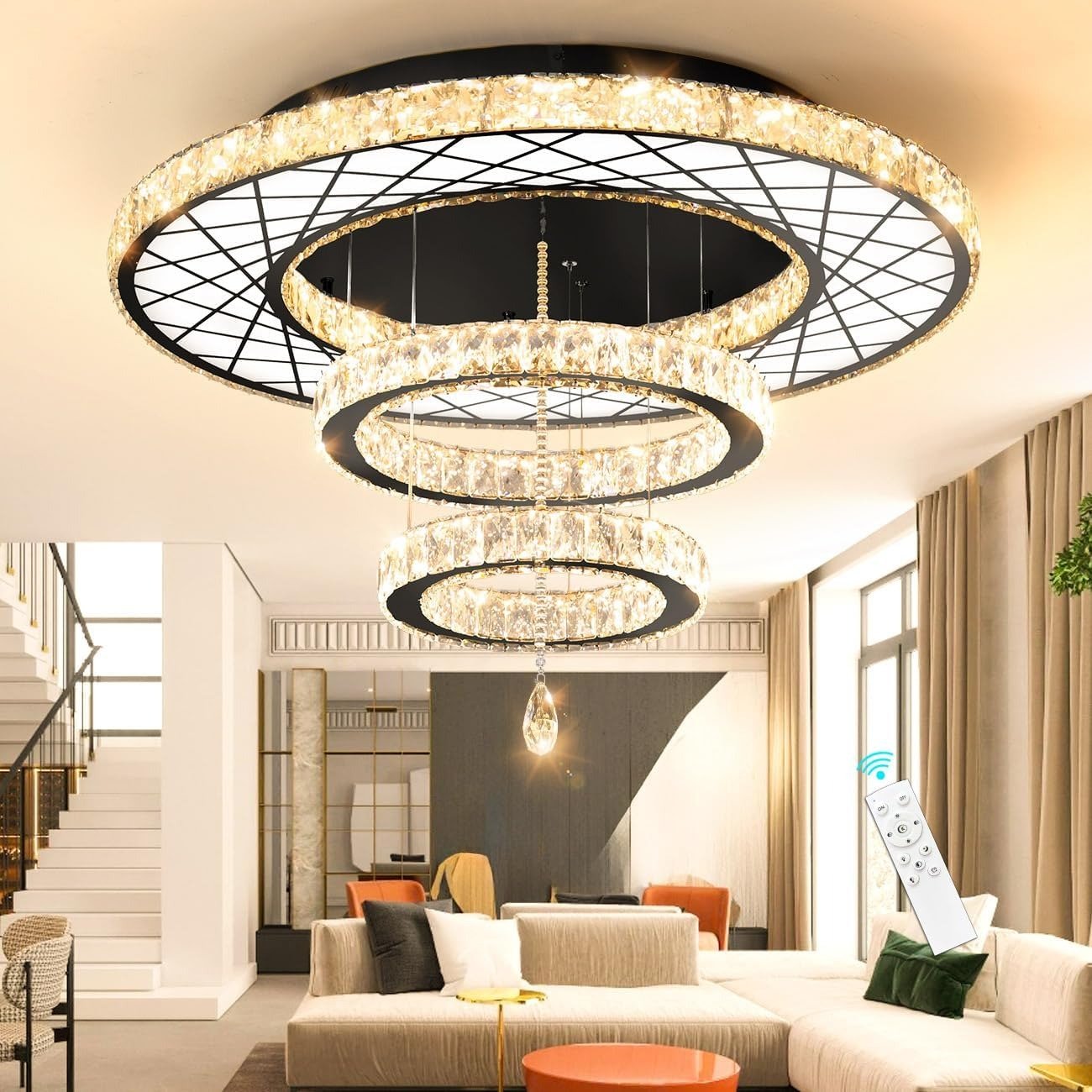
I’ve seen a lot of lighting fixtures that look expensive in photos and then behave like jewelry once they’re on the ceiling—pretty to look at, but not especially useful once real life starts. That was the first question I had when I studied this HAIXIANG crystal glam LED chandelier: is it actually a room light, or is it mainly a decorative object that happens to glow?
On paper, it gives you a 32″ x 32″ footprint, an integrated 108W LED engine, a claimed 8,640 lumens, adjustable color temperature from 3000K to 6000K, a stainless-steel frame, K9 crystal, and a substantial 35 lb installed weight. That combination immediately told me this is not a casual fixture purchase. It is a threshold purchase.
The useful way to judge it is not “Does it look luxurious?” It obviously does. The real question is simpler: when does a glam chandelier stop being visual theater and start behaving like dependable ambient lighting? For me, the threshold sits at the point where four things hold together at once: the fixture looks intentionally oversized without overwhelming the room, the light output is strong enough to avoid feeling ornamental, the dimming range actually lets the room change mood instead of just getting slightly brighter or dimmer, and the daily control method feels easier rather than fussier. That is what separates décor from utility.
Comparable room-lighting guides consistently frame brightness and room fit in practical terms—roughly 10–20 lumens per square foot for a living room, higher for task-heavy spaces, and fixture size that feels proportionate to the gathering zone rather than just visually dramatic.
The Threshold I Actually Care About
This chandelier gets my attention because, on paper, it clears the brightness hurdle better than a lot of decorative fixtures do. A claimed 8,640 lumens is a serious number for a residential ceiling light, and even after allowing for the normal gap between claimed output and perceived room brightness, it still suggests a fixture designed to illuminate, not merely sparkle.
The broader 3000K–6000K range also matters more than people think. Around 3000K tends to feel calmer and more residential, while cooler whites move the fixture toward a crisper, more alert visual profile. That range gives the chandelier a chance to shift with the room rather than locking it into one mood.
What keeps me from treating the spec sheet like a victory lap is the fixture’s physical reality. At 35 lb, this is not the kind of light I’d mentally file under “easy upgrade.” It belongs in the category of fixtures that ask whether the ceiling support, junction box, and installation plan are ready for the weight.
Even seller and installation guidance around comparable heavy chandeliers repeatedly flags the need for proper structural support, and that lines up with how I think about it: once a fixture reaches this mass, the hidden variable is no longer style but infrastructure. If the ceiling is right, the chandelier feels substantial. If the ceiling is not right, the whole buying decision was premature.
What Usually Fails First Isn’t the Light — It’s the Fit
This is where most people misread a chandelier like this. They assume the risk is brightness. I don’t think that’s the first risk. The first risk is fit drift—the slow realization that a fixture can be visually stunning and still wrong for the room it hangs in.
A 32-inch crystal piece with a dense glam profile, stainless-steel hardware, and integrated LED design is not a flexible neutral object. It carries presence all day, whether the light is on or off. That can be a strength in a formal dining room, foyer, or a living room that already leans polished and high-contrast.
In a softer, quieter, or lower-ceiling room, the same presence can turn from “statement” into “constant demand for attention.” General fixture-sizing guidance makes the same underlying point in a calmer way: a ceiling light should feel intentional over the gathering area, not merely large for the sake of looking expensive.
The second failure point is control friction. This chandelier’s dimming logic is built around its own included system, not a wall-dimmer ecosystem, and comparable listings repeat the same warning: do not connect it to another dimmer switch. That may sound minor, but in actual daily use it matters.
A fixture feels premium when the way you want to control it matches how it expects to be controlled. If you like direct remote-based brightness and color changes, that feels convenient. If you want your wall controls and broader lighting logic to stay standardized, it can feel like a small but persistent mismatch.
Similar glam LED chandeliers marketed through other retailers repeat this exact caution, which tells me it is not a random footnote; it is part of the category’s operating reality.
What People Seem to Like About This Type of Fixture
When I looked across public feedback on very similar glam crystal LED chandeliers, the praise clustered in predictable places: once installed, they tend to look more expensive in person than buyers expected; the combination of crystal refraction and adjustable LED color makes them feel more dynamic than a fixed-output chandelier; and the remote dimming adds day-to-night flexibility people notice quickly.
I also saw repeated appreciation for finish quality, packaging, and the “showpiece” effect after installation. That pattern shows up in marketplace summaries and reviews for comparable crystal LED chandeliers, even when the exact model has limited public feedback.
Just as important, the caution signals also cluster in predictable places: packaging can arrive rough even when the internal packing holds, installation is rarely something I’d call lightweight, and integrated-LED glam fixtures often reward buyers who confirm room size, mounting conditions, and control expectations before purchase rather than after it.
That is why I keep returning to the same threshold. The chandelier becomes a good buy only when the room is ready for a visual centerpiece that is also expected to carry real ambient load. If you clear that threshold, this style starts to make sense. If you do not, it becomes a very polished mismatch.
The One Sentence That Clarified It for Me
This fixture starts making sense when you need one object to do two jobs at the same time: anchor the room visually and still deliver enough controllable light that it does not feel decorative-only. That is the threshold.
Technical snapshot
Claimed output: 8,640 lumens
Strong enough on paper to be treated as real ambient lighting, not accent-only
Color temperature: 3000K–6000K
Useful range if you want softer evenings and crisper daytime tone
Size: 32″ x 32″ x 16″
Large enough to act like a room anchor, not a background fixture
Weight: 35 lb
Installation and support matter more than usual
Materials: stainless steel + K9 crystal
Built for visual impact first, but not with flimsy materials on paper
Integrated LED / included dimming logic
Convenient if you accept its control system; less ideal if you want universal dimmer behavior
If I were routing this cleanly inside the spine, I’d place the decision link right after the reader understands that brightness is not the real issue anymore—fit is.
If the chandelier clears the brightness threshold for your room, the real question becomes whether your ceiling, style, and daily control habits actually fit this kind of fixture.
Transparency Note:
This analysis is not based on quick personal impressions.
It is derived from documented system behavior, verified user patterns, and the physical constraints of storage capacity.
The goal is to translate complex technical behavior into a realistic performance model that helps you make a clear decision