When a 4-Door Access Control Kit Starts Feeling Reliable Instead of Merely Affordable
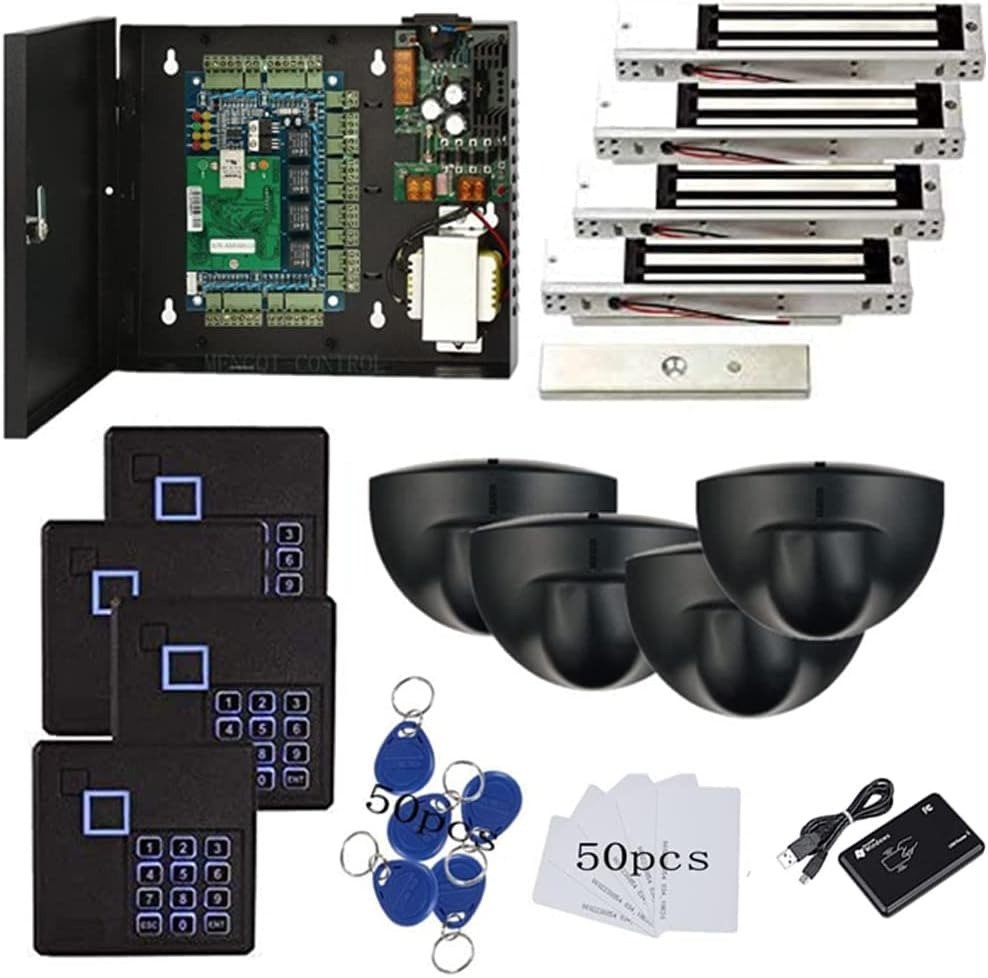
The moment that changed how I looked at this MENGQI-CONTROL kit was not the promise of remote door opening.
It was the quieter question underneath it: at what point does a budget four-door access system stop acting like a box of parts and start acting like a dependable layer in a real building routine?
This kit is sold as a four-door access-control package with RFID keypad entry, PIR exit sensing, app-based remote opening, 600-lb electromagnetic locks, 110–240V power support, and storage for up to 20,000 users and 100,000 records.
That sounds impressive on a listing.
What matters more is whether those pieces reduce friction once people start walking through the doors every day.
The Threshold That Actually Matters
The model I keep coming back to here is what I’d call the Operational Trust Threshold.
A four-door system crosses that threshold only when four things happen at once:
| Requirement | What it means in real use |
|---|---|
| Entry control | Credentials work consistently enough that people do not hesitate at the door |
| Exit flow | Leaving feels natural, not awkward or failure-prone |
| Admin control | Programming and remote release save time instead of creating a second job |
| Power reality | The owner understands exactly what happens during outages |
That last point matters more than many buyers realize.
Electromagnetic locks are fail-safe by design, which means they unlock when power is removed.
Allegion states this directly, and SDC notes that maglocks are used where fail-safe emergency release is required, with code compliance depending on the application and local authority.
In plain language, this is not the kind of lock you buy if your mental picture of “security” is “stays locked no matter what.”
What This Kit Gets Right Before You Even Get to the Psychology
On paper, the hardware package is stronger than the average “cheap smart security” impression people might have.
The system is positioned for up to four doors, includes RFID credentialing, remote opening by phone app, a PIR request-to-exit approach, and 600-lb electromagnetic locks.
The Amazon listing snippet also shows it ranking at #564 in Home Security Systems, which at minimum tells me it is not an invisible listing with no marketplace traction at all.
On Amazon UK, the same ASIN shows 5.0/5 from 2 reviews, while reseller pages repeat the core four-door / app / 600-lb lock configuration.
What stands out to me more than the raw spec sheet is that the brand’s own site and related videos lean heavily on wiring diagrams, installation guidance, remote-control setup, and programming help.
That usually tells me the real product is not “hardware only.” The real product is hardware plus guidance.
In lower-cost access control, that distinction matters because buyers are rarely judging just the board or lock.
They are judging whether the system can be made to behave predictably without a week of chasing diagrams and silent support inboxes.
The Hidden Variable Most Buyers Miss
The hidden variable is not holding force.
It is not card capacity.
It is not even the app.
It is routine interruption load.
That is the total amount of friction the system adds back into the day through setup confusion, odd exit behavior, programming mistakes, power-loss surprises, and the small hesitations that happen when a door does not behave the way staff expect.
This is why the user feedback around MENGQI-CONTROL is so revealing.
On the brand site, one reviewer says there are no paper manuals, that documentation is online, that setup is not a 10-minute install, and that extra cables may be needed.
Another says programming takes time to understand, but support repeatedly answered within roughly 12 hours with short tutorial videos.
A third explicitly notes that maglocks disengage if power goes out and recommends either a mechanical lock for overnight security or a UPS.
That is not glamorous feedback, but it is exactly the kind of feedback I trust because it describes routine reality instead of marketing theater.
Why People Still Like Systems Like This
Psychologically, this product is attractive for a very specific kind of buyer.
It is not the buyer chasing luxury.
It is the buyer trying to compress three pains at once:
- “I need more control than a dumb lock gives me.”
- “I do not want an enterprise contract.”
- “I want one system to cover multiple doors without turning into an endless monthly commitment.”
That lines up with how access-control professionals talk about MENGQI-style systems in public discussions.
In one Reddit thread, the original poster said a four-door MENGQI installation had been successful for a year.
The replies did not deny that it can work.
Instead, they drew a hard line: this kind of kit may be fine for a home, hobby, or small four-door need, but it is not in the same class as enterprise platforms such as Mercury-, Avigilon-, or Genetec-based systems built for thousands of doors, huge cardholder databases, integrations, and near-continuous uptime.
One commenter put it bluntly: a $400 Amazon-special system is not built for a 2,500-door environment, and another noted they have Mercury boards still running after 25 years.
That split matters because a lot of disappointment in access control comes from buying a small-site solution with big-site expectations.
Where the Threshold Breaks
For me, the threshold breaks in three situations:
| Threshold break | Why it happens |
|---|---|
| You need enterprise-grade uptime and lifecycle confidence | Public installer opinion consistently separates MENGQI-type kits from Mercury/Avigilon-class systems |
| You cannot tolerate fail-safe unlock behavior on power loss without backup planning | Maglocks unlock when power is removed |
| You want “simple smart security” but not wiring, programming, or setup work | Brand and user guidance both imply this takes real installation effort |
Those are not small caveats.
They are the boundary of the category itself.
The hardware can be strong enough for the job, but the job has to match the system.
What Convinced Me This Isn’t Just a Spec-Sheet Toy
What moved this product out of the “cheap but noisy” bucket for me was the repeated pattern of support-centered feedback.
I saw the same story more than once: setup takes time, documentation exists but is not frictionless, and support is unusually responsive with PDFs, links, and short videos.
The product also appears across the brand’s own site, reseller listings, and installation/tutorial content with the same core message: multi-door control, app-based remote opening, and DIY-friendly documentation rather than a no-learning-curve promise.
That consistency does not make it enterprise hardware.
But it does make it look more operational than a disposable listing.
The Real Meaning of “Reliable” Here
Reliable, in this category, does not mean invisible.
It means the system becomes understandable enough that the building stops arguing with it.
That usually happens when:
- the owner accepts that maglocks are power-dependent,
- exit behavior is chosen for the actual traffic pattern,
- support is good enough to shorten setup drift,
- and the site is small enough that a four-door kit remains a tool, not a liability.
That is the real threshold.
Not whether the listing sounds advanced, but whether the daily routine becomes calmer after the install instead of more brittle.
That is the line between “affordable hardware” and “usable access control.”
Where I’d Go Next Before Touching the Product Page
If I were narrowing this down seriously, the next question I’d ask is not whether this system can lock a door.
It clearly can.
The next question is whether my site profile sits on the right side of the fit boundary: small, multi-door, price-aware, willing to install carefully, and realistic about fail-safe power behavior.
That is where the real decision lives.
Transparency Note:
This analysis is not based on quick personal impressions.
It is derived from documented system behavior, verified user patterns, and the physical constraints of storage capacity.
The goal is to translate complex technical behavior into a realistic performance model that helps you make a clear decision