When a Smart Toilet Starts Solving Problems Instead of Showing Off
analysis framework
The moment a smart toilet stops feeling ridiculous is not the moment it gives me a heated seat. It is the moment it starts removing small , repetitive annoyances so consistently that going back to a standard toilet feels like stepping backward.
That is the line I care about. Not feature count. Not showroom appeal. Not whether the remote looks futuristic on the wall. The real question is simpler: when does this thing reduce friction often enough to justify becoming part plumbing fixture, part appliance, and part daily habit?
Smart-toilet testing from Good Housekeeping now emphasizes long-term use, installation, cleansing, drying, and maintenance rather than novelty alone, and broader bidet testing from Business Insider and WIRED shows the same pattern: comfort features matter, but routine performance matters more.
The Threshold I Actually Care About
I think a smart toilet crosses the line from clever to useful only when four conditions are true at the same time:
| Threshold condition | What I need to feel in real life | Why it matters |
|---|---|---|
| Flush confidence | I do not wonder whether I need a second flush | Reliability beats luxury talk |
| Wash comfort | Warm water and adjustable spray feel easy, not fussy | Cleaning has to become instinctive |
| Low-contact routine | Lid, flush, deodorizing, and seat heating reduce tiny irritations | The gain is cumulative, not dramatic |
| Contained upkeep | Maintenance stays lighter than the problem it claims to solve | A “smart” toilet that adds chores fails the test |
Independent MaP guidance matters here because flush performance is one of the few parts of this category that can be translated into a plain, useful number: a MaP score reflects the grams of simulated waste a toilet can clear in a single flush, and the testing scale tops out at 1,000 grams. MaP’s own guide classifies 600 to 1,000 grams as highly recommended.
Why Flush Strength Is the First Gate
This is the part people understate when they talk about “luxury toilets.” If the flush is soft, inconsistent, or too sensitive to water pressure, the rest of the feature set becomes decoration.
That is why so many newer smart-toilet brands now lean hard on built-in tanks, pump-assisted flushing, and 1000-gram MaP claims. Even Good Housekeeping’s smart-toilet buying guide puts performance, installation reality, and day-to-day use ahead of gadget theater.
What I’ve come to trust is not the promise of “powerful flush” by itself, but the combination of a strong waste-removal claim and a design meant to reduce dependence on perfect home water pressure. That matters more than it sounds, especially in older houses where plumbing consistency is not something I take for granted. Manufacturer listings for this newer wave of integrated models repeatedly stress built-in tanks and pump-assisted or jet-siphon systems for exactly that reason.
The Features That Actually Change the Routine
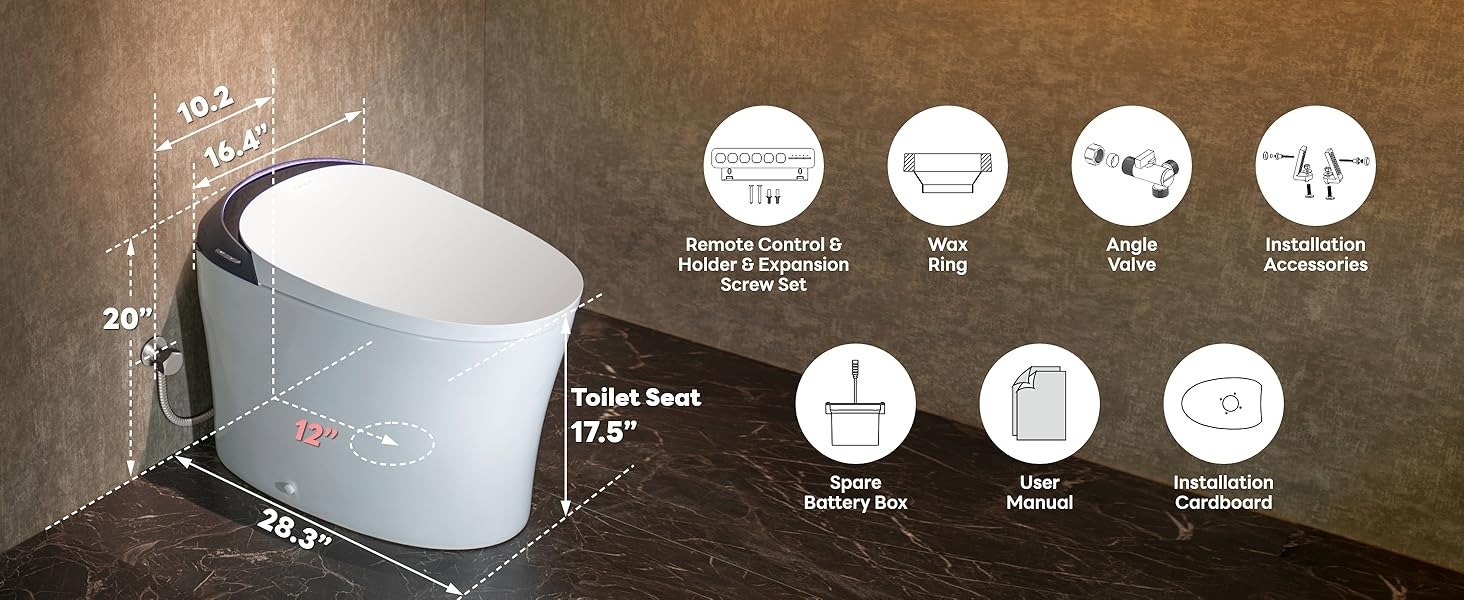
The features that look best in a spec sheet are not always the ones that change behavior. The ones that usually do are more boring: warm water that arrives quickly, a seat height that is easier to get on and off, a deodorizer that keeps the room from feeling stale, and touch-free lid or flush behavior that reduces the number of small surfaces I keep reaching for.
Category testing and user reviews keep circling back to the same winners: warm cleansing, heated seats, intuitive controls, and odor management.
The hidden variable is that these gains are cumulative. One individual feature rarely feels transformative. But warm water plus a heated seat plus off-seat flushing plus deodorizing plus night guidance at 2 a.m. starts to change the emotional texture of a bathroom routine.
Even casual owners on Reddit describe the heated seat and wash functions as the things they miss first once they get used to them.
Where the Category Starts to Drift
This is also where smart toilets can quietly fail.
The first drift problem is sensor fatigue. Auto-open and auto-flush sound elegant until they trigger at the wrong times or keep activating in a tight bathroom. Owners discussing integrated units regularly mention that motion-based lid behavior can become annoying enough that they disable it.
The second drift problem is dryer disappointment. Warm-air dryers sound like the end of toilet paper, but real users often describe them as helpful rather than complete. On forums, owners frequently say the dryer is fine, just slower and weaker than the fantasy version. That matters because it changes the expectation boundary: this feature should reduce paper use, not be treated as perfect replacement logic.
The third drift problem is maintenance creep. The more advanced the toilet, the more the buyer has to think like an appliance owner, not just a plumbing owner.
Good Housekeeping flags installation complexity in this category, and plumbers on Reddit repeatedly warn that integrated sub-$1,500 units can be harder to install, harder to service, and less reassuring on future parts support than long-established brands.
The Real Threshold, Stated Plainly
So here is the line as I see it:
A smart toilet becomes genuinely useful when it does four things at once: it flushes with confidence, cleans comfortably, reduces touchpoints, and does not create an equally annoying maintenance routine in return.
Once those conditions hold, the product stops being “bathroom tech” and starts becoming infrastructure.
That is why I do not judge this category by how futuristic it looks. I judge it by whether the routine gets quieter: less reaching, less wiping, less smell, less hesitation, and less cleanup after the cleanup. That is the threshold.
Transparency Note:
This analysis is not based on quick personal impressions.
It is derived from documented system behavior, verified user patterns, and the physical constraints of storage capacity.
The goal is to translate complex technical behavior into a realistic performance model that helps you make a clear decision