When a Wall-Mount Garage Door Opener Actually Solves a Problem
ANALYSIS FRAMEWORK
The fastest way to waste money on a garage upgrade is to buy a cleaner-looking machine for a problem that was never about looks in the first place. What stood out to me while studying the Genie 6072H-O is that it becomes genuinely useful only after one threshold is crossed: the moment your garage stops behaving like a simple overhead bay and starts behaving like a constrained working space. That is when the wall-mount format stops being a novelty and starts acting like relief.
What I kept seeing across the product data, homeowner questions, installer commentary, and video walk-throughs was the same pattern: people are not attracted to this kind of opener because they suddenly care about opener architecture. They buy it because the ceiling is in the way, the old system shakes too much, the room above the garage hears everything, or the garage has become storage, a workshop, or a partially finished extension of the house. The attraction is not “smart home energy.” It is friction reduction.
The Threshold That Changes the Category
For me, the real threshold is simple:
| Condition | What it means in daily use |
|---|---|
| Ceiling space has become functional space | You want racks, lighting, a lift, a fan, or simply less overhead clutter. |
| Noise transfer has become noticeable | Bedrooms or living space near/above the garage make vibration matter more. |
| Your current opener layout is mechanically awkward | Beams, obstructed ceiling lines, or a garage setup that resists a traditional rail. |
| You care more about clearance and calm than bargain pricing | A wall-mount only makes sense when layout quality matters enough to pay for it. |
That threshold matters because a jackshaft or wall-mount opener changes the shape of the garage more than it changes the basic act of opening the door. It mounts to the torsion tube at the side, removes the rail and central powerhead from the ceiling, and is designed for sectional doors up to 850 pounds and up to 14 feet high. In other words, its value is spatial before it is emotional.
What the Genie 6072H-O Actually Changes
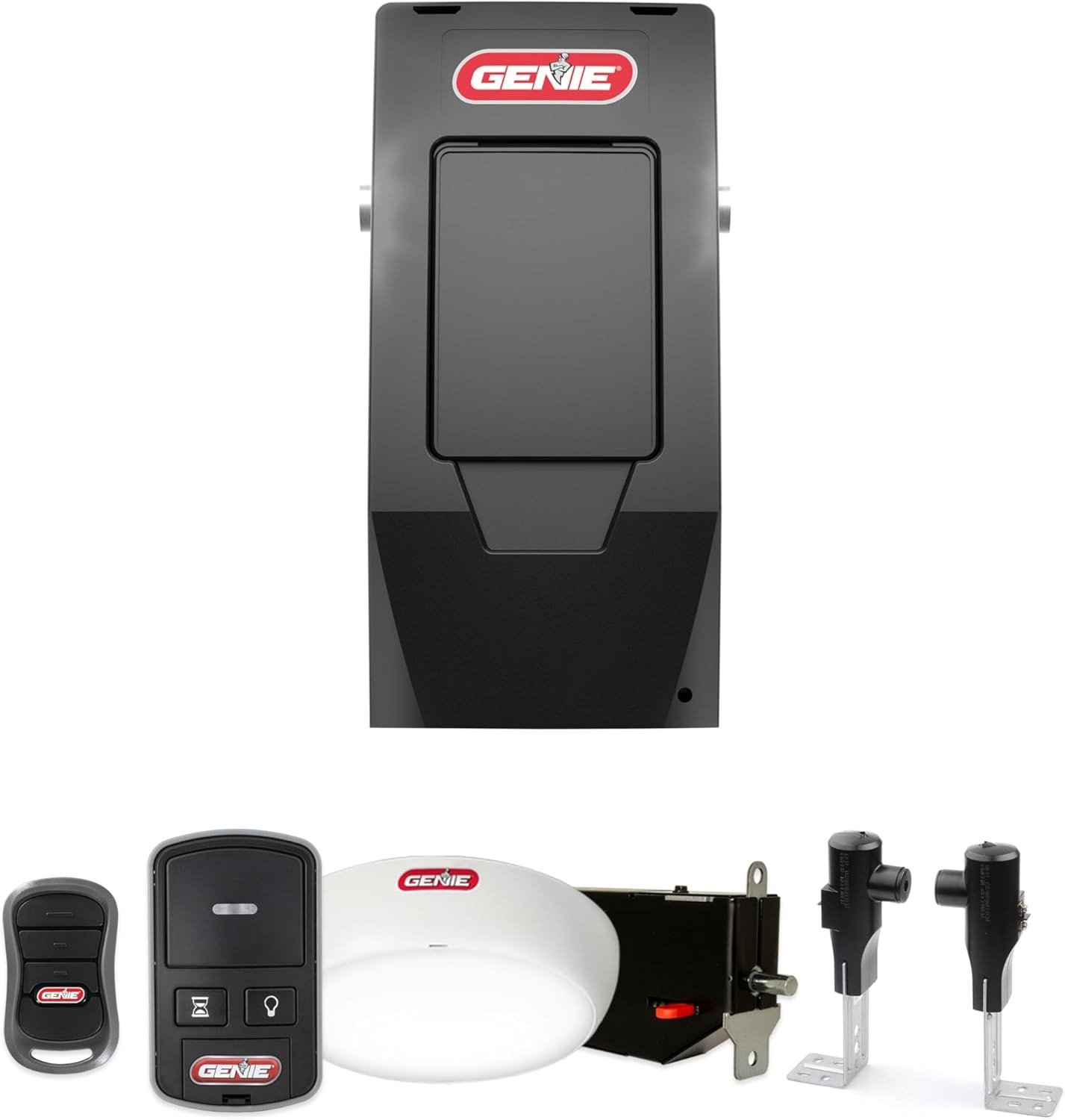
The Genie 6072H-O is a compact wall-mounted opener with a stated footprint around 6.8 inches wide, roughly 14.5 inches tall, and 9 inches deep, and it is built to work with residential sectional doors up to 850 pounds. It includes a wireless wall console, LED light, Intellicode remote, automatic door lock, and Genie’s Safe-T-Pulse cable monitoring approach. Installation requires a standard outlet within 6 feet and enough side and top clearance around the spring tube.
The practical shift is easier to feel than to advertise:
| Old overhead opener annoyance | What a wall-mount can reduce |
|---|---|
| Rail occupying ceiling lane | Frees overhead space completely |
| Central motor vibration through framing | Often quieter-feeling in attached garages |
| Bulky visual clutter | Cleaner sightline across the ceiling |
| Complicated fit with beams or storage plans | Better choice when ceiling geometry is the real problem |
That matches the broader case for jackshaft openers: they are valued for space savings and quieter operation, but they also ask more from the door system itself. When the door is properly balanced, many installers and owners describe the category as excellent. When the door setup is off, the elegance disappears quickly.
Why the 6072H-O Creates Strong Reactions
The positive reactions are easy to understand. Owners and marketplace summaries repeatedly point to the same benefits: cleaner ceiling space, quiet or mostly silent operation, good included accessories, and a modern side-mount footprint that feels like a bigger upgrade than a standard motor swap. Amazon currently shows it near the top of the garage-opener category, and aggregated marketplace feedback trends positive overall.
But the negative reactions are just as revealing. Complaints do not usually center on the basic idea of the opener. They center on fit, setup complexity, occasional reliability/support frustrations, and the fact that wall-mount systems are less forgiving when the door itself is not dialed in. In professional and owner discussions, the recurring caution is clear: this category rewards a correct door setup and punishes sloppiness faster than a conventional rail opener.
The Hidden Variable Most Buyers Miss
The hidden variable is not horsepower language or the product photo. It is door condition.
A wall-mount opener like this one is not the best answer to “I need a new opener.” It is the best answer to “my garage layout and my door system are suitable for a side-mount design, and I want the benefits that come with that geometry.” That distinction is where a lot of buyer disappointment begins. Installer discussions repeatedly point back to the same thing: balanced door, compatible spring/tube setup, proper clearances, and correct installation matter more here than they do with ordinary ceiling-rail expectations.
That is also why the format has a stronger memory imprint than a typical opener. When it works, people don’t describe it as “a little better.” They describe the garage as calmer, less cluttered, and more usable. The gain is environmental. That is what makes the threshold memorable.
Where the Threshold Breaks
Here is where I would stop romanticizing the format:
| Threshold break | Why it matters |
|---|---|
| One-piece door | Not supported |
| Extension spring setup | Not the right match |
| Reverse-wound / low-headroom outside hookup | Known limitation |
| No proper outlet nearby | Installation friction rises immediately |
| Door balance is questionable | Daily smoothness and reliability become uncertain |
| You mainly want app control and backup power | This exact version is weaker than smarter variants |
The 6072H family is meant for sectional doors, and Genie’s own wall-mount guidance excludes one-piece doors and warns about reverse-wound, low-headroom, and extension-spring configurations. That alone tells me this is not a casual plug-and-play purchase. It is a format decision first and a product decision second.
My Read on the Network Question
After going through the specs, owner behavior, installer comments, and side-mount category comparisons, my view is this: the Genie 6072H-O becomes compelling only when the garage itself is the problem being solved. If your current opener works and your ceiling space is irrelevant, the category can feel like a premium detour. If your garage ceiling is blocked, valuable, noisy, or visually oppressive, the wall-mount threshold arrives fast—and this model starts making sense in a much more practical way than the product photos suggest.
If I were moving deeper into the decision, the next question would not be “Is this opener good?” It would be: am I actually the right fit for this exact version, or do I need a smarter / more forgiving alternative?
Transparency Note:
This analysis is not based on quick personal impressions.
It is derived from documented system behavior, verified user patterns, and the physical constraints of storage capacity.
The goal is to translate complex technical behavior into a realistic performance model that helps you make a clear decision