Air Oasis iAdaptAir 2.0 Large Review: Does It Cross the Large-Room Stability Threshold?
DECISION ANALYSIS
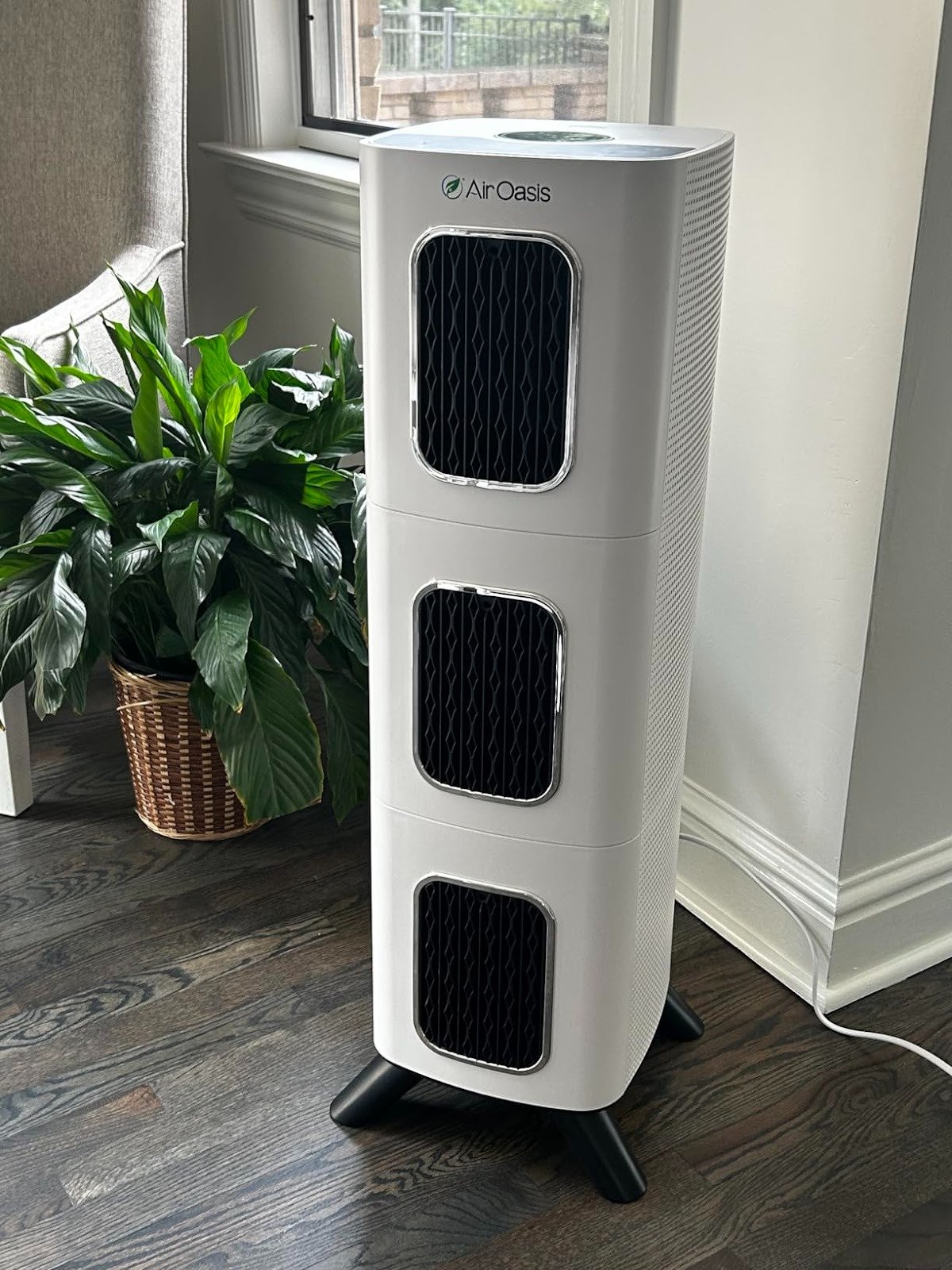
What convinced me to take this purifier seriously was not the giant one-hour coverage headline.
It was the quieter, more usable number underneath it: 795 square feet at five air changes per hour.
That is the kind of number that starts to matter in an actual living room, not just in a product carousel.
Once I lined that up with the published 530 CFM CADR, 25 to 53 dB operating range, H13 HEPA filter, 440 g carbon filter, auto mode, air-quality sensor, app control, removable Wi-Fi chip, and up-to-two-year filter claim, I could see why this model sits in a premium bracket.
But I could also see exactly where the hesitation begins: this is an electronic multi-stage purifier with ionization and UV in the mix, and that means the decision turns on trust as much as on airflow.
Technical Snapshot
The figures below are the ones that actually shape the decision for me, because they affect room fit, routine fit, and ownership drift more than marketing language does.
| Metric | Air Oasis iAdaptAir 2.0 Large | What It Means in Practice |
|---|---|---|
| Max CADR | 530 CFM | Legitimate large-room airflow |
| Coverage at 5 ACH | 795 sq. ft. | The real usefulness number |
| One-hour headline coverage | 3,975 sq. ft. | Attention-grabbing, but less decision-useful |
| Noise range | 25–53 dB | Easy to live with on low; audible on max |
| Filtration stack | H13 HEPA + 440 g carbon + silver antimicrobial filter + UV-C LEDs + bipolar ionization | Powerful feature set, but more trust-sensitive than a plain mechanical design |
| Sensor / Auto mode | Yes | Helps performance survive daily neglect |
| App / Wi-Fi | Yes, with removable Wi-Fi chip | Good convenience, unusual flexibility for EMF-sensitive users |
| Published filter life | Up to 2 years | Good on paper, but environment-dependent |
| Replacement guidance | 6–24 months depending on usage and environment | Real ownership drift matters |
| Certification | ENERGY STAR, ETL, CARB | Useful baseline, not a full performance verdict |
What I Like Without Forcing the Point
I like that this purifier’s strongest argument does not have to start with the controversial parts.
Even if I mentally demote the ionization and UV layers to “optional bonus,” the core package still makes sense: high CADR, real large-room coverage, auto sensing, quiet low-speed operation, substantial carbon by consumer-purifier standards, and enough control flexibility that the machine looks like it was designed to stay on, not just to impress during setup.
The removable Wi-Fi chip is also one of those small design choices that tells me the company at least understands the anxieties of the exact premium buyer it is chasing.
I also like that the size claim can be translated into something grounded.
AHAM’s rule of thumb is that CADR should be at least two-thirds of room area, and for wildfire smoke the recommendation is even more demanding.
With 530 CFM, the iAdaptAir Large lines up cleanly with the company’s own 795-square-foot, five-ACH positioning and still reads as a serious machine for open common areas rather than a bedroom purifier pretending to be more than it is.
Where My Caution Starts
My caution begins exactly where the category gets psychologically messy: electronic purification layers.
CARB’s list shows the AOIA-2L is certified, which means it met California’s ozone-emission requirement for electronic air cleaners.
But CARB also says very plainly that certification does not evaluate pollutant-removal effectiveness and does not imply that a device is “safe to use” in any broad, absolute sense.
EPA guidance adds why some buyers remain uneasy: ionizers can push particles onto room surfaces rather than purely removing them, and EPA notes they can be less effective than high-efficiency particle filters for pollutants like dust, smoke, pollen, and fungal spores.
In other words, the iAdaptAir makes the strongest case when I judge it first as a high-airflow HEPA-and-carbon purifier, not when I ask the electronic add-ons to carry the whole decision alone.
That caution is not theoretical.
Community reactions around Air Oasis repeatedly split along the same line.
Supportive owner summaries talk about quieter operation, breathing relief, smart controls, and solid construction, while skeptics object to paying premium money for ionization-related features they would rather disable altogether.
The fact that users discuss turning the ionizer and UV functions off is revealing by itself: it tells me the buying decision is not only about whether the purifier works, but also about whether the owner remains comfortable with the way it works.
The Benchmark Problem
Another reason I cannot call this the clean, universal winner is simple: the most cited mainstream testing and recommendation ecosystems are still pointing shoppers elsewhere.
Wirecutter’s current top pick is the Coway Airmega AP-1512HH Mighty.
RTINGS’ current overall and large-room praise leans heavily toward the NuWave OxyPure, while RTINGS also rates the Levoit Core 600S very highly for particle filtration and the Winix 5500-2 strongly for quieter operation and automatic adjustment.
That does not prove the Air Oasis is weak.
It does mean it is competing in a category where the safer default choices are easier to validate through mainstream third-party coverage.
And the benchmarks create a useful reality check.
The Levoit Core 600S has a measured PM1 CADR of 363 CFM and very strong filtration, but it becomes noisy at 61.2 dBA on high.
The NuWave OxyPure brings excellent particle filtration and lower recurring ownership costs thanks to washable components, but asks for more cleaning attention.
The Coway Mighty remains a respected mainstream standard but is fundamentally a medium-room machine.
Against that background, the iAdaptAir 2.0 Large earns its place by offering unusually high published airflow with a more premium convenience stack; it does not earn its place by being the simplest or most third-party-proven option in the field.
Compatibility Split 3.0
This is where the decision becomes clearer.
Fit Tier
- Excellent Fit
Large living-room buyers who care about allergies, dust, smoke, pet dander, auto mode, and quieter low-speed operation.
The airflow, sensor logic, and day-to-day usability make sense together. - Good Fit
Premium buyers who want strong HEPA + carbon performance and are comfortable treating ionization/UV as optional rather than essential.
The core purifier still stands up even if the add-ons are not the main attraction. - Borderline Fit
Shoppers who want the most mainstream third-party-validated recommendation for the money.
Category leaders like Coway, Levoit, Winix, and NuWave are easier to benchmark externally. - Poor Fit
Buyers who want a purely mechanical purifier with no ionization-related hesitation at all.
The electronic architecture will keep bothering them. - Wrong Fit
Budget-sensitive shoppers or anyone buying for a smaller bedroom.
This is too much purifier, too much price, and too much complexity for that use case.
My Verdict
If I strip away the dramatic claims and force the question back to the threshold, my answer is straightforward:
Yes, the Air Oasis iAdaptAir 2.0 Large does cross the large-room stability threshold — but only for the buyer who values high airflow, automation, and premium daily usability more than ultra-simple design or mainstream third-party consensus.
I would not frame it as the best purifier for everyone.
I would frame it as a high-capacity, premium large-room purifier whose case is strongest when I treat it as a serious HEPA-and-carbon machine first, and a more debatable electronic multi-stage system second.
That distinction matters, because it keeps the decision stable over time.
If I already know I dislike ionization-related ambiguity, I should not talk myself into this.
But if I want a large-room unit with strong published airflow, low-speed quietness, auto adjustment, app control, removable Wi-Fi, and a routine that looks easier than some equally powerful competitors, this is one of the few premium models that makes sense beyond the headline.
Decision Closure
If I were closing the loop calmly, I would not add five more product links here.
I would keep the spine intact and move once: the Air Oasis iAdaptAir 2.0 Large makes sense when the room is genuinely large, the buyer wants sustained automation, and the premium is being paid for airflow plus habit fit — not for miracle language.
Transparency Note:
This analysis is not based on quick personal impressions.
It is derived from documented system behavior, verified user patterns, and the physical constraints of storage capacity.
The goal is to translate complex technical behavior into a realistic performance model that helps you make a clear decision