When a Countertop Oven Starts Feeling Reliable Instead of Clever
ANALYSIS FRAMEWORK
I remember thinking a dozen times, “This will save me time,” only to end up hovering over yet another countertop oven a week later. That pattern—initial excitement, then slow disappointment—led me to one central question while testing the Typhur Sync Oven: when does a countertop oven stop being clever and start being reliably helpful?
The Reliability Threshold I Actually Care About
Call it the Intervention Threshold: the point where the appliance removes guesswork instead of adding options. For a countertop oven, that threshold is clear—three concurrent capabilities:
- Hold temperature with minimal drift.
- Cook evenly enough that timing remains predictable.
- Stop the cook based on the food’s internal state, not a clock.
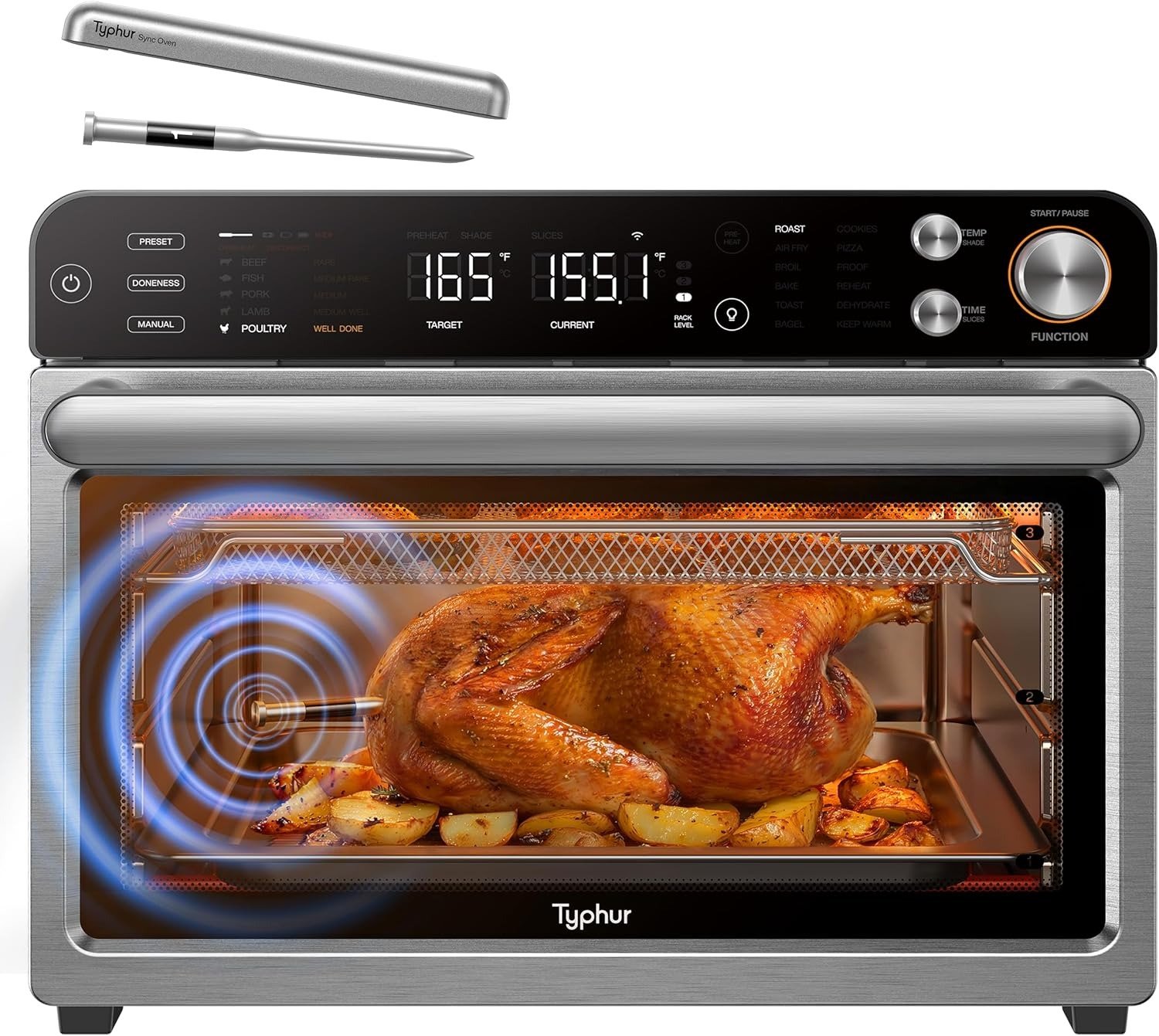
On paper the Sync Oven has a lot: a built-in wireless probe, app-based doneness control, dual heating elements, a 2400 RPM convection fan, a 27-quart cavity, and a 85°F to 450°F range across 12 cooking modes. In practice, those specs matter only if they combine to eliminate the moment you have to open the door and guess whether the center is done. The Sync Oven’s design is explicitly about solving that exact failure point.
Why the Probe Changes the Whole Experience
A good app alone is window dressing. A responsive probe changes the cooking model. The Sync Oven’s doneness logic attaches to a built-in wireless probe with five sensors and claimed ±0.5°F accuracy, with an automatic stop once target doneness is reached. That flips cooking from “set a time and hope” to “track the food and finish it at the right moment.” Practically, that reduces the background stress of chicken breasts, salmon, pork loin, or thicker steaks in a compact chamber where timing errors compound quickly.
What the Better Test Data Suggests
The Sync Oven’s performance metrics paint a clear behavioral picture: it preheats fast and runs hot enough to finish air frying more aggressively than many oven-style models. It reached 350°F in 2:54 in comparative tests, versus 3:23, 5:33, and 6:45 for three competing models. In the same comparisons it reached a 45% moisture-loss mark faster in air frying than those models, which is consistent with a unit that moves heat forcefully rather than circulating it lazily.
The Hidden Variable Most People Miss
Raw wattage or a long feature list can impress when the oven is empty. The real test is how precision holds up once cold food enters the chamber. Many ovens look strong in empty-chamber tests but lose composure in real cooking. That’s why language about temperature stability matters more than a preset tally: stability signals predictable cooks over time, not just a fast idle fan.
Where the Practical Benefit Shows Up First
The Sync Oven’s everyday value is in the unglamorous wins: reheated pizza that crisps, toast that browns quickly, weeknight chicken that stops where you want it, and frozen or breaded food that gets real exterior definition. Typhur says the cavity fits a 12-inch pizza, six slices of toast, a 6-pound whole chicken, or 2 pounds of fries; other measurements indicate room for a 13-inch pizza. Quick preheat plus usable capacity increases the chance you’ll reach for this rather than the full-size oven.
The User Pattern Around It
User feedback skews strongly positive for convenience and control. App ratings are very high across thousands of responses, and product comments often praise how the appliance replaces the need to heat a larger oven. That doesn’t mean perfection—bugs and confusing preset logic appear in some reviews—but it does mean buyers who embrace the probe-led workflow report consistent gains.
The Friction Point Is Also Clear
Smart appliances split into two camps: those whose intelligence saves attention, and those whose intelligence becomes an extra hurdle. Expect a learning curve. Some users report confusing preset logic and intermittent app quirks. If the software hides critical machine choices, the oven can feel like an extra step rather than a shortcut.
My Compatibility Split
- People who overcook proteins because they rely on time → High fit. The built-in wireless probe and auto-stop logic address that exact failure point.
- Households that reheat, toast, air fry, and roast often → High fit. Fast preheat and stable temperature behavior make the oven practical for daily mixed use.
- Buyers who want a simple knob-and-go oven with minimal app dependence → Medium fit. Much of the value lives in the app and probe workflow.
- People expecting a cheap replacement for every full-size oven task → Medium-low fit. It’s roomy for a countertop model but not a full wall oven substitute for all scenarios.
The Quiet Conclusion
When an oven preheats quickly, maintains composure, circulates heat forcefully enough to air fry credibly, and monitors the food instead of just the clock, it stops feeling clever and starts feeling dependable. For anyone whose main failure pattern is overcooked proteins or uneven reheats, the Typhur Sync Oven crosses a meaningful threshold. If you’re buying to reduce guesswork—especially on proteins—this is one of the few countertop ovens I’d seriously consider.
Evidence + emotion before CTA: The Sync Oven’s speed, stability, and probe-led stop logic combine into a straightforward outcome: fewer ruined dinners and less kitchen anxiety. If that matters to you, check whether this workflow fits your routine.
Final verdict: Buy
Three short reasons behind the verdict:
- Probe-led doneness with ±0.5°F-claimed accuracy fixes the most common countertop failure: stopping confidence.
- Fast preheat (2:54 to 350°F) and forceful heat delivery improve mixed-use performance, especially air frying.
- Stable temperature behavior preserves moisture and repeatability across real meals.
| Model | Category signal | Preheat to 350°F | Air-fry result | Moisture-loss pace | What that means to me |
|---|---|---|---|---|---|
| Typhur Sync Oven | RTINGS’ current best toaster oven overall. | 2:54 | 78% crispy fries vs BOV900, 75% vs Ninja, 52.9% vs BOV800 comparisons | 20:05 in RTINGS comparison views. | Fast, forceful, and more serious about air frying than most oven-style units. |
| Breville Smart Oven Air Fryer Pro BOV900BSS | Strong premium benchmark. | 6:45 | 78% crispy fries | 22:44 | Excellent oven reputation, but slower here. |
| Breville Smart Oven BOV800XL | Established classic. | 3:23 | 52.9% crispy fries | 31:26 | Still respectable, but the Sync looks more aggressive and modern in mixed-use cooking. |
| Ninja Foodi DT201 | Strong alternative. | 5:33 | 75% crispy fries | 25:57 | Good air-fry performance, but slower to heat. |
Transparency Note:
This analysis is not based on quick personal impressions.
It is derived from documented system behavior, verified user patterns, and the physical constraints of storage capacity.
The goal is to translate complex technical behavior into a realistic performance model that helps you make a clear decision