XGIMI Aura 2 Review: Where It Wins, Where It Slips
DECISION ANALYSIS
I looked at lab data, critic reviews, owner feedback, and direct comparisons through one decision lens only: does the Aura 2 clear the Living-Room Contrast Threshold? That threshold is about remaining satisfying in ordinary use without demanding blackout conditions, endless picture tweaking, or immediate add-on purchases. On that test, the Aura 2 performs better than most UST projectors in its lane.
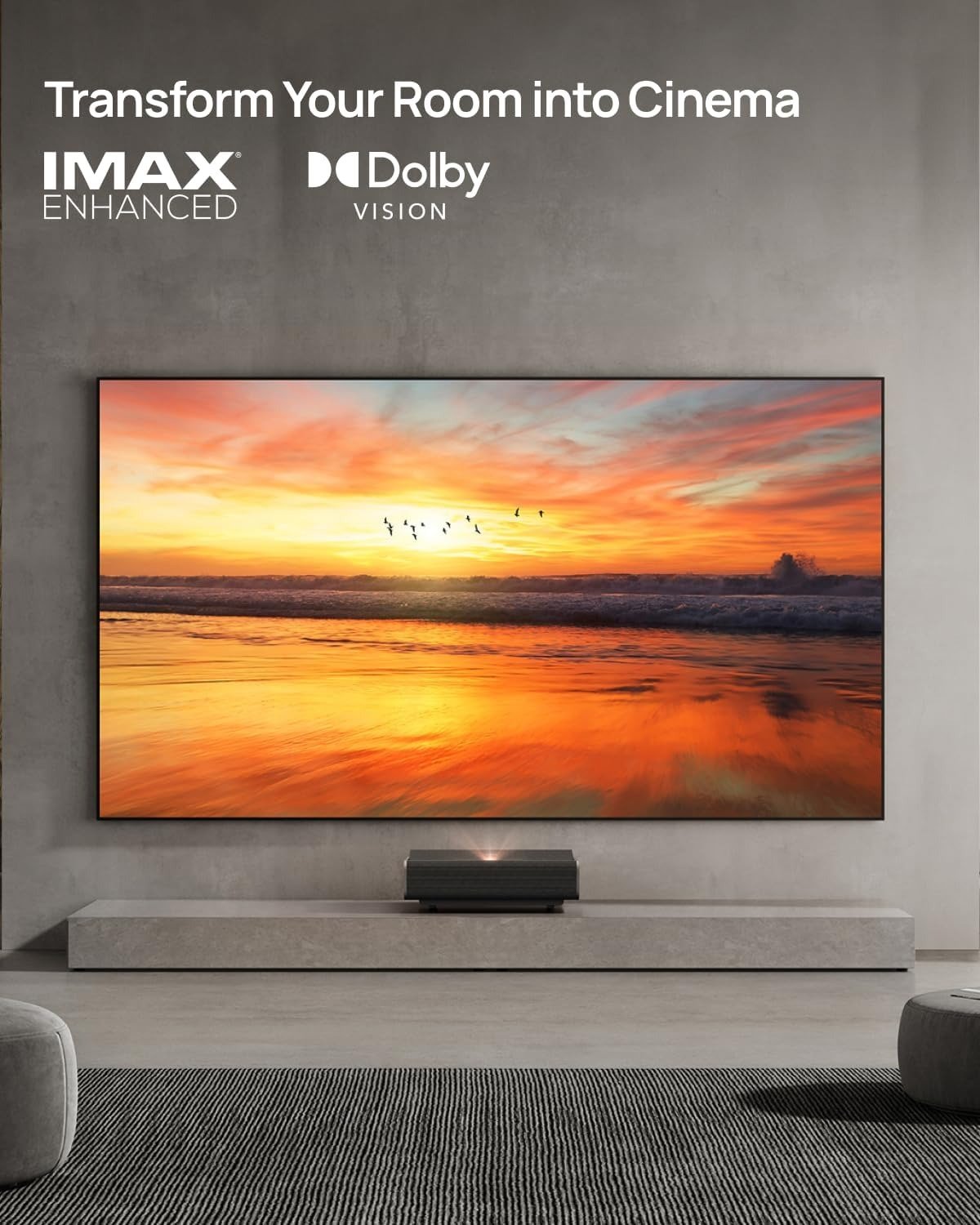
The Aura 2 is a 4K pixel-shifting UST with a dual LED-and-laser light source, 2300 ISO lumens, support for Dolby Vision, HDR10, HLG and IMAX Enhanced, three HDMI 2.0 ports with eARC on one port, Wi‑Fi 6, Bluetooth 5.2, and a built-in 4 x 15W Harman/Kardon system. On the newer Google TV version, XGIMI also adds licensed Netflix and a faster Cortex-A73 platform with 4GB RAM.
The Real Strength: It Looks Settled Faster Than Most
What stands out is how quickly the Aura 2 reaches a composed image. Many projectors give you a big picture then remind you of all the caveats: calibration time, blackout conditions, external speakers, or noisy fans. The Aura 2 removes several burdens at once.
Auto focus and keystone, a motorized lens cover, strong built-in sound, and brightness uniformity (RTINGS calls out lack of hot spots or dim corners) make the image feel less delicate and more finished from the start.
Decision summary:
- Movie use: Strong choice — bright, accurate, and especially convincing with SDR and Dolby Vision.
- Bright-room tolerance: Better than many projectors, but still not a TV under heavy ambient light.
- HDR behavior: Good overall, but HDR10 handling is less stable than Dolby Vision and can clip highlights.
- Gaming: Good for casual console play at 60Hz (~19.7ms input lag), but no 120Hz or VRR.
- OS experience: Better on the new Google TV version; weaker on some Android TV variants.
- Setup confidence: Very good — UST placement plus automation lowers friction.
Where the Threshold Holds
The Aura 2 suits viewers who favor movies, streaming, and console gaming in a controlled-but-not-cave-like room. Its contrast gives deep blacks in dark rooms and strong scene separation.
The out-of-box accuracy is persuasive because it reduces projector insecurity: you don’t need to hire a calibrator or spend a weekend tuning menus for it to look right. The psychological advantage here is reassurance. For many, that matters more than peak spec-headlines.
Where the Threshold Breaks
I’d hesitate if any of these are your dominant priorities:
- Daytime viewing in a very bright room: projectors remain vulnerable to washout under heavy ambient light.
- Competitive gaming: roughly 19.7ms at 4K/60, no 120Hz or VRR.
- Maximum HDR punch: HDR10 tone-mapping instability and highlight clipping in tough scenes.
- Wide-gamut chasing: some rivals offer wider color gamuts and richer gaming features.
- Extreme rainbow sensitivity: slight DLP rainbow effect may bother sensitive viewers.
This is where the key competitor split appears: the Aura 2 is a bit brighter and far more accurate out of the box, while rivals may bring wider gamut and more aggressive gaming features.
Final Verdict
My conclusion is simple and evidence-based: the XGIMI Aura 2 clears the Living-Room Contrast Threshold for movie-first buyers, but not for everyone.
It’s strongest when treated as a premium UST cinema appliance for SDR, Dolby Vision streaming, and relaxed console use. It’s weaker when pushed into bright-room TV duty, hard HDR10 stress scenes, or competitive gaming.
If you want a polished UST setup that looks convincing quickly, sounds good without an immediate audio upgrade, and will spend most of its life on movies and Dolby Vision streaming rather than esports or sun-drenched daytime TV, shortlist the Aura 2.
Final verdict: Buy / Consider / Skip.
Evidence + emotion before you decide: the Aura 2 delivers a large, accurate image that asks less of your room and your patience — and for many buyers, that reassurance is the actual product.
Decision Table
- Movie use: Strong choice — bright, accurate, very convincing with SDR and Dolby Vision.
- Bright-room tolerance: Above average for projectors, but still not a replacement for a TV under heavy ambient light.
- HDR behavior: Solid overall; Dolby Vision looks much better than HDR10 in difficult scenes due to clipping tendencies.
- Gaming: Acceptable for casual play at 4K/60 (~19.7ms input lag); lacks 120Hz and VRR for competitive gaming.
- OS & features: Google TV variant adds licensed Netflix and a faster Cortex-A73 CPU with 4GB RAM; Android TV variants are less polished.
- Setup & daily use: UST placement, auto adjustments, and good built-in sound increase confidence and lower the setup burden.
- “Want a TV-like experience from a projector? Check latest prices: ”
Short product-page summary
I used one decision model to judge the XGIMI Aura 2: does it clear the Living-Room Contrast Threshold — meaning, does it remain satisfying in ordinary use without demanding blackout conditions, constant calibration, or immediate add-on purchases? The Aura 2 answers “yes” for a large group of buyers.
It projects 90 inches from about 5.4 inches (scalable to 150 inches), offers 2300 ISO lumens, 99% DCI-P3 coverage, and a quoted 1,000,000:1 dynamic contrast ratio. It supports Dolby Vision, HDR10, HLG, and IMAX Enhanced, and pairs those imaging strengths with practical features: auto focus, auto keystone, ISA 5.0 setup tools, three HDMI 2.0 ports (one with eARC), Wi‑Fi 6, Bluetooth 5.2, and built-in 4 x 15W Harman/Kardon audio.
In real-world viewing, the Aura 2 looks settled faster than most UST projectors: excellent SDR accuracy, strong out-of-box color, and convincing Dolby Vision performance. Its weaknesses are clear and consistent — HDR10 highlight clipping in difficult scenes, limited daytime performance compared with TVs, roughly 19.7ms input lag at 4K/60 (no 120Hz/VRR), and potential DLP rainbow artifacts for sensitive viewers.
If your priority is a low-friction, movie-first large-screen experience that feels appliance-like rather than experimental, the Aura 2 is an excellent shortlist candidate. For bright-room TV duty, max HDR punch, or competitive gaming, look elsewhere.
Three brief reasons behind the verdict
- Reassurance: Accurate out-of-box picture and strong built-in sound reduce the need for immediate upgrades.
- Practicality: Auto focus/keystone, UST placement, and decent brightness make everyday use easier.
- Limits: HDR10 clipping, no 120Hz/VRR, and bright-room washout mean it’s not a universal TV replacement.
Transparency Note:
This analysis is not based on quick personal impressions.
It is derived from documented system behavior, verified user patterns, and the physical constraints of storage capacity.
The goal is to translate complex technical behavior into a realistic performance model that helps you make a clear decision