Why a Security Camera System Can Look Excellent and Still Fail at the Wrong Moment
ANALYSIS FRAMEWORK
Most people think home security breaks at the point of coverage. I did not come away with that conclusion. What stood out to me was something quieter: a system can look sharp, cover a wide area, record all day, and still lose the exact detail that matters when a person moves through the frame at night. That is the real threshold. Not whether the cameras are on, but when usable evidence starts to drift away from what the eye expected.
I kept seeing the same pattern across wired PoE systems and user discussions. Daytime confidence is usually easy. The image is clean, the installation feels stable, and the local NVR model removes the constant anxiety of subscriptions and cloud dependence. But when movement, darkness, distance, and timing collide, the question changes. It is no longer “Can this system see?” It becomes “Can this system hold enough detail at the exact second I need to identify what happened?”
That is why the better way to judge a camera kit is not by megapixels alone. It is by the point where performance shifts from reassuring to actionable. The hidden split is simple: some systems are built to monitor space, while others are good enough to preserve useful evidence when behavior becomes fast, irregular, and low-light. That is where this category gets more honest.
The Real Problem Is Not Coverage, It Is Night Motion Drift
The more I examined real-world comments and hardware specs, the more obvious this became: a security system often feels strongest when nothing is moving. Static scenes look crisp. Driveways look wide. Yards feel covered. But the failure pattern begins when motion enters darkness and the system has to balance exposure, shutter behavior, bitrate, and available light. That is when detail can soften, faces can smear, and confidence can drop even if the footage technically exists.
This is why a lot of buyers are initially impressed by resolution numbers. A 12MP frame looks like a major step forward on paper. And in daylight, it often is. Extra detail helps with distance, facial clarity, and scene review. But several experienced users comparing Reolink’s 12MP generation with its 8MP alternatives said the daytime gain was more noticeable than the night gain, and some felt lower frame behavior or low-light motion still remained the real limit. That does not make higher resolution meaningless. It just means the threshold is mechanical, not marketing.
What a Good Local PoE System Actually Solves
What I do trust more in this category is the stability advantage of a wired PoE kit with local recording. One Ethernet run per camera, a central NVR, 24/7 local storage, and no mandatory monthly fee solve problems that a lot of cloud-first systems never really escape. You reduce dependency, improve continuity, and stop treating security like a subscription-shaped convenience layer. That matters more than many buyers realize.
A good wired system also changes behavior. You stop thinking in terms of charging, signal fluctuation, and missed battery events. You start thinking in terms of placement, angle, light discipline, and retention time. That is a healthier security model because it forces the conversation back to evidence quality instead of app theatrics.
The Threshold That Separates Monitoring From Evidence
The phrase I kept coming back to was this: coverage is not the same thing as proof. A camera can absolutely tell me that something happened. That is not the same as giving me the frame that settles who did it. The threshold usually appears when one or more of these conditions stack up:
| Condition | What Starts to Drift |
|---|---|
| Fast subject movement at night | Facial clarity and edge detail |
| Longer viewing distance | Useful identification confidence |
| Weak ambient lighting | Dependence on IR or spotlight behavior |
| Poor placement angle | Exposure imbalance and wasted pixels |
| Overreliance on notifications | Delay between event and review |
These are not dramatic failures. They are partial failures, which are more dangerous because the system still feels trustworthy right until the important clip is not as useful as expected.
Why This Matters Before Choosing a System Like the Reolink RLK16-1200B8-A
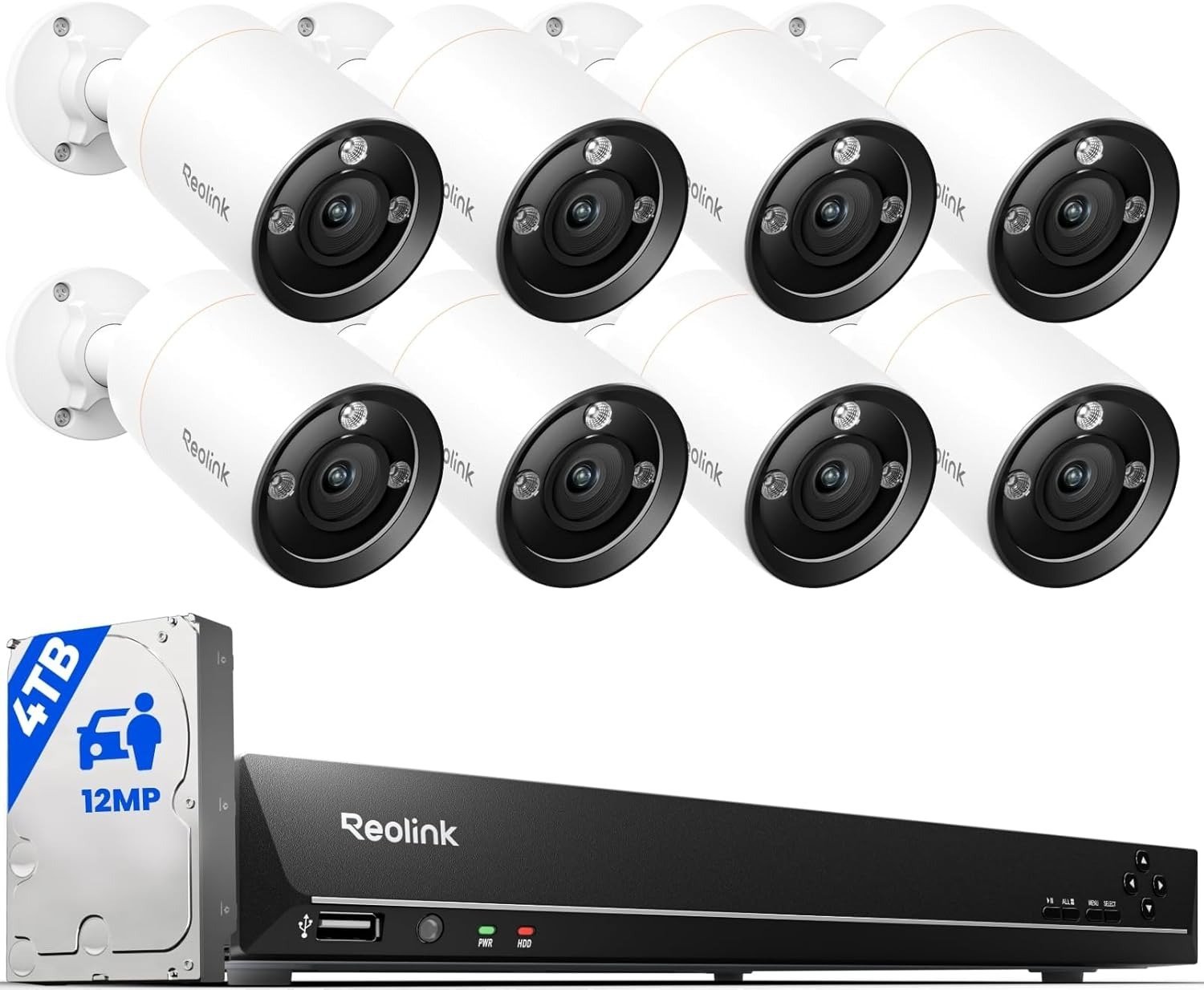
When I look at a system such as the Reolink RLK16-1200B8-A, the value proposition becomes much clearer when viewed through this threshold model. On paper, it gives exactly the kind of architecture I like seeing in a serious home setup: eight wired 12MP PoE bullet cameras, a 16-port NVR, local 24/7 recording, a built-in 4TB drive, expandability, person/vehicle/pet detection, color night vision via spotlight, and no required subscription layer. That is a strong structural foundation.
The sharper question is not whether that foundation is good. It is whether the buyer understands what it is best at. A system like this is strongest for people who want local control, broad property coverage, a clean wired backbone, and enough detail to review incidents without building an enterprise surveillance stack. It is not magic. It still obeys lighting, motion, angle, and behavior. But structurally, it solves the right class of problems first.
My Bottom Line
After going through the technical side and the real user patterns, I would frame the category this way: the best wired home security systems are not the ones that promise invincibility. They are the ones that stay stable, record locally, reduce false dependence, and hold enough clarity before the night-motion threshold is crossed. That is the real battle. And that is exactly why some people end up satisfied with a system for years, while others discover too late that what they bought was good at watching but less decisive at proving.
Transparency Note:
This analysis is not based on quick personal impressions.
It is derived from documented system behavior, verified user patterns, and the physical constraints of storage capacity.
The goal is to translate complex technical behavior into a realistic performance model that helps you make a clear decision
One Comment