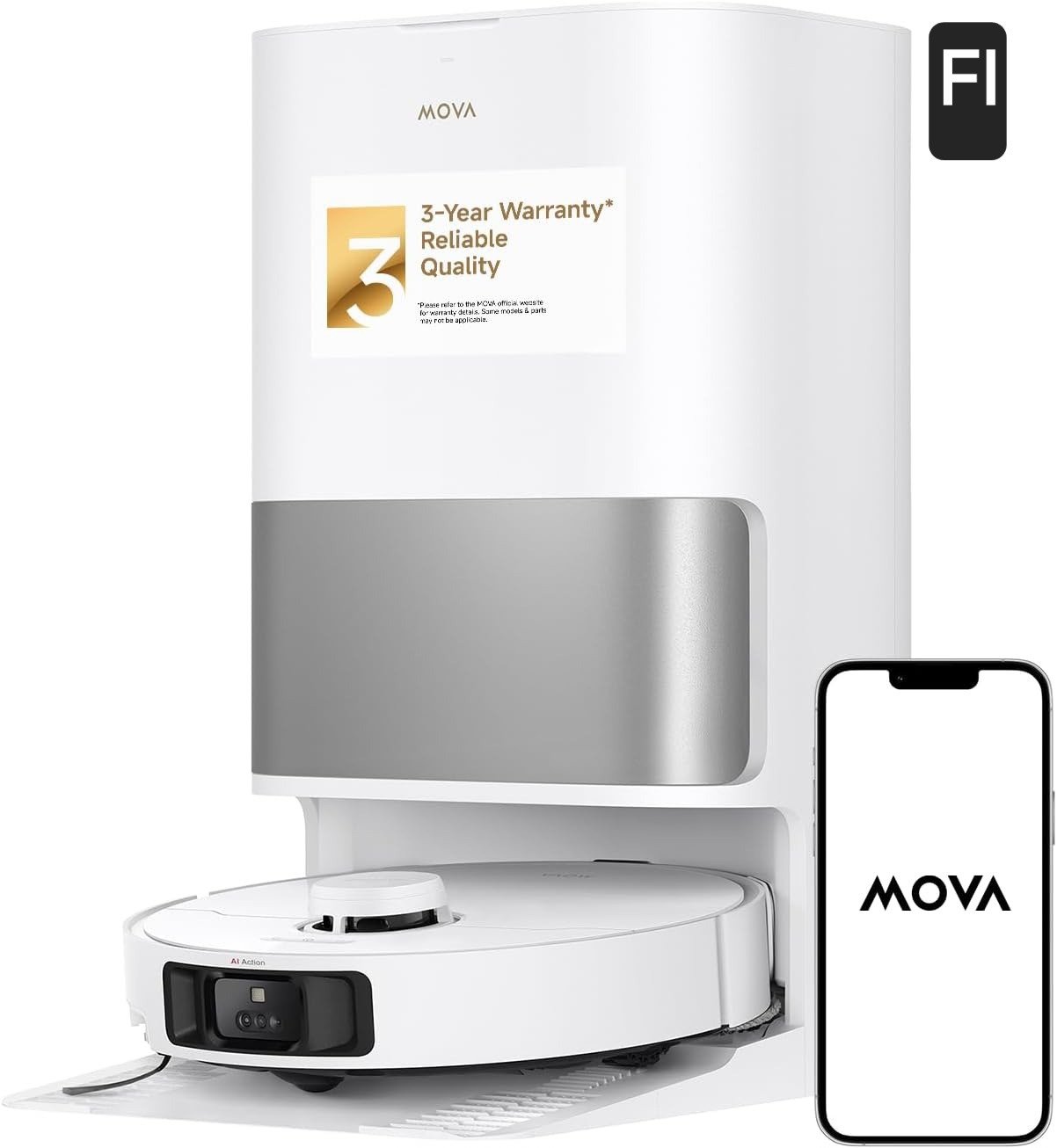
The First Week Felt Effortless—Then the Carpet Edges Started Telling on It
ANALYSIS FRAMEWORK
In the beginning, I thought the MOVA P10 Pro Ultra was going to be one of those rare “set it and forget it” robots: it navigated like it could see, it avoided cables and toys without me pre-cleaning the room, and the dock handled the messy parts—emptying, refilling, washing, drying—so the routine stayed frictionless. RTINGS’ lab results back up that “hands-off” feeling: obstacle handling is a standout, even in clutter, with excellent avoidance and virtually no intervention.
But a robot vacuum doesn’t fail loudly at first.
It fails quietly—through small, repeatable drifts.
And with this model, the drift I kept seeing in the data and owner reports is not about navigation. It’s about a mechanical choice that changes what happens on carpets.
The Hidden Mechanical Variable: When the Side Brush Stops Being “Allowed” on Carpet
Here’s the uncomfortable variable most people miss: on carpet, the P10 Pro Ultra doesn’t use its side brush, and that changes the entire edge-cleaning physics. RTINGS is blunt: it performs poorly on carpets in part because it can’t pick up debris along carpet edges and corners, leaving material along walls.
Psychologically, this is why the first days feel “perfect”:
You notice the open-floor cleanliness first.
You trust the robot because it doesn’t get stuck.
You stop scanning the room for problems.
Then you notice something small: dust lines near baseboards on carpeted rooms.
Not catastrophic—just… persistently there.
The Threshold You Can Actually Observe (Not Drama)
This isn’t “it depends.” It’s a threshold you can watch for.
Threshold Anchor (Field Signs):
After 5–7 daily runs on carpet-heavy rooms, the same edge zones keep reappearing. (Owners keep describing “looks great overall, but edges…”)
You start doing repeat passes or manual spot vacuuming near walls (a behavioral tell: the robot is no longer “closing the loop”).
The robot still feels intelligent because obstacle avoidance remains excellent—so the problem hides behind competence.
That’s the trap: navigation excellence can mask pickup drift.
Drift Path (What Degrades, Step by Step)
This is the drift pattern that emerges when carpet performance is the mismatch:
Step 1: Vacuuming looks “fine” because the brushroll path is clean.
Step 2: Edge debris survives because the side brush isn’t engaging on carpet.
Step 3: You notice it only when light hits the baseboards / corners (visual proof anchor).
Step 4: You schedule extra runs (time cost increases).
Step 5: Manual intervention returns—exactly what you bought the dock-equipped robot to avoid.
This is not a “bad robot” story.
It’s a system mismatch story.
What It’s Genuinely Great At (So You Don’t Misread the Product)
If your home is mostly hard floors, the P10 Pro Ultra’s value proposition becomes real:
Strong overall power numbers in independent testing (Vacuum Wars measured above-average airflow and suction in their evaluations).
A premium-style dock that automates the daily pain: auto-empty, water management, hot wash + heated drying.
Mop lifting (10.5 mm) so it can handle mixed runs without soaking rugs.
Owners repeatedly frame it as the “sweet spot” where spending more hits diminishing returns—especially for routine scheduled cleaning.
This is why ratings stay solid: Amazon UK shows ~4.3/5 with a large review count, and BestBuy Canada shows 4.3/5 (smaller sample).
The Psychological Core: Why People Love It… Even When It Has a Weak Spot
People don’t bond with suction numbers.
They bond with reduced friction.
The P10 Pro Ultra sells a lifestyle loop:
It avoids obstacles so you don’t “prep” rooms.
The dock handles maintenance so you don’t “babysit” runs.
The app is full-featured enough to feel like control without complexity.
That creates trust inertia—you assume it’s also solving the parts you don’t look at closely (like carpet edges).
So the drift isn’t noticed immediately. It’s noticed only when you’re already emotionally invested in the routine.
Decision Divergence (Two Paths, No Gray Zone)
Path A — System Compatible → Buy
Choose the MOVA P10 Pro Ultra if:
- Your home is mostly hard floors (tile/wood/vinyl).
- Your biggest pain is clutter + obstacle chaos (cables, toys, pet bowls).
- You want a dock that reduces daily maintenance friction.
Path B — System Misaligned → Pause
Pause (or reassess) if:
- You have low-pile carpet-heavy rooms and you care about edges/corners looking “finished.” RTINGS shows carpet edge performance is a core weakness.
- You’re buying this mainly for pet hair embedded in carpet—RTINGS notes poor pet hair pickup on carpets in their testing.
This isn’t you being “picky.”
This is you refusing to pay premium money for a loop that reintroduces manual cleanup.
My Bottom Line (Grounded, Not Salesy)
If I judge it by the only metric that matters in real homes—does it keep the cleaning loop closed without me stepping in?—then the MOVA P10 Pro Ultra is dangerously good in the environments it’s mechanically aligned with (hard floors + clutter), and quietly disappointing in the environments where carpet edges define “clean.”
So the product isn’t “good” or “bad.”
It’s precise.
And once you know the hidden variable (carpet edge behavior), you stop guessing—and you stop regretting.
**This analysis is based on aggregated user feedback, verified buyer reviews, and technical documentation. It is designed to provide structured clarity rather than personal opinion**
One Comment