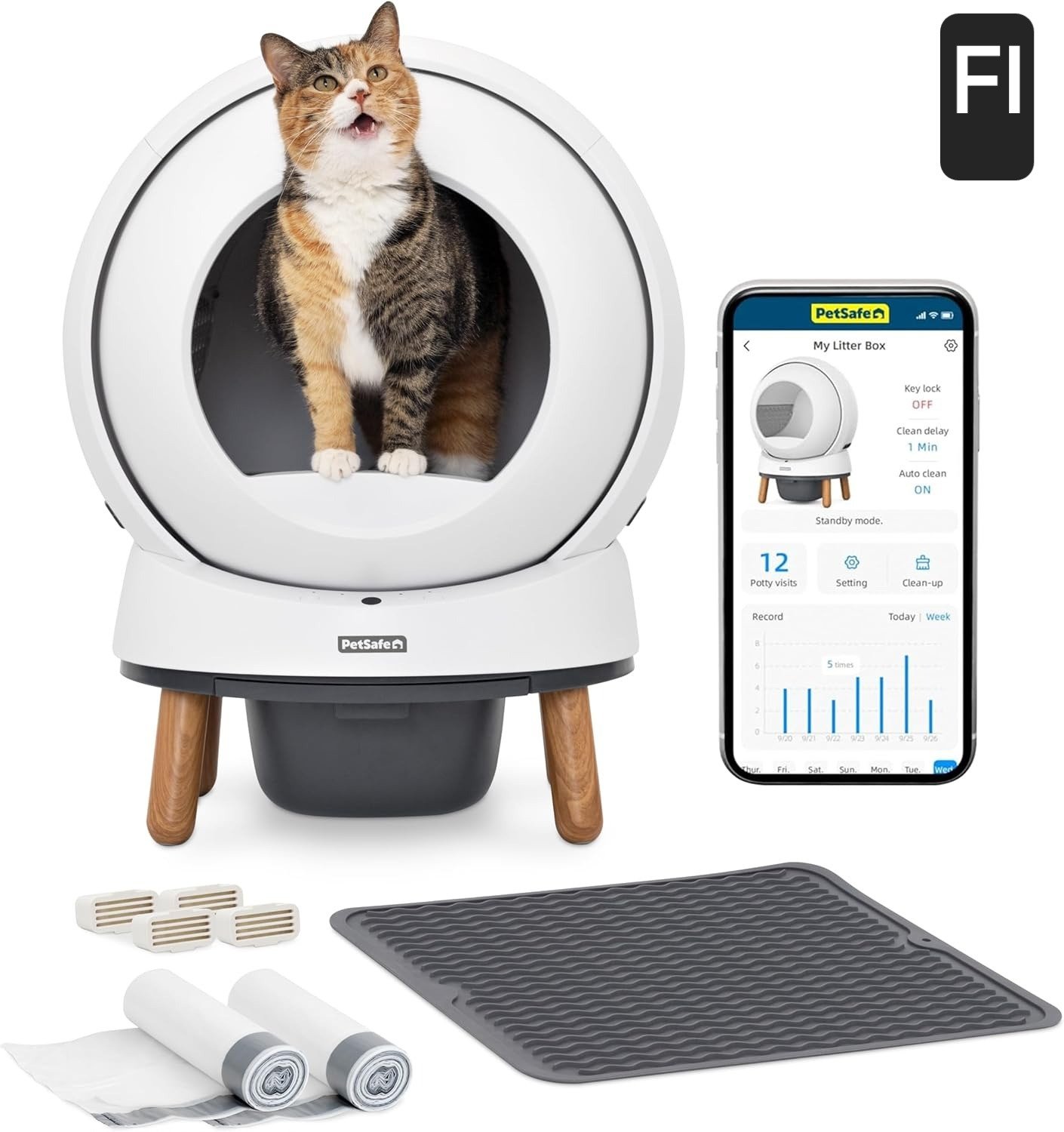
I Thought an Automatic Litter Box Would Remove the Problem — Until I Realized It Redefined It
DECISION ANALYSIS
The first night I plugged it in, I felt relief.
No scoop in my hand.
No
bending before coffee.
No silent resentment toward a plastic box in the corner of my home.
But three days later, I caught myself staring at it.
Why?
Because when something cleans itself, you stop watching it.
And when you stop watching it, trust becomes the new variable.
That’s when I understood something important:
This is not a convenience purchase.
It’s a stability decision.
Executive Signal Layer (Key Takeaways)
If your main goal is to eliminate daily scooping, then SmartSpin can lower friction significantly — provided cleaning cycles remain consistent.
If your cat is sensitive to surface texture and smell shifts, then rotating-drum mechanics become the true decision threshold.
If you travel often or leave home for long hours, then sensor reliability defines your risk margin.
If you expect zero maintenance, then recalibrate — automation reduces labor frequency, not responsibility.
If odor control is your priority, then drawer sealing and timely emptying matter more than the word “automatic.”
No hype.
Just filters.
The Real Decision Variable — Clean Appearance vs. Mechanical Stability
At first glance, the SmartSpin feels elegant.
It rotates. It sifts. It hides waste in a sealed lower drawer.
It looks clean.
But here’s the question I had to ask myself:
Why does “looking clean” not always equal “feeling stable”?
Because this system rotates the entire litter bed.
That means the surface your cat steps on is constantly re-leveled.
It is dynamic, not static.
For some cats, that’s irrelevant.
For others, even minor shifts in texture or residual scent can lower comfort.
The governing equation became clear to me:
Perceived Surface Stability ÷ Mechanical Consistency = Behavioral Confidence
If consistency stays high, confidence stays intact.
If it dips, hesitation begins.
Cats don’t negotiate hesitation.
Failure Progression — The Quiet Cascade Nobody Markets
Let me describe what worried me most.
Not the noise.
Not the design.
Delay.
A small sensor obstruction.
A delayed cycle.
A drawer that fills a little too long.
Nothing dramatic happens at first.
Then:
Waste accumulates slightly.
The surface smells different.
Your cat pauses.
The pause becomes avoidance.
The floor becomes the alternative.
Why does this matter?
Because automation compresses time.
Manual scooping spreads responsibility daily.
Automation demands consistent mechanical performance.
If reliability drops below your tolerance threshold, stress rises fast.
Scenario Modeling — Where You Fit Changes Everything
I ran two realistic scenarios in my mind before committing.
Scenario One:
Single cat. Moderate sensitivity. Stable clumping litter. Owner present daily.
In this case, the system lowers daily friction dramatically.
Weekly oversight feels manageable.
Stress stays low.
Scenario Two:
Two cats. One territorial. Open living space. Long workdays.
Now the drawer fills faster.
Surface shifts happen sooner.
If a cycle stalls, behavioral consequences escalate quickly.
Same product.
Different stability margin.
Which one are you?
Boundary Conditions — When Performance Shifts
Performance shifts when:
- Litter clumps smear instead of isolate.
- The waste drawer exceeds its practical capacity.
- Sensors accumulate dust.
- Maintenance gets delayed “just this once.”
One boundary crossed is manageable.
Two crossed at the same time?
Instability grows.
Why does this matter?
Because systems don’t fail all at once.
They degrade gradually.
Expert Discipline — How to Keep the System Above Threshold
If you decide to move forward, discipline protects stability:
- Use firm, fast-clumping litter only.
- Clean sensors before they appear dirty.
- Empty the drawer earlier than necessary.
- Introduce gradually — keep the old box temporarily.
- Watch behavior closely during the first 2 weeks.
Automation rewards attention.
Neglect shortens tolerance windows.
Conditional Verdict — Direction Without Pressure
If your dominant frustration is daily scooping fatigue and your cat adapts well to subtle surface variation, this system can meaningfully reduce cognitive load and visible mess.
If your dominant fear is behavioral regression or mechanical inconsistency while you’re away, your decision must hinge on reliability tolerance, not convenience appeal.
If your household matches the first profile and you are willing to maintain mechanical discipline, then this is the exact model I analyzed:
Not because it is perfect.
But because, under the right thresholds, it aligns.
And that is the only thing that matters.
**This analysis is based on aggregated user feedback, verified buyer reviews, and technical documentation. It is designed to provide structured clarity rather than personal opinion**
One Comment