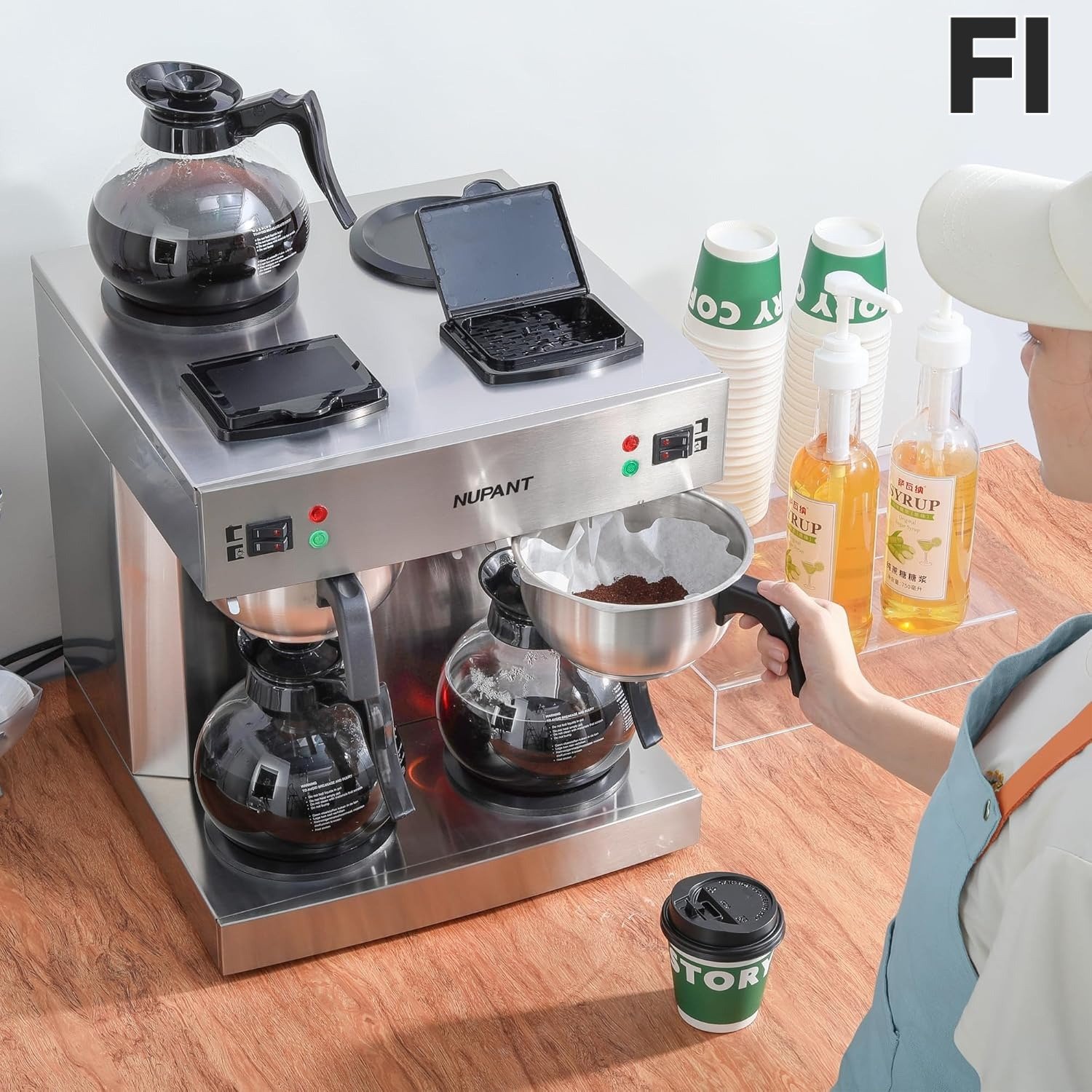
Why Does Bulk Coffee Keep Failing Even When “Nothing Changed”?
ANALYSIS FRAMEWORK
We’ve all seen it.
Same beans. Same scoop. Same water line. Same room.
Yet one pot tastes fine, the next is
thin, and the third is hot-but-wrong.
Why?
Because in high-volume drip service, the enemy isn’t flavor. It’s variance—tiny shifts that stack until people stop trusting the station.
And once trust drops, the coffee starts dying socially before it dies chemically. People hover. They sniff. They ask, “Is this fresh?” Then they walk away.
We don’t lose users to “bad coffee.”
We lose them to unreliable outcomes.
The Five Variables That Quietly Create Variance
When a brew station feels unstable, it usually comes from five places:
- Heat recovery between cycles
- Flow rate stability during extraction
- Timing predictability (start → finish)
- Holding behavior (warmth without burn)
- Operator friction (small steps that get skipped)
Why does this matter?
Because most of these aren’t “coffee” variables. They’re system variables.
And systems don’t fail loudly at first. They drift.
Mechanism-to-Sensory Translation — Where We Can Actually Feel the Problem
We don’t experience “mechanisms.” We experience outcomes.
So we translate every mechanical variable into something we can notice—fast, with our senses—while we’re busy and not thinking like engineers.
Heat Recovery Consistency
→ the unit feels like it “snaps back” the same way after each batch
→ staff stop hovering and start trusting timing
Flow Stability
→ the brew doesn’t swing between watery and overcooked without explanation
→ fewer “let’s redo it” cycles
Holding Behavior
→ coffee stays warm without that sharp hot-plate smell creeping in
→ fewer silent dumps and angry re-brews
Operator Friction
→ the station feels “obvious” instead of fussy
→ fewer skipped steps when the room gets crowded
This is where stability becomes human: not in specs, but in what the station lets us stop doing—checking, guessing, babysitting.
A Short Real Scene — The Moment Trust Breaks
We’re in a rush.
Someone pours a cup, takes a sip, and pauses.
Not dramatic—just enough.
They glance at the pot.
They sniff.
They don’t complain. They just… don’t refill.
Why does that small moment matter?
Because that’s how a station collapses: not with one big failure, but with micro-doubts that spread.
When people don’t trust the pot, they start “sampling” instead of “using.”
Sampling is cognitive load. Cognitive load creates avoidance.
That’s variance turning into behavior.
Constraint Awareness — Where High-Volume Stations Break in Real Life
A stable brew system still has constraints. If we ignore them, the station punishes us.
Mechanical Constraints
- Batch discipline (overfilling can create mess or overflow behavior)
→ we experience “sudden chaos”
→ staff start underfilling to avoid risk, and throughput dies - Heat protection cycles (some designs pause when too hot)
→ we experience “it stopped”
→ people interpret protection as failure unless they understand it
Environmental Constraints
- Outlet/circuit stability
→ we experience weird cycling or sudden resets
→ trust drops because the station behaves differently day to day
User Skill Constraints
- Rotating staff, different habits
→ we experience inconsistency that looks like “the machine’s mood”
→ the station becomes a recurring argument
Why is this the part most people skip?
Because constraints don’t look like features.
They look like “annoyances.”
But annoyances are what decide whether a system gets used or avoided.
The Pattern We Hear in People’s Reactions (Without Turning This Into a Review)
When users talk about this category of dual-station, multi-carafe drip systems, their language tends to fall into two buckets:
Bucket A: “It’s straightforward.”
→ sensory signal: fewer steps, fewer surprises
→ behavioral result: people keep using it even under pressure
Bucket B: “It scared me / it failed / it felt unsafe.”
→ sensory signal: odd smells, sudden stops, unpredictable heat behavior
→ behavioral result: people refuse to leave it unattended
Why does Bucket B dominate memory?
Because once a machine gets tagged as a risk object, every minor anomaly becomes evidence.
Even normal heat cycling starts feeling suspicious.
This is the psychological fork:
“utility appliance” versus “thing we must monitor.”
Expert Tip — The One Test That Predicts Station Stability
If we want a quick reality check, we don’t start with taste.
We run a repeatability test:
Brew cycle #1, then #2, then #3—back-to-back.
And we ask:
Do we get the same heat feel, the same timing feel, the same “confidence feel”?
If cycle #2 already feels different, variance is already winning.
And variance always gets worse when real life hits: busy hands, imperfect fills, imperfect outlets, imperfect patience.
The Equilibrium Gap — Why We’re Still Not Ready to “Decide” Here
This is where informational intent ends.
We can see the system problem: variance.
We can map its sources: recovery, flow, holding, friction.
We can feel how it behaves: trust or doubt.
But we still haven’t closed the only question that matters:
Why does this specific build behave as a stability engine in some environments…
and become a stress machine in others?
That closure belongs in the Decision Article—where we do full constraint mapping, trade-offs, and worst-case simulation.
Controlled Exit Toward Decision
If we’re searching right now, we’re not really searching for “a coffee maker.”
We’re searching for a station that becomes boringly reliable—
so we can stop thinking about it.
Here’s the next step:
One Comment