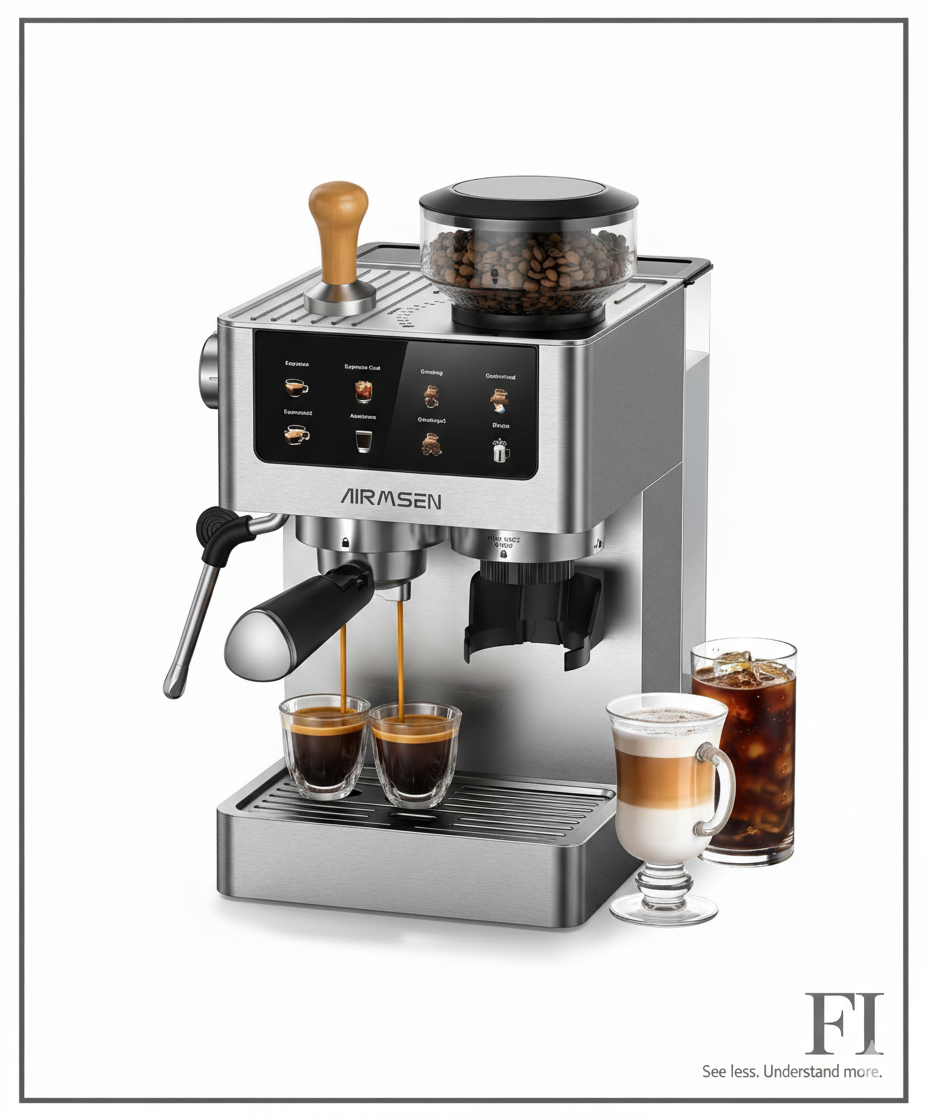
Why Our Home Espresso Feels Inconsistent Even When We Do Everything “Right”
ANALYSIS FRAMEWORK
We used to blame the beans.
Then we blamed the grind.
Then we blamed ourselves.
But after weeks of pulling shots back-to-back, I noticed something uncomfortable: the process looked identical, yet the cup behaved differently.
Why?
Because espresso at home is not a flavor problem. It is a variance problem.
One tiny mechanical shift — grind distribution, puck saturation, pressure timing, steam behavior — and the result drifts. Not dramatically. Just enough to make us doubt the system.
And doubt is what kills daily consistency.
The Real Enemy Is Not Bad Coffee — It Is Mechanical Drift
I started paying attention to sound.
The grinder tone slightly higher one morning.
The first drops forming too quickly another day.
The steam wand hissing aggressively instead of softly breathing.
Mechanical Variable
→ Audible or Visible Signal
→ Behavioral Consequence
When particle size distribution changes
→ The flow starts unevenly
→ I compensate with pressure or dose adjustments that create new instability.
When pre-infusion is inconsistent
→ The puck darkens on one side first
→ Channeling begins before I can see it.
When steam power surges
→ Milk expands too fast
→ Texture becomes airy instead of dense.
None of this feels dramatic.
But together, it builds silent instability.
Why We Misdiagnose the Problem
Most of us chase taste adjustments.
We grind finer.
We tamp harder.
We switch beans.
But we rarely ask:
Why did the system behave differently today?
Because if a machine integrates grinding, extraction, and steaming inside one workflow, the variables are not isolated. They influence each other.
If grinding produces slightly inconsistent particles
→ Water finds weak paths
→ Pressure feels strong but extraction weakens
→ We blame the roast.
If temperature recovery lags
→ The cup cools subtly faster
→ We think the shot was under-extracted.
We are correcting symptoms, not causes.
Constraint Awareness — The Hidden Layer Nobody Talks About
There is another factor we ignore.
Time.
Morning pressure changes behavior.
If a machine reduces the number of manual corrections
→ We hesitate less
→ We repeat the same routine
→ Stability improves.
If cleaning feels complex
→ We delay maintenance
→ Residue builds up
→ Flow changes without warning.
Mechanical constraint
→ Sensory change
→ Habit shift
→ Outcome drift.
Why does this matter?
Because espresso stability is not created by specs. It is created by reduced daily friction.
The Worst-Case Scenario Nobody Mentions
The real danger is not a bad cup.
It is slow inconsistency.
A machine that performs well the first week
→ Then small deviations appear
→ We start adjusting every morning
→ The routine becomes reactive instead of stable.
Once that happens, we stop trusting the system.
And when trust disappears, we stop using the machine daily.
That is the true failure.
The Equilibrium Question We Must Answer
So the question is not:
Is the coffee good?
The real question is:
Does the system reduce mechanical variance under real-life constraints — time pressure, skill limits, cleaning habits — without increasing cognitive load?
That is where the decision becomes structural, not emotional.
If you want the full mechanism breakdown, constraint mapping, trade-off logic, and worst-case simulation that closes this gap, continue here → Decision Framework for This Integrated Espresso System.
Only one path forward.
No comparison.
No distraction.
Just structural clarity.
![The Hands-Free Espresso Problem: When Convenience Breaks Consistency ([شاركنينجا][1])](https://focusedinsight.net/wp-content/uploads/2026/02/image-26.png)