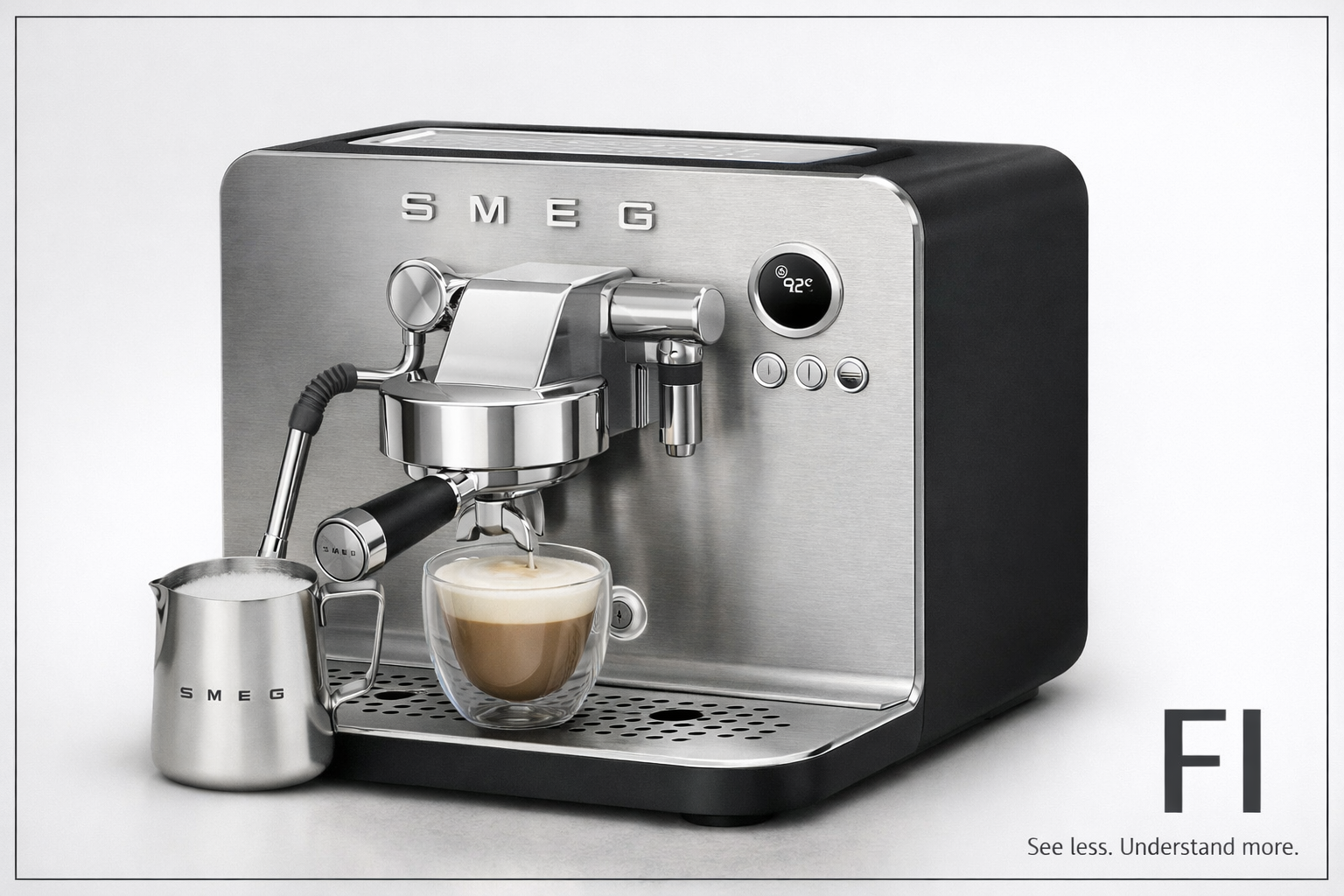
SMEG EMC02 Espresso Machine Review: Structural Stability Breakdown
DECISION ANALYSIS
When I approached this SMEG EMC02 espresso machine review, I did not evaluate taste first. I evaluated structure.
Because in the semi-pro espresso machine category, instability does not come from flavor potential. It comes from workflow mechanics, thermal behavior, and how honestly the machine exposes user precision.
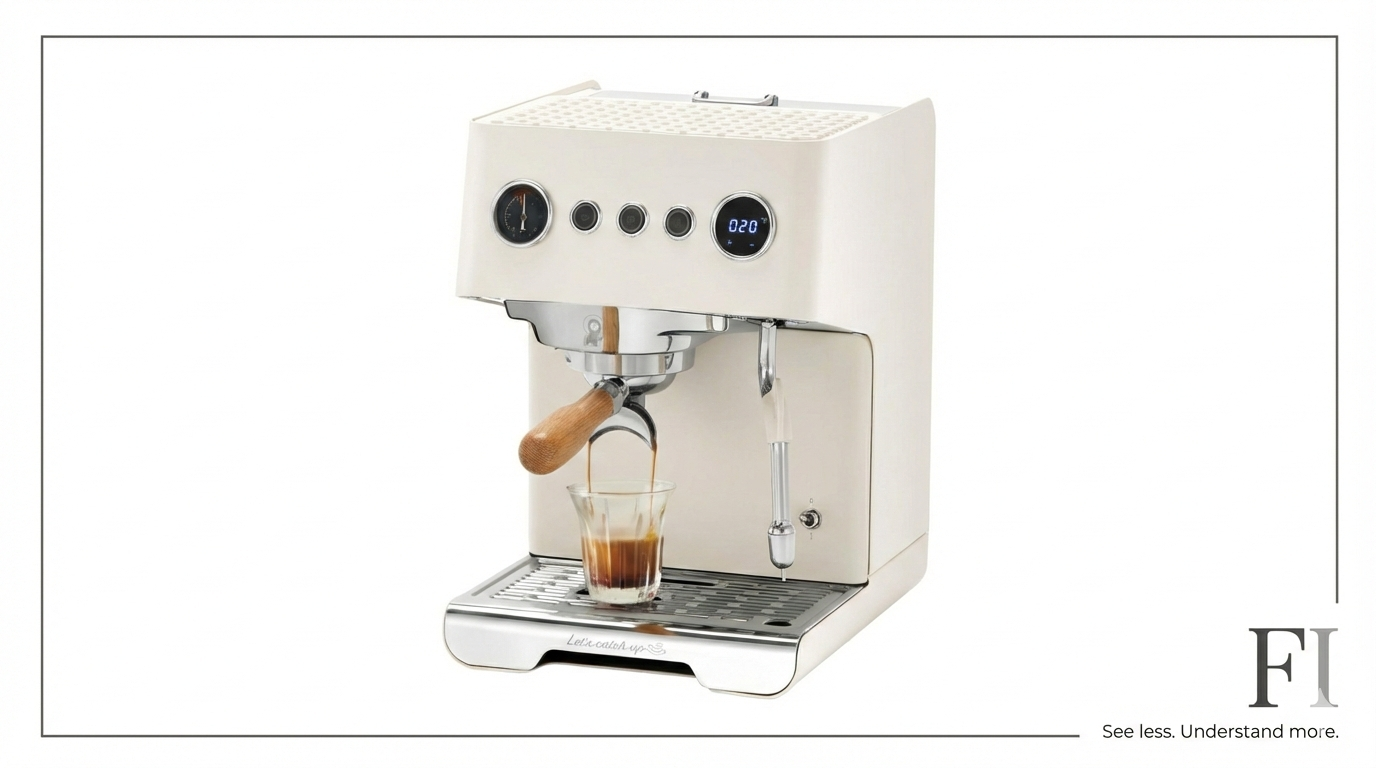
The SMEG EMC02 positions itself as a design-forward, triple thermoblock, 58mm platform. The real question is not aesthetic. It is structural:
Does it behave like a stabilizer, or does it magnify inconsistency?
Architectural Overview: What the Triple Thermoblock Actually Changes
The SMEG EMC02 espresso machine uses a triple thermoblock system instead of a traditional single boiler.
Spec → Independent heating paths for brew and steam.
Behavior → Faster transition between brew extraction and milk steaming.
Outcome → Reduced idle lag in consecutive drink preparation.
Effect → Workflow continuity improves when preparing milk drinks.
The improvement is not marketing speed. It is temperature rebound behavior. Thermal stability in mode switching defines repeatability in domestic semi-pro machines.
In this case, the triple thermoblock system reduces transition friction compared to single-path heating systems.
58mm Portafilter: Precision Amplifier, Not Precision Generator
The SMEG EMC02 includes a commercial-standard 58mm portafilter.
This is significant.
A 58mm basket increases puck surface area and extraction transparency. That transparency is structural. It makes grind variance visible in the cup immediately.
Spec → 58mm commercial diameter
Behavior → Increased sensitivity to grind uniformity
Outcome → Extraction clarity improves only with grinder alignment
Effect → Stability depends on the grinder, not the machine alone
The machine does not create consistency automatically. It rewards it.
This is an important distinction in any serious SMEG EMC02 espresso machine review.
.
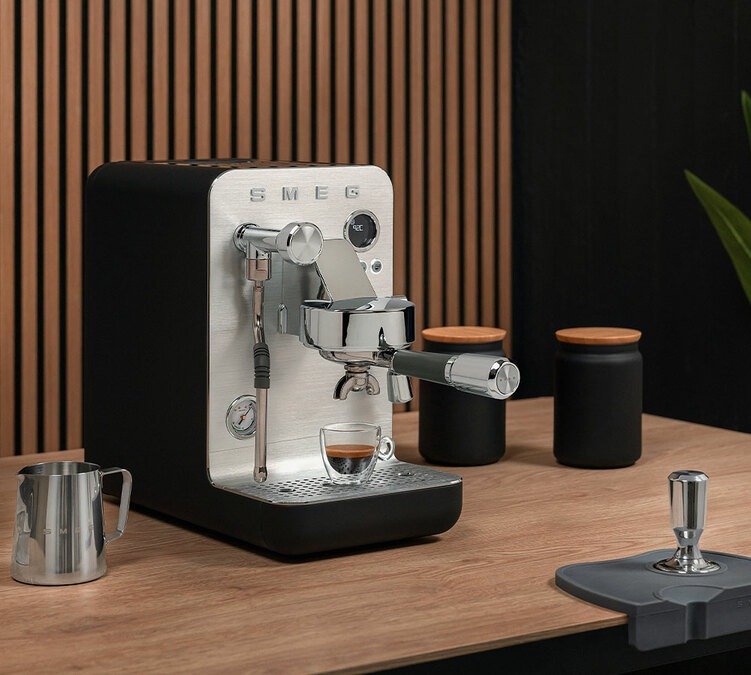
Pressure Gauge Feedback: Diagnostic Clarity
The integrated pressure gauge provides visible extraction feedback
Spec → Analog pressure display
Behavior → Real-time resistance visibility
Outcome → Easier detection of under-extraction or channeling
Effect → Reduced blind troubleshooting
However, pressure feedback is interpretive, not corrective.
If puck preparation is inconsistent, the gauge simply documents instability more clearly. It does not neutralize it.
This aligns with semi-pro architecture logic: transparency over automation.
Manual Extraction Control and Workflow Discipline
The SMEG EMC02 espresso machine offers manual start and stop extraction control alongside programmable options.
Spec → Lever-based or manual shot control
Behavior → User controls yield and timing
Outcome → Flexible ratio experimentation
Effect → Increased precision ceiling
But flexibility increases cognitive load if workflow is not standardized.
Semi-pro machines reward ritual. They penalize improvisation.
Steam Wand Performance and Microfoam Control
Steam behavior defines milk drink repeatability.
Spec → Stainless steel manual steam wand
Behavior → Strong steam output with manual modulation
Outcome → Capable of producing fine microfoam
Effect → Milk quality depends on steam ramp control
The steam is powerful enough to texture milk efficiently. The stability variable becomes modulation, not output strength.
Power without control destabilizes milk texture. Here, control is present—but user-dependent.
Hidden Stability Variables Most Buyers Underestimate
In high-ticket domestic espresso machines, the hidden costs are structural:
- Grinder precision alignment
- Shot scale compatibility
- Timing visibility
- Cleaning rhythm realism
The SMEG EMC02 espresso machine does not remove these variables. It amplifies them.
That amplification is neutral. It becomes positive or negative depending on user discipline.
Trade-Offs and Constraints
- No pressure profiling
- No flow control adjustment
- Manual workflow required
- Premium pricing reflects architecture and industrial design
This is not a prosumer dual boiler platform. It is a semi-pro domestic precision instrument.
Understanding that boundary is critical.
Observational Validation Layer
Technical Claim: 58mm platforms increase grinder dependency.
Observed Field Pattern: Owners of semi-pro 58mm machines frequently report that grinder upgrades produce greater consistency gains than machine upgrades at this level.
Structural Interpretation: Hardware capacity exceeds entry-level grinder tolerance.
Technical Claim: Manual steam control improves milk quality over time.
Observed Field Pattern: Users transitioning from automatic frothers often describe an initial inconsistency phase before achieving repeatable microfoam texture.
Structural Interpretation: Steam architecture enables refinement but does not automate it.
These behavioral patterns reinforce structural logic without introducing promotional bias.
Pricing Logic and Positioning
The SMEG EMC02 espresso machine sits in the upper domestic segment.
Price reflects:
- Triple thermoblock heating architecture
- Commercial 58mm standard
- Stainless steam assembly
- Industrial design positioning
The premium is structural, not automatic.
You are paying for capacity. Not for correction.
Verdict: Does It Close the Stability Gap?
In this SMEG EMC02 espresso machine review, the conclusion is structural:
When paired with:
- A capable espresso grinder
- Measured dosing
- Controlled workflow
The machine behaves predictably and closes the Equilibrium Gap defined earlier.
Without that infrastructure, it exposes inconsistency.
It is not forgiving. It is transparent.
Transparency, in semi-pro machines, is the true dividing line between frustration and mastery.
For complete specifications and configuration details, consult the official product listing here:
SMEG EMC02 Espresso Machine
One Comment